
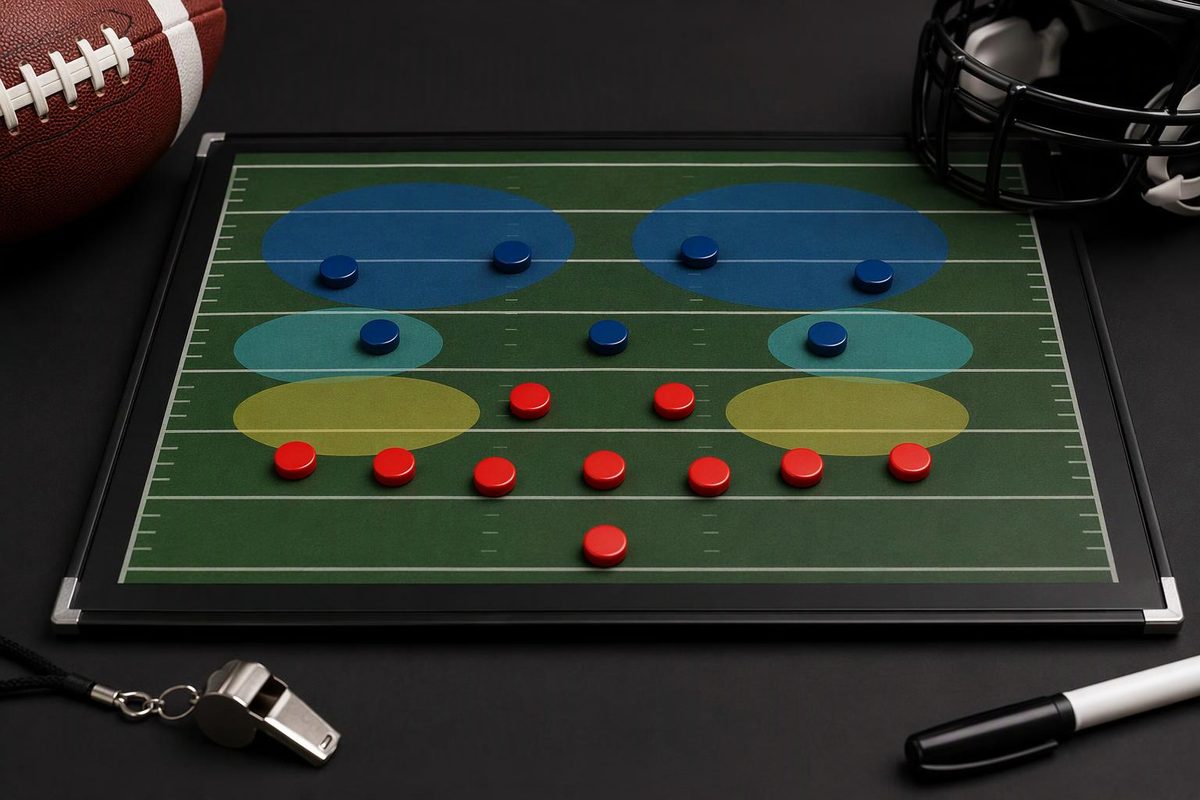
Cover 2 is a zone pass coverage with two defenders—usually the safeties—splitting the deep field into halves. In the standard four-man-rush version, five defenders cover underneath zones. The “2” describes the deep coverage, not the number of pass rushers or linebackers. Former NFL defensive back Matt Bowen describes that structure as two-deep, five-under in his NFL Cover 2 breakdown.
The basic idea: disrupt receivers’ releases, close short throwing lanes and keep safeties above the vertical routes. Underneath defenders help protect deeper windows before rallying to short completions.
Who covers what?
Use a four-lineman, three-linebacker example to teach the basic map. Cover 2 is a coverage call, not a defensive front; nickel personnel can fill the same coverage jobs with different players.
The assignments below follow the conventional zone structure explained in Breakdown Sports’ Cover 2 fundamentals. This example uses corners who disrupt and sink; variants such as Cover 2 Trap change their route reads and reactions.
| Position | Pass assignment | Coaching checkpoint |
|---|---|---|
| Two safeties | Each protects one deep half | Stay above vertical threats; do not chase a short route and surrender depth. |
| Two cornerbacks | Each covers the flat—the short outside area toward the sideline | Disrupt the outside receiver, then sink beneath deeper routes before driving on a short throw. |
| Two outside linebackers | Hook/curl zones between the outside flats and middle | Get into throwing lanes, account for inside receivers and react to routes entering the zone. |
| Middle linebacker, or Mike | Middle underneath hook area | Gain depth and locate crossers rather than standing still over the ball. |
| Four defensive linemen | Rush the passer | Pressure the quarterback without abandoning the called rush lanes. |
“Zone” does not mean guarding an empty patch of grass. Defenders adjust to route distribution while keeping the coverage connected.
How Cover 2 works after the snap
In a common corner technique, the corner aligns outside the widest receiver and funnels his release inside toward help. After disrupting the release, the corner sinks underneath a fade or corner route while remaining responsible for the flat. If every receiver goes vertical, the corner keeps gaining depth to help the safety; he does not stop simply because he is the flat defender. Breakdown Sports explains these press and off-alignment options.
That relationship is critical. A corner who immediately jumps a short route can open a large window behind him and outside the safety. Bowen’s Flat-7 film example shows exactly that failure: the corner takes the underneath bait instead of protecting the deeper corner route.
Against the run, use the front’s called gap fits rather than treating the coverage diagram as a complete run defense. Corners can provide force support—restricting the outside running lane—and safeties can become secondary support after confirming run. Bowen’s NFL examples show both corner edge-support and safety alley responsibilities.
Strengths and weak spots
Cover 2 puts five defenders underneath, giving the defense bodies to contest quick throws and crossing routes. Corner reroutes can disrupt timing, while the safeties provide deep help. Its success still depends on tackling short completions and generating pressure; seven coverage defenders cannot close every window indefinitely. Viqtory’s coverage guide explains the underneath coverage benefit, and Bowen emphasizes the four-man rush.
The main stresses are:
- Deep middle: routes can enter the space between the safeties and above the Mike.
- Sideline window: an offense can throw behind a sinking corner but outside or beneath the safety.
- Multiple vertical routes: four verticals force each safety to account for more than one deep threat.
Breakdown Sports identifies these weak spots. They are pressure points, not automatic completions. Depth, route disruption and disciplined underneath coverage can reduce them. For the hitch-corner version of a sideline high-low, see the Smash concept breakdown.
Cover 2, Tampa 2 and 2-Man are different
Tampa 2 changes the Mike’s job: he carries the inside vertical threat deeper down the middle instead of remaining primarily in the underneath hook area. That helps close the middle hole but demands a linebacker who can turn and run. The safeties still have deep-half responsibilities. See the basic Cover 2–Tampa 2 comparison.
2-Man, also called Cover 5 in some systems, keeps two deep-half safeties but uses man coverage underneath rather than five zones. Viqtory distinguishes those assignments; our Cover 5 guide covers that separate call.
A quick film-teaching check
Treat two high safeties as a clue, not a confirmed coverage. For the broader recognition sequence, use How to Read a Defense Before the Snap.
Choose three conventional Cover 2 pass clips. Pause once after the releases and once at the throw. Have players identify both deep-half defenders, both flat defenders and the Mike’s path. Then ask: Did the corner protect the deeper route before reacting short, and did each safety stay above his threats? Correct the first assignment or leverage error—not just the defender nearest the completed pass.