
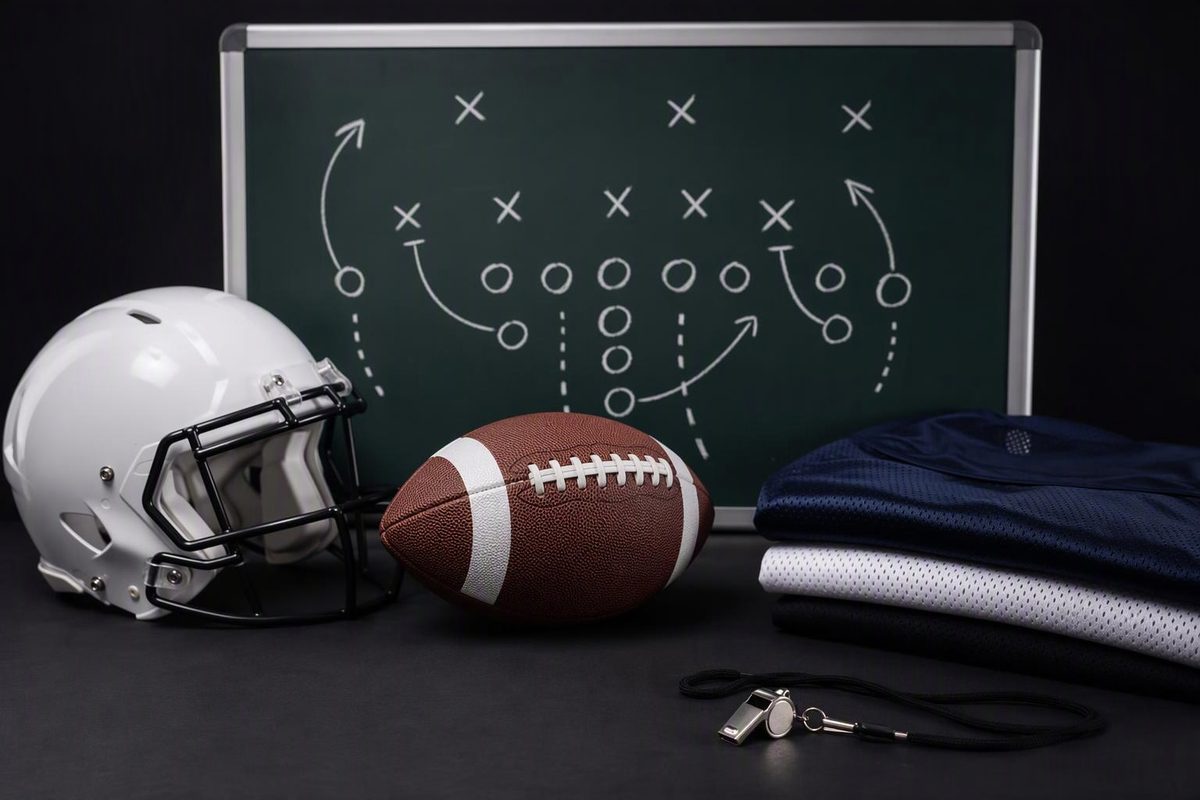
Cover 5 defense commonly means two-man under: five defenders cover the five eligible receivers man-to-man, while two safeties protect the deep halves. The “5” refers to the underneath man defenders—not five deep zones. It is also called Cover 2 Man or 2-Man. Confirm your staff’s terminology before installing it. VIQTORY’s coaching guide uses these names for the same structure.
The central coaching point: underneath defenders can play tight, inside trail technique because they have help above them. That help must actually be there.
Who covers whom?
Cover 5 is a coverage call, not a front or personnel package. It is different from the 4-2-5 defense, which describes four defensive linemen, two linebackers and five defensive backs.
For an 11-player example, use four rushers and seven coverage defenders against a balanced 2x2 formation with one running back. Number receivers from the sideline inward: No. 1 is widest; No. 2 is inside.
| Position | Assignment in this example | Observable checkpoint |
|---|---|---|
| Two corners | Each covers his side’s No. 1 | Stays attached when the receiver breaks; does not release him into a zone |
| Nickel and one linebacker | Each covers an assigned No. 2 | Identifies the correct receiver before the snap and carries his route |
| Remaining linebacker | Covers the running back | Matches the back’s release instead of watching the quarterback |
| Two safeties | Each protects a deep half | Maintains an angle above vertical threats rather than chasing a short route |
| Four rushers | Execute the called rush and contain responsibilities | Do not assume the coverage supplies a free quarterback defender |
This distribution follows the basic Cover 5 assignment structure. Which linebacker or defensive back gets each inside receiver depends on your personnel and formation checks.
Before the first rep, settle two rules: what the back’s defender does if the back blocks, and how assignments change with motion, bunch or trips. For the walkthrough below, have the back’s defender hold responsibility for a delayed release rather than add to the rush. Do not improvise receiver exchanges after the snap.
Coach the underneath technique and deep help together
Corners, nickel and coverage linebackers
Teach inside leverage: start positioned to contest an inside release, then stay close to the receiver’s inside hip. “Trail” means working slightly below the receiver on a vertical route—not deliberately falling several yards behind.
Cue: “Inside hip, stay connected.”
Correction: If the defender looks into the backfield and loses the receiver at the break, return his eyes to the receiver. If he drifts too far underneath, stop and restore a close relationship before increasing speed.
Press is an option, not a requirement. In his NFL film breakdown, former defensive back Matt Bowen describes both press and off-man versions using the same inside-leverage trail principle, supported by two deep safeties. Bowen’s 2-Man explanation shows how that relationship challenges short routes and vertical throws.
Safeties
Teach the safeties to stay above the deep threats in their halves and approach the throw from depth. One safety may have both an outside vertical and an inside seam threatening his area; “my half” does not mean standing on a fixed landmark.
Cue: “Keep depth; overlap the throw.”
Correction: If a safety widens toward the outside receiver and loses the seam, replay both routes together. If he drives a shallow route while another receiver remains vertical, freeze the rep and identify the uncovered deep threat.
Bowen’s film examples show how insufficient safety depth creates poor angles to seams and fades. Safety techniques can vary: in a 2023 X&O Labs college clinic report, Sacred Heart coordinator Mike Cooke describes quarterback-reading safeties who can play more aggressively underneath when routes are shallow. Set consistent eye and depth rules for your staff’s version.
Recognize it on film—and understand the tradeoff
Two high safeties suggest a split-safety structure, not necessarily Cover 5. Confirm it after the snap:
- Underneath defenders stay with individual receivers through their breaks.
- The back has a dedicated coverage defender.
- Two safeties remain available above the routes.
In Cover 2 zone, underneath defenders work zone responsibilities rather than simply following their assigned men. Use the pre-snap defensive read sequence to form a hypothesis, then check the route reactions.
Cover 5 is useful on likely passing downs because it combines tight man coverage with deep help. Its costs include reduced immediate run support and exposure to underneath crossers. VIQTORY’s guide identifies those limitations.
For game planning, also ask who handles quarterback draw or scramble: with four rushing and seven covering, there is no unassigned spy in this example. Test that responsibility with the front, not just the secondary. Trips and multiple vertical routes also require rehearsed safety-help rules; two safeties cannot automatically double every receiver.
A 10-minute no-contact coverage walkthrough
Setup: Seven coverage defenders, a quarterback, four receivers and one back. Use a full-width field section with at least 25 yards of depth. Place four cones at the line to represent the rush. Start receivers in 2x2, with No. 1 near the numbers and No. 2 near the hashes; put the back beside the quarterback. Work at walking speed, cap routes at 20 yards, and use no jams, blocks, tackling or live rush.
For this starter rep, place corners and inside man defenders about 3 yards off their receivers and safeties about 12 yards deep near the hashes. These are walkthrough starting points, not universal game alignments.
- 0–2 minutes: Four assignment checks. Each defender points to his receiver or deep half. Move the back once and reset assignments.
- 2–5 minutes: Four route reps. Alternate outside hitches with slot seams, then outside verticals with slot outs. Have the back release immediately to the flat on the first two reps and delay his flat release on the last two. Check close trail position, safety depth and the back defender’s patience.
- 5–8 minutes: Four crossing reps. Run shallow crosses at different depths while the outside receivers stay vertical and the back releases to the flat. Underneath defenders carry their assigned men; safeties stay above the vertical threats. Keep the crossing paths separated—do not simulate contact or picks.
- 8–10 minutes: Two situational checks. Show trips, then a bunch. Walk through the staff’s adjustment without throwing. If that adjustment is not installed, rehearse the call to a coverage your players already know.
Grade three items: correct assignment, connected man coverage, available deep help. Fix the first failed item before adding disguise or full-speed competition. This period teaches coverage relationships; install run fits and quarterback contain separately with the front.