
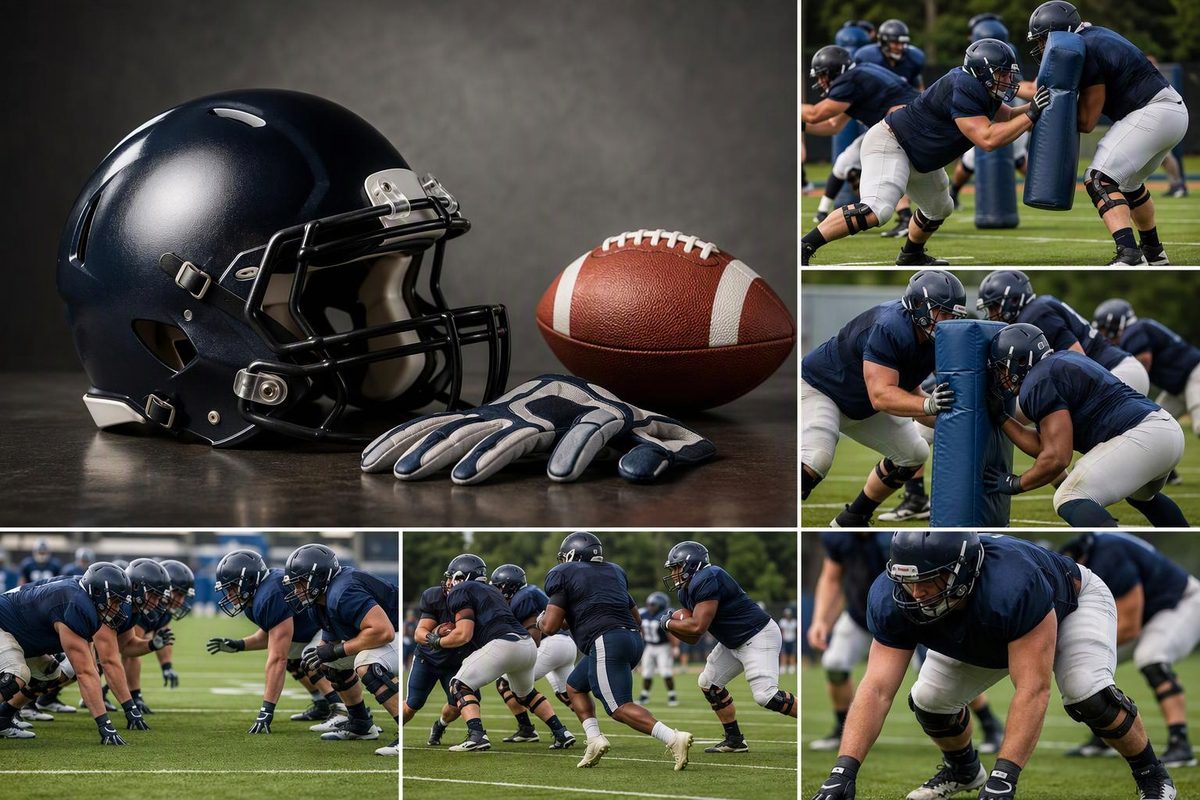
The offensive guard lines up between the center and tackle—one left guard and one right guard—and opens running lanes while protecting the quarterback from pass rushers. That alignment and role are described in NFL Football Operations’ position glossary. For high school or small-college coaching, organize guard work around three tasks: combinations, pulls and interior pass protection. Teach the assignment before judging the block; a guard can move a defender and still block the wrong player.
Choose the technique you need to correct; use the drill reset and checkpoint shown.
Choose The Next Guard Correction
Reset Before The Release
Drill reset: Restore the adjacent blocker’s position, then rehearse the linebacker movement that triggers the climb under your installed rule.
Checkpoint: At the simulated release, the remaining blocker is positioned to account for the down defender.
Limit: A shield fit rehearses positioning; it does not prove control against a resisting defender.
Mark The Entry Path
Drill reset: Mark the intended wrap-pull path just behind the adjacent blockers. Walk it before adding speed.
Checkpoint: Clear adjacent linemen and stop balanced at the installed entry point without a deep loop.
Limit: This correction is for a wrap pull, not a universal path for every pull assignment.
Remove Contact And Recover The Feet
Drill reset: Have the defender change direction slowly while the guard maintains position without contact.
Checkpoint: Keep the body between the threat and the protected lane before restoring the hand fit.
Limit: Set depth, angle and responsibility still come from the installed protection.
Source: The technique corrections and controlled practice progression in this article.
For the full line’s layout, see the five offensive line positions.
Start With The Call, Not The Defender Directly Ahead
Before each rep, have the guard answer:
- What is the play and direction?
- Who or which gap am I responsible for?
- Am I working alone, combining, or pulling?
- What changes if the defense moves?
Use your installed terminology. The A gap is between center and guard; the B gap is between guard and tackle. If players confuse those spaces with defensive alignment numbers, review the football gap map.
Do not teach “block the defensive tackle” as a universal guard assignment. On one call the guard may combine with the center; on another, pull away from that same defender. In pass protection, a slide-side guard protects an assigned gap, while a man-side guard has a designated matchup and exchange rules. VIQtory’s protection guide explains that distinction.
Combination Blocks Must Secure The First Level
A zone combination puts two adjacent offensive linemen on a down defender while accounting for a second-level linebacker. Coach Jerry Campbell describes that first-level-to-second-level responsibility in his offensive line fundamentals guide.
For your installed zone run, identify the down defender, linebacker and release rule before the snap. Then coach:
- First two steps: Move toward the assigned fit without narrowing the base or standing up.
- Fit: Keep the head out of contact and hands on the assigned torso target.
- Release: Leave for the linebacker only when the partner can control the down defender under your scheme’s rule.
Correction: If the guard climbs and the down defender immediately splits the pair, stop and reset the rep before the release. Restore the partner’s position and rehearse the linebacker movement that triggers the climb. Do not solve it by telling both blockers to stay forever; the linebacker is part of the assignment.
Pulls Must Reach The Assigned Target On The Installed Path
“Pull” means leaving the original line position to block elsewhere. It does not tell the guard whom to block. A kick-out block moves a defender away from the running lane; a wrap or lead pull takes the guard through the lane toward an assigned defender, often a linebacker.
Pull technique also depends on the destination. In USA Football’s film breakdown of North Dakota State’s college power offense, the backside guard used a skip pull for A-gap power and an open pull for a wider bounce variation. Those are scheme examples, not one universal footwork rule.
For a wrap-pull drill, mark the installed entry point. Cue “clear the line, stay close to the blocking wall, find the assigned linebacker.” The guard should arrive balanced rather than sprint past the target.
Correction: If the guard loops too deep, mark the intended path just behind the adjacent blockers and rehearse at walking speed. Check both clearance and arrival angle before adding speed.
Interior Protection Requires Feet Before Reach
Set to the depth and angle required by the protection and defender’s alignment. Do not automatically copy the tackle’s outside pass set.
Cue “eyes on the torso, feet under you, hands inside.” In USA Football’s pass-protection guidance, coach Steve Ciocci emphasizes footwork, tracking the chest and stomach rather than head or hand fakes, and inside hand placement.
Correction: If the guard reaches and falls forward, remove contact. Have the defender change direction slowly while the guard maintains position. Restore the hand fit only after the feet can keep the body between the threat and the protected lane.
For twists—two rushers exchanging paths—rehearse your installed guard-tackle or guard-center exchange. Do not let both blockers chase the first rusher.
A 12-Minute Period Rehearses Assignments And Movement
Setup: Use one pod of six players: two guards receiving the teaching reps and four helpers. Bring four cones and a shield. Mark the center, guard and tackle spots at your normal line splits, plus the pull entry point.
For combinations, helpers act as the adjacent blocker, down defender holding the shield, and linebacker. For pulls, use helpers as stationary adjacent blockers. For protection, use one adjacent blocker and two rushers. Rotate helper roles; switch which players receive guard reps in the next period. This is a teaching period, not a live competition.
Follow your program’s governing contact limits, including state-association limits for high school teams. Use no-contact movement and controlled shield fits; USA Football’s Levels of Contact progression separates unopposed work, bag contact and increasingly competitive player contact. No takedowns or helmet-led contact in this period.
| Time | Action | Checkpoint |
|---|---|---|
| 0–2 minutes | Show two fronts against one installed run and one protection. Both guards state their assignments before walking the first two steps. | Correct partner, target or gap—not just direction. |
| 2–6 minutes | Each guard takes four combination reps, two from each side: one with a stationary linebacker and one with a slow scrape. Use controlled shield fits and no contact with the linebacker. | At the simulated release, the remaining blocker is positioned to account for the down defender. |
| 6–9 minutes | Each guard takes six unopposed wrap pulls, three each direction, stopping balanced at the entry cone. | Clears adjacent linemen and reaches the entry point without a deep loop. |
| 9–12 minutes | Each guard takes four no-contact protection reps with a neighbor: two straight rush paths and two slow twists. | Maintains the assigned lane and exchanges threats without both blockers following one rusher. |
Shield reps rehearse fit and release positioning; they do not establish that a pair can control a resisting defender. If an assignment is wrong, repeat it at walking speed instead of increasing intensity. Cut remaining reps if correction time uses the block.
Grade The Guard Separately From The Play Result
On film, record four items: assignment, first two steps, fit or positioning, and legal finish until the whistle. Stop on the whistle. On pulls, add the arrival landmark; on combinations, note release timing; on protection exchanges, identify which blocker owned each threat.
Choose one recurring error for the next individual period. “Late release with the center” gives the guard a correction to rehearse. “Be more physical” does not.