
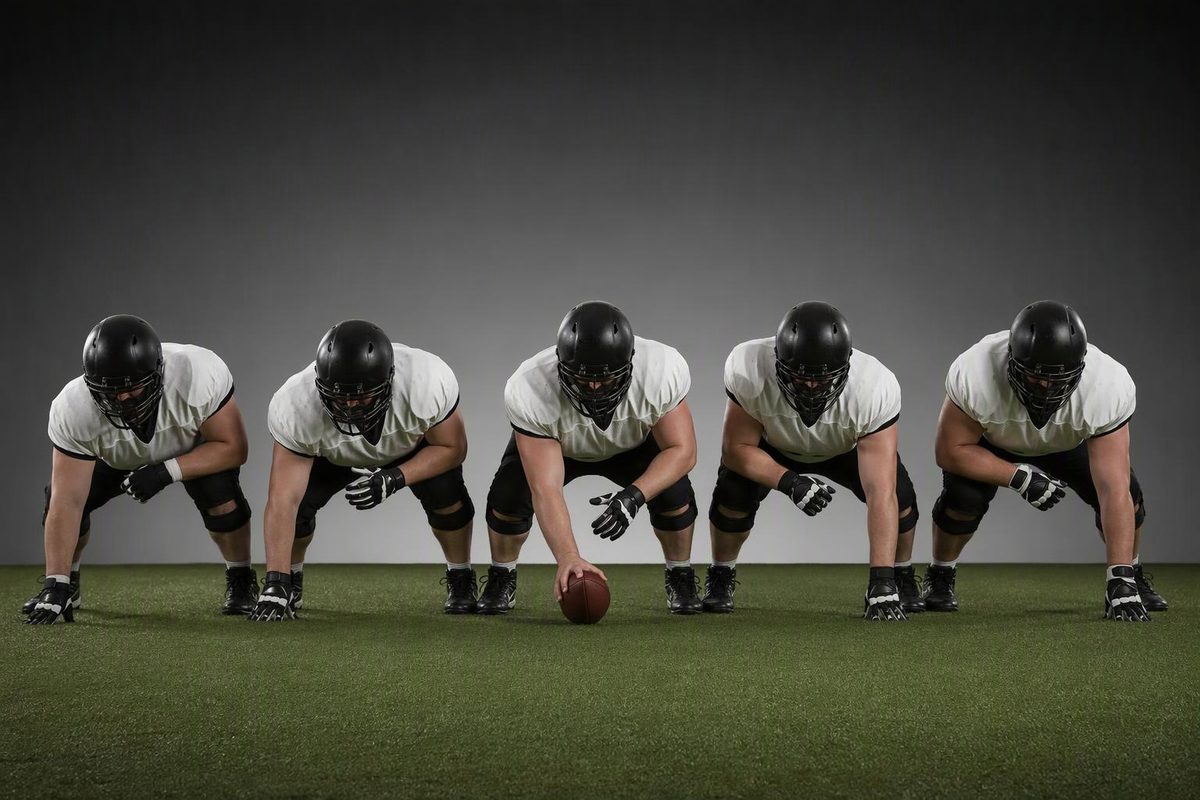
The standard offensive line in 11-player tackle football has five positions: left tackle, left guard, center, right guard and right tackle. They create running lanes and protect the quarterback; the center also snaps the ball to start the play. These basic roles are outlined in the NFL’s youth and high school tackle glossary. A position tells you where a player lines up—not the player’s complete blocking assignment on every snap.
Choose a position to see its location, starting job and first coaching checkpoint.
Position-to-Assignment Check
Center (C)
Location: Middle, over the ball.
Starting Job: Deliver the snap, communicate assigned calls and execute the block.
Check First: Does the snap reach its target while the center takes the required first step?
| Spot | Location and Core Job |
|---|---|
| LT | Outside left guard. Handle assigned run blocks and pass-protection threats. |
| LG | Between left tackle and center. Block assigned inside threats; combine or pull when called. |
| C | Over the ball. Snap, communicate assigned calls and block. |
| RG | Between center and right tackle. Block assigned inside threats; combine or pull when called. |
| RT | Outside right guard. Handle assigned run blocks and pass-protection threats. |
Checkpoints for Every Position
Left Tackle: Does the first movement preserve leverage on the assigned threat?
Left Guard: Can the player identify both the initial target and any combination partner?
Center: Does the snap reach its target while the center takes the required first step?
Right Guard: Does the player execute the call rather than simply block whoever is nearest?
Right Tackle: Can the player stay balanced without opening an easy inside path?
Left and right are from the offense’s perspective. The installed play determines the target, footwork and communication; position alone does not.
Sources: NFL youth and high school tackle glossary for positions; coaching checkpoints drawn from the article’s cited USA Football progressions.
The Five Positions Run From Left Tackle to Right Tackle
Viewed from behind the offense, looking toward the defense, the order is LT → LG → C → RG → RT. The ball is at the center’s snapping hand, with the quarterback behind the center. Left and right refer to the offense’s perspective, not the camera’s view.
| Position | Abbreviation | Location |
|---|---|---|
| Left tackle | LT | Outside the left guard |
| Left guard | LG | Between left tackle and center |
| Center | C | Middle, over the ball |
| Right guard | RG | Between center and right tackle |
| Right tackle | RT | Outside the right guard |
Guards are next to the center; tackles are outside the guards. An attached tight end lines up outside a tackle as an additional blocker or receiver, rather than replacing one of these five core positions.
For a new player, teach location before technique. Have the player find the spot, name the adjacent linemen and identify which direction is toward the center. That prevents a common teaching mix-up: a player may understand “inside” as toward the middle of the formation while hearing “left” as the left side of a diagram.
Use the same viewing direction when drawing plays and reviewing film. If the camera faces the offense, the offensive left tackle appears on the viewer’s right. Label the positions before discussing a missed block so the correction reaches the intended player.
Position Identifies the Starting Spot, Not Every Blocking Target
The five positions share the job of executing the called run scheme or pass protection. Their location changes the threats they encounter and the teammates they work beside, but the play call determines the assignment.
Do not teach a guard simply to block the nearest defender or a tackle always to block the widest defender. Those shortcuts break down when the call requires a combination block, a pull or responsibility for a different threat. A lineman needs to connect the position name to the installed rule.
Before a walkthrough rep, ask the player to state: Who am I responsible for, where do I step, and what must I communicate? An answer such as “I block the defensive lineman” is incomplete if the call also requires identifying a combination partner or a defender at the next level.
Separate assignment errors from movement errors. If a player confidently steps toward the wrong target, repeating the footwork will not fix the misunderstanding. Reteach the rule and have the player identify the target again. If the target is correct but the opening movement loses position, work on that movement without changing the assignment.
The Center Must Snap and Begin the Block Together
The center’s distinctive responsibility is delivering the snap while beginning the assigned block. A center cannot finish the exchange and then begin thinking about the defender. Practice the snap together with the first step the play requires.
Watch the exchange and the feet during the same rep. A clean snap with no useful first movement does not complete the center’s job. Neither does a good step paired with a snap that misses its intended target. The checkpoint is whether the ball reaches the quarterback while the center starts the required blocking movement.
Use the exchange your offense actually runs. For an under-center play, rehearse that exchange with the quarterback present. For a shotgun play, check the snap to the intended target while the center executes the opening step. The draft’s sources do not provide a universal snap-distance or accuracy standard, so use the demands of your installed offense rather than an invented measurement.
The center commonly organizes line communication, but that does not mean every offense assigns every declaration to the center. Define which calls belong to the center, quarterback and other linemen in your system. Then require the adjacent players to acknowledge the relevant call.
One player speaking is not proof that all five understand. During a walkthrough, ask a guard to explain what the center’s declaration changes for that guard. If the player can repeat the words but cannot identify the resulting responsibility, the communication has not yet done its job.
Guards Work With Their Neighbors and Pull When Called
Left and right guards have the same core role from opposite sides: block their assigned inside threats in the run and pass game, and combine or pull when the call requires it. Each guard works beside both the center and a tackle.
Combination Blocks Need a Target Beyond the First Defender
On a zone combination block, two blockers initially work together. The players need to identify the down defender and the second-level defender, such as a linebacker, they may work toward. USA Football’s zone-combination guidance emphasizes identifying that second-level target and echoing calls before the snap.
Teach the partnership explicitly. The guard should name the teammate involved, the initial defender and the second-level target under your installed rule. “We double that defender” does not explain the complete assignment if the combination must also account for a linebacker.
In a walking-speed rep, freeze the players after their opening steps. Check whether both understood the same combination, whether their movement matches the call and whether they can still name the next responsibility. Do not turn every combination into a memorized instruction to leave after a fixed number of steps; teach the release according to your scheme.
A Pull Requires a Route and an Assignment
A pull moves a lineman away from the starting position toward another blocking assignment. Guards may pull on calls such as trap, power or counter, but “guard” does not mean “pull every run.” Teach the route and target for the actual play.
Keith Grabowski’s pulling progression starts with footwork, then adds half-line or full-line spacing so the puller learns to navigate neighboring blocks. That progression addresses a practical problem: a player can perform an isolated pull step correctly and still struggle once teammates occupy the path.
Begin by checking the opening movement. Then put the adjacent blockers back into the rep using your installed splits. Watch whether the guard can travel along the intended route without running into a teammate or arriving with no clear target.
Keep the left and right guard’s assignments tied to the call, not to a permanent nickname such as “the pulling guard.” If your playbook asks either guard to pull, rehearse the actual direction and neighboring blocks for that player.
Tackles Need Leverage and Balance, Not Just Width
Left and right tackles handle assigned perimeter or interior blocks and pass-protection threats from opposite sides of the line. Their outside location does not make every assignment an outside block. Start with the protection or run rule before prescribing the footwork.
A pass set is the blocker’s opening footwork to establish position against a pass rusher. Do not coach every set as “get outside as fast as possible.” The protection and the defender’s alignment determine the set.
For a basic pass-protection checkpoint, watch whether the tackle opens the hips early and exposes an inside path. Coach the player to track the defender’s torso rather than head or hand fakes. These are teaching points in USA Football’s pass-protection discussion with Steve Ciocci.
At walkthrough speed, ask the tackle to identify the assigned threat before moving. Then check whether the opening steps preserve useful position against that threat. A player who moves wide but loses the inside path has not necessarily improved the protection.
For the left tackle, the immediate checkpoint is whether the first movement preserves leverage on the assigned threat. For the right tackle, use the same principle from the opposite side: stay balanced without opening an easy inside path. These are not separate techniques simply because the positions have different names.
Avoid correcting a tackle by demanding more width before checking the assignment. If the player is responsible for a different threat than the coach assumes, that correction may make the rep worse. For a fuller teaching progression, use the offensive tackle practice guide.
Use a Six-Minute Walkthrough to Check Position and Assignment
Set up five linemen, a quarterback, a ball and cones marking defensive locations. Use your installed splits. Keep the period walking-speed and noncontact so you can hear declarations and see opening movements without turning the exercise into a collision drill.
The purpose is to connect each starting spot to an actual call. Use installed plays rather than introducing a new scheme during the check.
| Time | Work | What to Check |
|---|---|---|
| Minutes 0–2 | Locate and communicate | Position, neighbors and responsibility |
| Minutes 2–4 | Four reps across two run calls | Initial target, combination or pull |
| Minutes 4–6 | Four pass reps across two looks | Responsibility, exchange and balance |
Minutes 0–2: Name the Spot and Explain the Call
Each player names the position, adjacent teammates and responsibility under one installed call. Change the defensive cone locations once and repeat.
Listen for an assignment that responds to the defensive picture, not just a repeated position definition. “I’m the left guard” establishes location. It does not establish whom that player must block on the next snap.
Use the changed look to check communication ownership. The player responsible for a declaration makes it, and the affected teammates acknowledge it. If the group disagrees, settle the rule before advancing to the movement portion.
Minutes 2–4: Freeze the Run Assignment After Two Steps
Run four walkthrough reps across two installed run calls. Before each snap, every lineman names the initial target and any combination or pull responsibility. Freeze after two steps to check direction and spacing.
For the center, observe the exchange and opening movement together. For a combination, check that the partners identified the same initial defender and second-level target. For a pull, inspect the opening route in relation to neighboring blocks.
The freeze is a diagnostic pause, not a claim that the block is finished after two steps. Resume the walkthrough when needed to see whether a player understands the rest of the assignment.
Minutes 4–6: Check One Protection Against Two Looks
Run four walkthrough reps across two defensive looks using one installed protection. Players declare their responsibility, then snap and take their opening steps. Check the center’s exchange and each player’s balance.
Keep the protection constant so the changed defensive look tests the players’ understanding of that protection. When a player cannot explain the responsibility, return to the rule rather than giving an isolated command to block a particular cone.
Finish with a specific correction for the next rep: the target to identify, the call to acknowledge or the movement to rehearse. Correct assignment before technique. If the assignment is right but the first step is wrong, isolate that movement using the blocking fundamentals progression.