
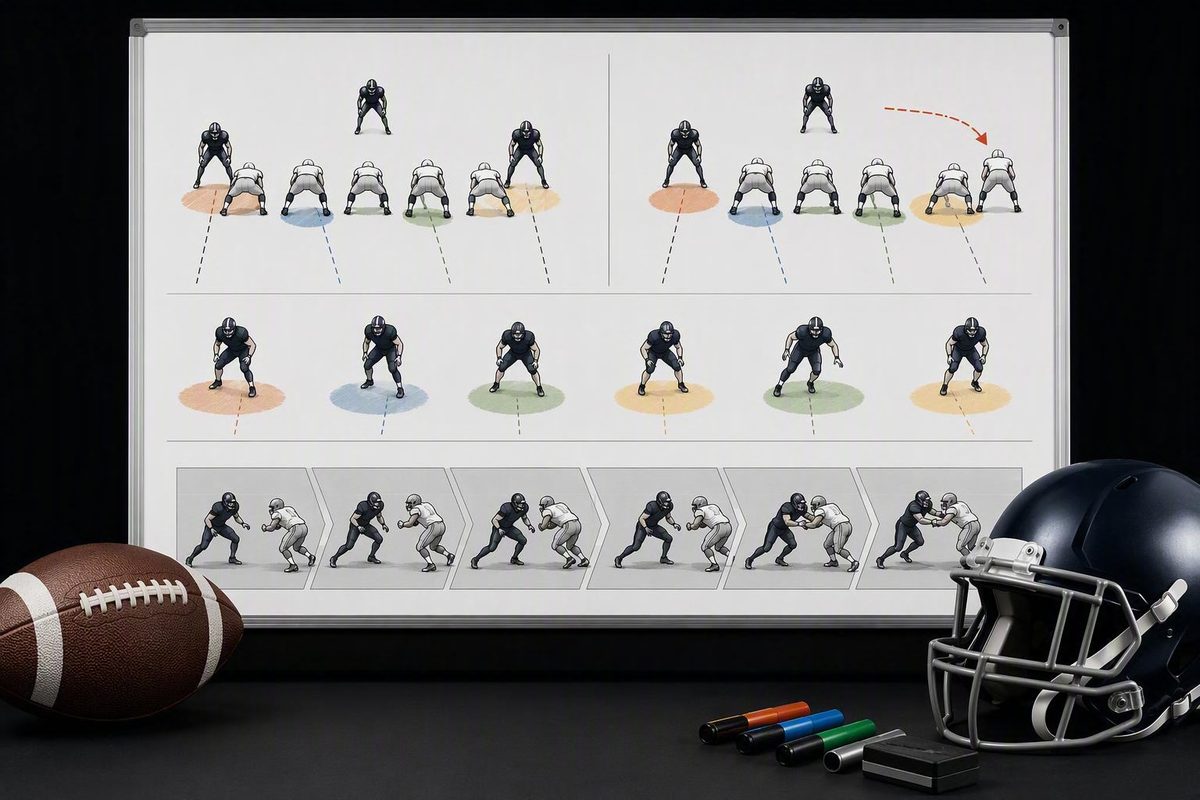
Football gaps are the spaces between—or immediately outside—the offense’s blockers. The A gaps sit beside the center, the B gaps between guards and tackles, the C gaps at the tackle edge or between a tackle and an attached tight end, and the D gaps outside attached tight ends when a staff uses that label.
That map gives offense and defense a shared starting point, but it does not identify a defender’s assignment. Technique numbers describe alignment; the call, keys, leverage and post-snap movement determine gap ownership.
The quick answer: Where are the A, B, C, and D gaps?
Gap labels begin on both sides of the center and progress outward. In a balanced two-tight-end surface, the map is:
D | TE | C | LT | B | LG | A | Center | A | RG | B | RT | C | TE | D
- A gap: Between the center and guard.
- B gap: Between the guard and tackle.
- C gap: Between the tackle and an attached tight end, or outside the tackle when no tight end is attached.
- D gap: Outside an attached tight end, if the staff includes D in its system.
These are common coaching conventions, not definitions enforced by a football rulebook. GoRout’s guide to defensive-line gaps and techniques uses the center-to-guard A gap, guard-to-tackle B gap, tackle-to-tight-end C gap and outside-the-tight-end D gap.
The main terminology problem occurs when the offensive surface changes. Some staffs always describe C as “outside the tackle.” Others call the tackle-to-tight-end space C and the space outside the tight end D. Either convention can work until a tight end attaches, detaches or motions and the defense has not established whether its gap labels travel with the surface.
Put the answer in the playbook. For example:
With no attached tight end, C is outside the tackle. With an attached tight end, C is tackle-to-tight-end and D is outside the tight end.
If your system keeps C as the edge regardless of the tight end, state that instead. The objective is not to win a terminology argument. It is to ensure that the defensive line, linebackers and secondary are using the same map.
Some resources also distinguish a gap between offensive linemen from a hole between defensive linemen. Team language varies, so coaches should not assume that distinction carries from one program to another.
Gap letters and technique numbers describe different things
A gap letter identifies a location. A technique number identifies a defender’s alignment relative to an offensive blocker. The concepts are connected, but they are not interchangeable.
| Technique | Landmark | Adjacent gap |
|---|---|---|
| 0 | Head-up on center | Both A gaps |
| 1 | Shade on center | Near A gap |
| 2 | Head-up on guard | A and B |
| 2i | Inside shade of guard | A |
| 3 | Outside shade of guard | B |
| 4 | Head-up on tackle | B and C |
| 4i | Inside shade of tackle | B |
| 5 | Outside shade of tackle | C |
In a common numbering convention, even numbers indicate head-up alignments, while the “i” suffix indicates an inside shade. A 4-technique is head-up on a tackle, a 4i is on the tackle’s inside shoulder and a 5 is on the tackle’s outside shoulder. A standard alignment crosswalk also places the 0 on the center, 1 on a center’s shoulder, 2 on a guard, 2i inside a guard and 3 outside a guard.
Treat that numbering as useful base language rather than a universal law. Definitions become less consistent around an attached tight end and in wide edge alignments. Different systems use 6, 7 and 9 differently, so the staff must define those terms rather than assume players learned the same convention elsewhere.
The clean player-facing communication pattern is:
“I am aligned in a 3-technique, and my assignment is the B gap.”
That sentence forces the player to name two separate pieces of information. “I’m in the B gap” may seem sufficient on a static drawing, but it becomes unreliable once the front moves or the call changes ownership.
Alignment is not the same as gap ownership
No—a defender does not automatically control the gap where he lines up. He may align outside a blocker and enter another gap through a slant, stunt or exchange. A head-up player may lag into the backside gap. Another defender may be asked to account for both sides of the blocker.
A one-gap defense assigns a defender responsibility for one run gap. The player does not have to begin inside that gap; he must execute the call while preserving access to it.
A two-gap technique asks the defender to control or account for the spaces on both sides of the offensive blocker across from him. A head-up nose playing both A gaps is the standard diagram example, although the exact read and technique belong to the defensive system.
Do not reduce this distinction to personnel labels. “Four-man front” and “one-gap defense” are not synonyms; neither are “three-man front” and “two-gap defense.”
Pre-snap alignment creates a prediction. Post-snap evidence confirms or rejects it. Check five details:
- First step: Is the defender stepping vertically, crossing a blocker’s face or lagging behind movement?
- Blocking key: Which offensive player is he reading?
- Movement: Does he remain in the apparent gap, exchange with a teammate or work across the block?
- Leverage: Is he forcing the ball inside, spilling it outside or controlling both options?
- Support: Which linebacker, overhang or safety replaces the space he vacates?
The fit must be evaluated as a coordinated action, not as a still image of the front.
How individual gaps become a complete run fit
A run fit is the defense’s coordinated plan for placing defensive linemen, linebackers, edge or overhang defenders—and potentially secondary support—against the run. Completing the fit requires more than assigning letters to the defensive front.
The front alone does not reveal the full plan. Coverage structure can add or remove a support player. Box numbers change with formation. An overhang may be involved against one backfield set and treated as an RPO player against another. Stunts and post-snap rotations can make the final structure different from the pre-snap presentation.
Throw Deep Publishing presents one useful spacing framework:
- Seven-man spacing: A light or out-gapped fit with one fewer run defender and an open gap that must be managed through a tool such as two-gapping, movement or pursuit.
- Eight-man spacing: A gapped-out fit with one defender available for each gap.
- Nine-man spacing: A maxed-out or blitz fit with an extra box defender.
These labels are tied to the article’s particular personnel and run-fit framework, not universal football vocabulary. Its run-fit spacing guide also emphasizes that the defense’s post-snap spacing matters more than its initial presentation.
Staffs can teach the fit through fixed gap assignments, leverage roles or a combination of the two. Terms such as force, spill, fold, stack and vice describe how players relate to the ball and neighboring fitters, but their exact definitions are system-specific. Preferring those concepts over fixed gap letters is a coaching philosophy—not proof that one method reduces memory demands or performs better.
The target is coordinated leverage. If an interior defender spills a kick-out block, an outside defender must retain outside leverage while pursuit closes from inside. If every defender chases the same visible lane, the defense can place two bodies in one gap and leave the next gap open.
A complete-looking fit also does not guarantee a stop. A player can own the correct gap and still be displaced, lose leverage or miss the tackle. Assignment integrity and play result should be graded separately.
Do not confuse gap locations with gap-scheme runs
When an offensive coach calls Power or Counter a gap scheme, “gap” describes a blocking family. It does not add new locations to the A-through-D map.
Those actions can change which defender must fit the play even though the original landmarks remain. The defense should identify the blocking surface and pullers before chasing backfield action.
A USA Football article about a specific Gap Series illustrates how staff terminology can work:
- Power: The fullback is the system’s “Wham” blocker, and the backside guard is its “Wrap” blocker.
- Counter: The backside guard is the Wham blocker, and the fullback is the Wrap blocker.
- Teaching sequence: “Wham-Wrap-Ball.”
Those assignments and that sequence belong to the article’s specific Gap Run System. They are not universal definitions of Power and Counter.
A Tite front provides another example of why the surface matters. In a USA Football recap of Matt Drinkall’s approach, the defensive ends are positioned in the B gaps. Against a three-man surface consisting of a guard, tackle and extra blocker, Drinkall recommends a gap-game family of Power, Counter and Counter Trey. The offense uses the surface and blocking angles to account for the interior structure rather than abandoning its run menu merely because the defense is in Tite, as explained in the USA Football Tite-front recap.
For a defensive player, the useful order is:
- Read the assigned offensive-line key.
- Recognize down blocks, pullers and releases.
- Execute the called leverage or gap rule.
- Find the ball through the blocking action.
Looking directly into the backfield reverses that order. The ball can draw two defenders toward one lane while a down block or puller changes the actual point of attack.
A repeatable film-study sequence for grading gap control
Use the same worksheet for every clip:
- Identify the offensive surface. Mark the center, guards, tackles, attached tight ends, wings and reduced splits. Note motion that can change the surface.
- Label every gap. Write A through D on both sides according to the playbook’s convention.
- Label defensive techniques. Record 0, 1, 2i, 3, 4i, 5 and any staff-defined wide alignments.
- Count the box and note the coverage shell. Record overhangs and safeties who could become support players.
- Predict ownership. Assign a likely gap or leverage role to each defender.
- Verify the post-snap fit. Follow movement, keys and leverage rather than defending the pre-snap prediction.
For a deliberately simplified 4-2-5 over-front teaching example, use a five-man offensive-line surface with no attached tight end. Place the 3-technique on a guard’s outside shoulder and the 1-technique on a center’s shoulder. The two interior linemen account for one A and one B gap, the two inside linebackers handle the remaining A and B gaps, and the defensive ends handle the C gaps or edges. With no attached tight end in this picture, there is no separate D gap to assign. This is one instructional example, not a universal 4-2-5 rule; the underlying assignments appear in this 4-2-5 run-fit example.
If the offense adds an attached tight end, redraw the surface before grading the defense. Under the convention used earlier, tackle-to-tight-end becomes C and the space outside the tight end becomes D. The call must then identify whether a defensive end, overhang, linebacker or rotating support player accounts for that outside gap.
After the snap, check defensive-line movement, offensive-line combinations, pullers, linebacker flow and overhang support. On zone action, determine whether the linebacker tracked the moving gap rather than plugging its original pre-snap location.
Grade the defender in separate categories:
| Film result | Grading question |
|---|---|
| Alignment | Was he on the called landmark? |
| Stance | Could he execute the required first step? |
| First step | Did his initial movement match the call? |
| Eyes/key | Did he read the assigned blocker before the backfield? |
| Leverage | Did he maintain the required shoulder or hip relationship? |
| Assignment | Did he preserve or exchange the correct gap? |
| Block defeat | After fitting correctly, could he separate and finish? |
This separation prevents every bad result from becoming a “missed assignment.” A defender may align and fit correctly but lose the block. Another may make the tackle after abandoning his assignment. The first is a physical-execution problem; the second can still warrant a negative assignment grade.
Box count and safety structure help predict where support may come from, but they do not prove the final fit. Defenses can disguise and rotate, so the film process should include a late pre-snap check and post-snap confirmation.
Install the vocabulary in practice, then add movement
The following is an adaptable, no-contact recognition period—not a validated universal drill prescription.
Set five offensive-line landmarks using the offense’s normal splits: center, two guards and two tackles. Add an attached tight end when needed, then place defenders at their called alignments.
Run a six-minute sample block:
- Minutes 1–2: Static recognition. Point to a defender or gap and require the appropriate call.
- Minutes 3–4: Walk-through fits. Defenders take their first steps and enter or leverage their assignments without contact.
- Minutes 5–6: One constraint. Add tight-end motion, a defensive slant or an offensive puller.
On every static rep, require two statements:
“My alignment is ______.”
“My assigned gap is ______.”
Do not accept one answer as a substitute for the other. On movement reps, grade whether the defender keeps his eyes on the blocking key, takes a first step consistent with the call, maintains the required shoulder or hip leverage and remains able to enter the assigned gap.
Use the correction to identify the next coaching action:
| Observed error | Correction category |
|---|---|
| Wrong pre-snap landmark | Alignment |
| Late reaction to block | Key recognition |
| Two defenders enter one gap | Assignment communication |
| Correct fit, then displacement | Block defeat |
Once players can handle one constraint, change the picture without changing the language. Attach or detach the tight end. Motion across the formation. Slant the front. Pull a guard. The defender should reset the surface, state the alignment and state the assignment before moving.
Contact technique must be taught and supervised in person under the rules applicable to the team’s competition. Training carries injury risk, and written or online instruction does not replace a qualified coach or athletic trainer observing the athlete in person, consistent with Down the Tunnel’s stated training qualification.
Frequently asked questions
What does “shooting the gap” mean in football?
“Shooting the gap” means penetrating quickly through the space between offensive blockers, including as part of a pass rush or blitz. It describes an aggressive movement through the gap, not a complete run-fit assignment by itself. The player still needs to know the call, the required leverage and who accounts for any space the movement vacates.
Are a football gap and a hole the same thing?
They are often used loosely as synonyms, but some coaching resources distinguish them: a gap is the space between offensive blockers, while a hole is the space between defensive linemen. Because team vocabulary varies, define both terms in the playbook rather than assuming every coach or player uses the distinction.
The coaching sequence is straightforward: name the surface, map the gaps, separate alignment from assignment, and verify the fit after the snap. Standardize what C means when a tight end moves, define wide techniques in the playbook, and reinforce the vocabulary through short recognition periods and position-by-position film grading. A gap chart becomes useful only when players can carry it from the whiteboard into a moving fit.