
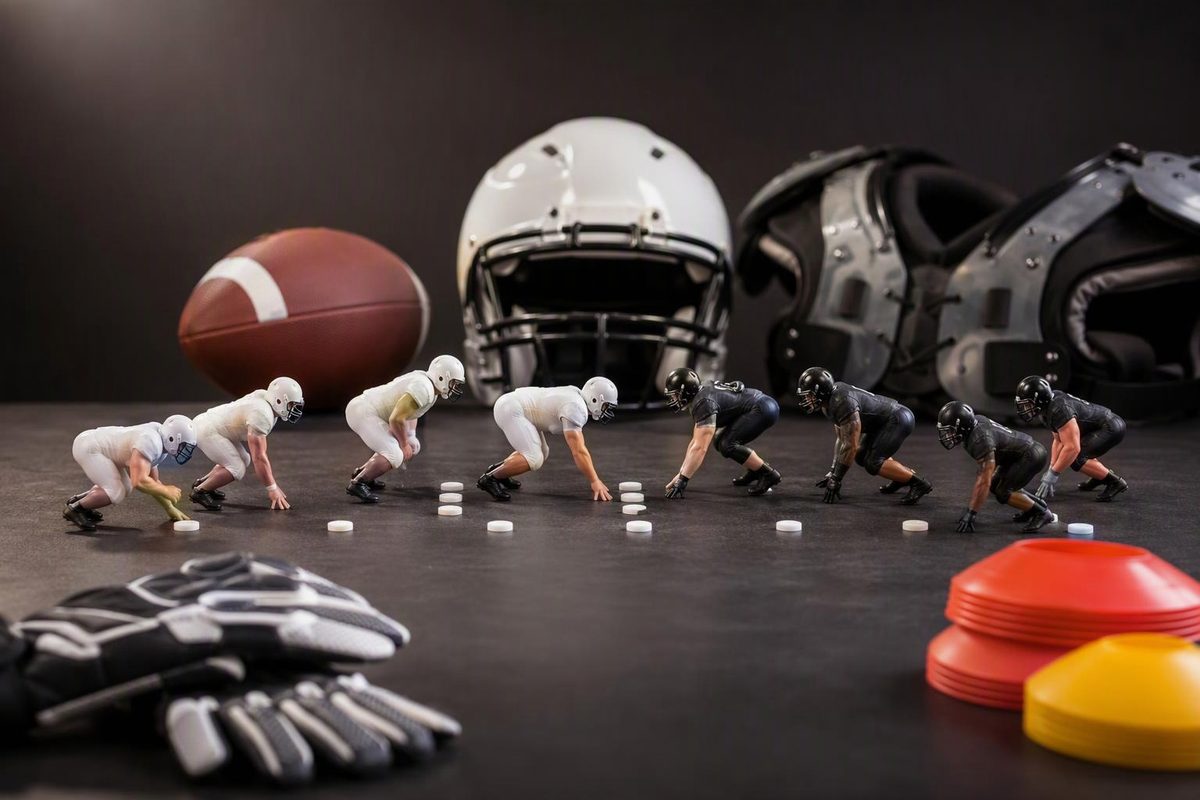
Defensive line techniques describe both where a lineman aligns—such as a 3-technique outside the guard—and how he plays: stance, get-off, hand fit and block destruction. Teach alignment separately from assignment. A player can line up correctly and still fit the wrong gap.
For a high school or small-college one-gap run-defense period, give each lineman four answers: alignment, assigned gap, block key and response. The progression below teaches those answers; it is not a two-gap installation.
Pick the blocker and shade to find the alignment number; assign the gap separately.
Alignment Number Finder
Alignment number
3-technique
Outside shoulder of the guard.
This gives the starting location, not the assigned gap, movement or force responsibility.
Inside is toward the ball; outside is away from it.
Used only for tight-end alignments. Confirm your staff’s labels.
Complete Alignment Reference
| Technique | Starting Location |
|---|---|
| 0 | Head-up on the center |
| 1 | Outside shoulder of the center |
| 2i | Inside shoulder of the guard |
| 2 | Head-up on the guard |
| 3 | Outside shoulder of the guard |
| 4i | Inside shoulder of the tackle |
| 4 | Head-up on the tackle |
| 5 | Outside shoulder of the tackle |
| 6 | Head-up on the tight end |
| 7 / 6i | Inside shoulder of the tight end; convention-dependent |
| 9 / 7 | Outside the tight end; convention-dependent. Specify tight or wide. |
Kuchar uses 7 inside and 9 outside the tight end. The alternate convention uses 6i inside and 7 outside. No center inside-shade number is supplied by this reference.
Sources: Numbers Angles Grass alignment explanation and Mike Kuchar’s USA Football 7-technique teaching, linked in the article.
Technique Numbers Identify Alignment, Not Assignment
Inside means toward the ball; outside means away from it. Use this common numbering convention, then confirm your staff’s terminology around the tight end.
| Technique | Alignment |
|---|---|
| 0 | Head-up on the center |
| 1 | Outside shoulder of the center |
| 2i | Inside shoulder of the guard |
| 2 | Head-up on the guard |
| 3 | Outside shoulder of the guard |
| 4i | Inside shoulder of the tackle |
| 4 | Head-up on the tackle |
| 5 | Outside shoulder of the tackle |
| 6 | Head-up on the tight end |
| 7, sometimes called 6i | Inside shoulder of the tight end |
| 9 | Outside the tight end; specify tight or wide |
The center-through-tackle labels are widely used. Tight-end labels vary: some systems use 6i for the inside shade and 7 for the outside shade; Mike Kuchar’s USA Football teaching uses 7 inside and 9 outside. Put your convention on the installation sheet rather than assuming everyone shares it. See the alignment terminology explanation and Kuchar’s 7-technique breakdown.
Numbers describe the starting location, not the complete job. A head-up 2 can slant into either adjacent gap. A 5-technique does not automatically own force or contain. State the movement and responsibility with the alignment. Use the football gaps map to separate those terms.
Build the Rep From Stance to Block Response
Stance and Get-Off: Move Without a Reset
Choose the stance for the assignment. For this one-gap progression, start with a balanced base, modest foot stagger and a down hand that lets the player see his key without falling forward.
Use one visual block key consistently—such as the near shoulder/neck area of the assigned blocker—with peripheral vision on ball movement. Kuchar teaches a neck-area key and ball movement in his one-gap stance and get-off progression.
Cue: “Ball moves; step to your landmark.”
Checkpoint: The first movement advances toward the assignment. If the player rocks backward, lifts and replaces a foot, or stands up before moving, reset his balance and shorten the stagger. For a longer stance period, use the three-point stance progression.
Hand Fit: Create Separation Without Leading With the Helmet
Teach the hand targets before adding resistance. Fit to the blocker’s chest/shoulder-pad surface, keep elbows controlled and extend enough to see and respond. Avoid a long reaching step that narrows the base or brings the helmet into contact.
USA Football’s blocking and defeating-blocks progression emphasizes balance, hip-driven hand contact and controlling the opponent at arm’s length rather than initiating with the head.
Cue: “Hands first; keep your base.”
Checkpoint: Freeze the fit. Can the defender remain balanced, see the blocker and maintain leverage toward his assigned gap? If his chest collapses onto the blocker, rehearse the hand fit at a slower speed.
Do not teach a head slap as a clearing move. For high schools using NFHS rules, 2026 Rule 9-4-7 prohibits all players—not just defenders—from slapping an opponent’s head. See the NFHS rule announcement.
Block Recognition: Control the Gap Before Escaping
For an outside-shade defender in this one-gap installation, teach three pictures:
- Base block: The blocker comes at him. Fit, resist displacement and preserve leverage in the assigned gap.
- Reach block: The blocker works across him to cut off the gap. Recover the base with the next step; do not allow lateral movement to carry him out of his responsibility.
- Down block: The blocker moves inside. Follow your installed squeeze rule, get eyes to the next threat and anticipate a possible puller. Teach the spill response (forcing the ball outside toward support) or box response (keeping it inside) separately—not as interchangeable choices.
Kuchar’s base/down/reach progression uses those three reactions and delays the escape until the ball commits, protecting gap integrity.
Cue: “Control your gap, then clear.”
Checkpoint: Stop the film before the tackle. Did the defender preserve his assignment, or abandon it while chasing the runner?
Keep Pass Rush Separate From the Run-Fit Period
On a called rush, name the assigned lane and quarterback landmark before naming the move. Start with one primary move and one counter; rehearse clearing the blocker’s hands and finishing toward that landmark. Bill Williams recommends repeated work on a small move set and a counter in his USA Football pass-rush guidance.
Grade the finish as well as the escape. A clean win that leaves the assigned rush lane is not a complete rep.
Install One-Gap Reactions in a 12-Minute Progression
Setup: Pair players by size and readiness. Give each pair a five-yard-wide lane with clear runoff space, cones to represent a center, guard and tackle, and a handheld shield. Arrange pairs facing the same direction so a coach behind the defenders can signal the blockers together. Run pairs simultaneously and switch roles halfway through each period.
Keep player-to-player work at an assigned noncompetitive speed, with the defender predetermined to win; contact stays above the waist and everyone stays on their feet. Follow local contact limits and equipment requirements. These restrictions adapt the controlled progression described in USA Football’s Levels of Contact.
| Time | Action and Repetitions | Checkpoint |
|---|---|---|
| 0–3 minutes | Four alignment walkthroughs per player. Call a technique, gap and movement; player aligns and points to the gap before stepping. | Correct shade and assignment. |
| 3–6 minutes | Four no-contact get-offs per player, two on each side. Coach moves a ball; player takes two steps and freezes. | No false step; balanced finish at the landmark. |
| 6–9 minutes | Four shield fits per player. Position the shield within hand reach from the defender’s balanced stance; fit, extend and freeze without lunging or driving. | Hands on target; helmet out of contact; base intact. |
| 9–12 minutes | Six controlled block-read reps per player: two base, two reach, two down, mixed rather than announced. Coach signals the blockers from behind the defenders. End after recognition and fit. | Correct response without abandoning the assigned gap. |
If recognition or balance breaks down, remove resistance and repeat the picture. For the next film session, chart just four items: alignment, first movement, hand fit and gap retained. Choose one observable miss for each player’s next individual period.