
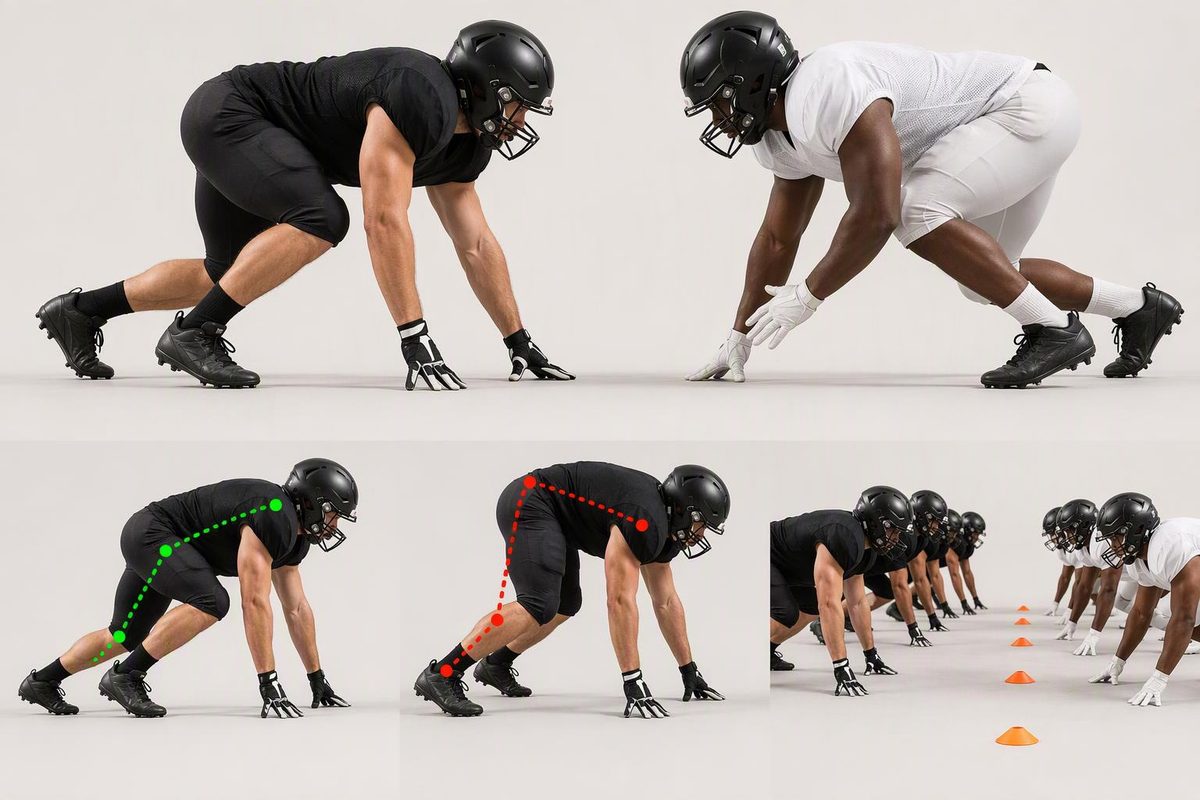
A 3 point stance in football puts both feet and one hand on the ground. Teach it so the player can see his assigned key and execute his first two steps without resetting—not simply so he looks low. Offensive players need balance; defensive players need a stance matched to their gap responsibility and trigger. Tim Horton’s Complete Running Back excerpt defines the three contact points and emphasizes balanced starts without giving away the play.
For high school and small-college practice, build a repeatable setup, then test the actual assignment. Do not force an offensive tackle and a penetrating defensive lineman into identical stances.
Choose the player’s position and visible error; use the correction and retest shown.
Stance Correction Selector
Rebuild Offensive Balance
Rebuild the feet-and-hips position and reduce forward lean.
Retest: Have the player lift his own down hand during a stationary teaching rep, then take the assigned first step.
Do not pull the supporting arm away or perform this check after getting set for a live snap.
Source: ACTIVE’s offensive-line hand-lift guidance and the coaching progression in this guide. Defensive checks depend on the installed assignment.
Build an Offensive Stance That Allows Movement
Use this progression for guards, tackles and attached tight ends whose assignment calls for a hand-down stance. Teach the center separately with the snap included.
- Set the feet. Start around shoulder width with a modest stagger. Name which foot is back in your system rather than letting the player change it with every call.
- Bend through the knees and hips. Sink into an athletic position before reaching down. Do not solve “get lower” by folding the chest toward the ground.
- Place the down hand. Reach from the shoulder to the turf without twisting the shoulders or collapsing one hip. Avoid loading so much weight onto the hand that the player cannot lift it without losing balance.
- Set the free arm. Keep it relaxed and ready to enter the block or pass-protection fit, rather than tucked behind the body.
- Set the eyes. Keep the head aligned with the torso and the eyes on the assigned pre-snap information. Avoid staring at the intended blocking path.
Stance depth should fit the athlete. If a player must rise substantially before he can step, try a shallower stance and retest. A player who cannot bend and maintain position needs an adjustment, not another demand to crouch. VIQTORY’s offensive-line stance guidance stresses individual depth, hip alignment and balanced weight distribution.
Use the Hand-Lift Check Only During Teaching Reps
During a stationary teaching rep, ask the offensive player to lift his down hand briefly. His torso should not lurch forward or rise substantially. Have the player lift it himself—do not yank the supporting arm away. ACTIVE’s offensive-line guide describes this test as a way to identify excessive weight on the hand.
This is a drill check, not a movement to make after getting set for a live snap. Follow it with the actual assignment: an inside step, a reach step or a pass set. A balanced pose that cannot produce the required movement is not finished technique.
Match the Defensive Stance to the Gap Assignment
For defensive linemen, decide the alignment, gap responsibility and visual key before correcting the stance.
In Mike Kuchar’s one-gap teaching progression for USA Football, the ballside foot is back and the ballside hand is down. He teaches feet slightly narrower than shoulder width, weight toward the balls of the feet and a toe-to-instep stagger, with a longer stagger available on pass-rush downs. Players key the outside “V” of the offensive lineman’s neck while using peripheral vision to see the ball move.
That is one system’s model, not a universal prescription. A two-gap defender’s read-and-control assignment should not automatically inherit a pass rusher’s launch position. Do not impose the offensive hand-lift standard on every defensive stance.
The defender must see the assigned key and leave toward the assigned gap without resetting a foot first. Speed into the wrong gap is not a successful rep. Pair stance work with your gap and run-fit teaching.
Correct the Visible Error, Then Retest
For beginners who twist when placing one hand down, coach Tom Bass recommends first establishing a balanced four-point stance, then lifting one arm without shifting the remaining hand. His USA Football explanation specifically addresses young defensive linemen and the shoulder-and-hip tilt caused by placing the down hand beneath the nose.
| What You See | Correction to Try | Retest |
|---|---|---|
| Offensive player falls forward when lifting the hand | Rebuild feet and hips; reduce forward lean | Hand lift, then assigned step |
| One shoulder and hip drop | Move the hand out from beneath the nose; square the torso | Front-view stance check |
| Player rises before stepping | Start slightly higher; reduce the crouch | Two-step departure |
| Player cannot see the key | Adjust depth and head alignment without cranking the neck | Identify the key before moving |
| Offensive stance changes with the play | Compare hand pressure, stagger and eye direction | Alternate run and pass calls |
Change the setup, then repeat the same movement. Otherwise, a cleaner-looking stance can hide the original problem: the player still cannot leave it toward his assignment.
Run an Eight-Minute, No-Contact Stance Period
Use parallel lanes roughly three yards apart, with five clear yards ahead. Work in pairs: one player performs, one observes from outside the movement path. A coach operates a ball where defensive players can see it.
No opponent or collision is needed. This period tests setup and departure, not block recognition. Stop any rep that causes pain and involve the athletic trainer.
| Time | Work | Check |
|---|---|---|
| Minutes 0–2 | Four reps per player; hold for two seconds, then reset | Shoulder and hip alignment; offensive hand lift |
| Minutes 2–5 | Four reps per player; take two steps and freeze | Direction and base |
| Minutes 5–8 | Four reps per player; alternate two installed movements | Setup and departure across assignments |
During the two-step phase, give one assignment at a time. Offensive players use your cadence; defensive players react to ball movement.
For the mixed phase, alternate movements already installed: a run-block step and pass set for offensive linemen, or two called gap departures for defensive linemen. Give one correction between reps.
Film one rep from the front and one from the side. Grade three things: repeatable setup, correct trigger, correct first two steps. Carry the same cues into the blocking progression rather than treating stance as a separate skill that ends when contact begins.