
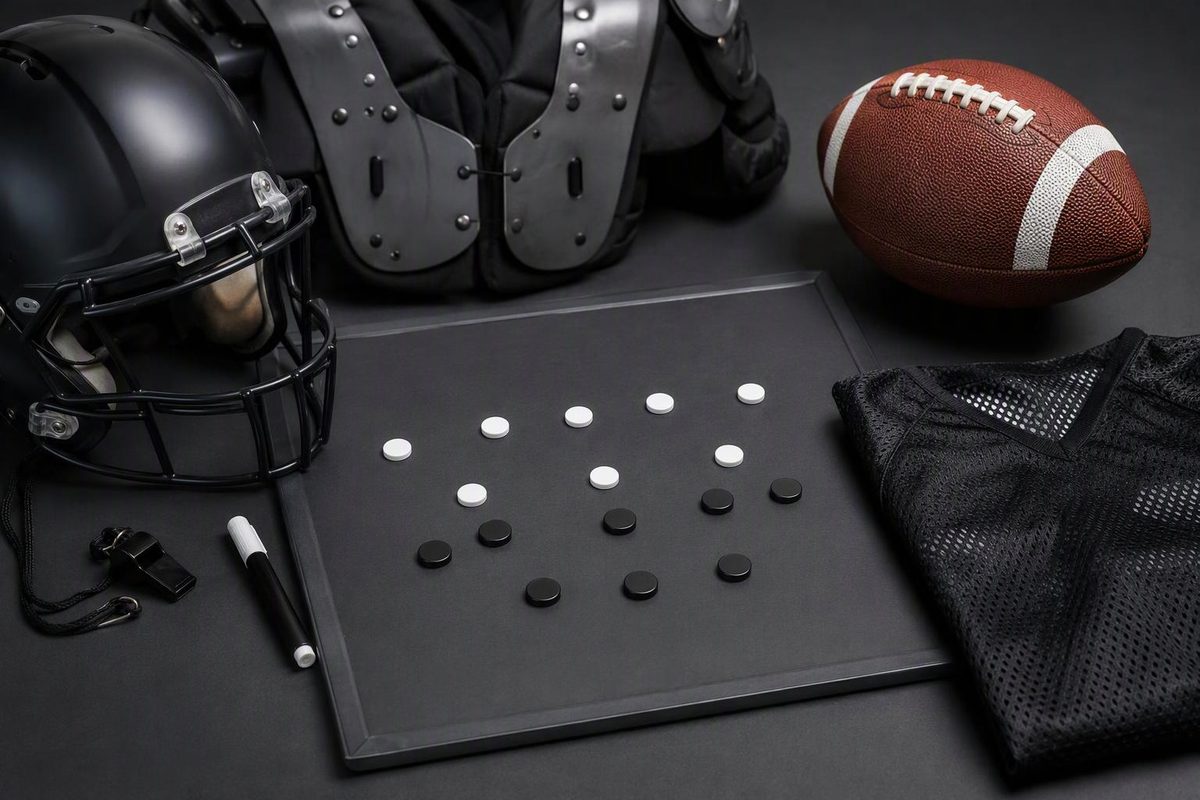
The 4-3 defense, sometimes written “43 defense,” uses four defensive linemen and three linebackers, with four defensive backs completing the unit. The front typically includes two ends, two tackles, and the Sam, Mike and Will linebackers. Matt Bowen’s NFL front breakdown identifies those roles and illustrates both Over and Under alignments.
For a high school or small-college install, start with one front against one formation. Each defender should be able to answer: Where do I align, what do I read, and which gap do I own? Add movement and coverage after those answers are consistent.
Positions and a base Over fit
Use a formation with one attached tight end for the first teaching period. Declare the tight-end side strong and the opposite side weak. This is the strength rule for this example—not a universal rule for every formation.
Name the spaces before naming the techniques:
- A gap: Between center and guard.
- B gap: Between guard and tackle.
- C gap: Between tackle and tight end; outside the tackle on the side without a tight end.
- D gap: Outside the attached tight end.
A technique describes alignment; a gap describes responsibility. Use the football gap map if players confuse the two.
The following is a static, one-gap Over fit, adapted from Bowen’s NFL example. It is a starting assignment map, not a complete answer to every blocking scheme. His Over-front film breakdown assigns the strong-side B gap to the tackle and weak-side A gap to the nose.
| Position | Starting alignment | Base run responsibility |
|---|---|---|
| Strong-side defensive end | Outside shoulder of the tight end | Strong D gap; hold the outside edge |
| Defensive tackle | Outside shoulder of the strong guard: 3-technique | Strong B gap |
| Nose tackle | Weak-side shoulder of the center: 1-technique | Weak A gap |
| Weak-side defensive end | Outside shoulder of the weak tackle: 5-technique | Weak C gap; hold the outside edge |
| Sam: strong-side linebacker | About 4–5 yards deep, over the strong tackle | Strong C gap |
| Mike: middle linebacker | About 4–5 yards deep, over the center | Strong A gap |
| Will: weak-side linebacker | About 4–5 yards deep, over the weak tackle | Weak B gap |
Those linebacker depths are suggested walkthrough landmarks. Adjust them for your players and opponent.
Defensive-line cue: “Control your gap before chasing the ball.” On film, stop at the first two steps. If a tackle crosses into the neighboring gap without a called movement, correct his path—not just the missed tackle.
Linebacker cue: “Read the assigned blocker, confirm the back’s path, then fit.” For this limited base-block walkthrough, assign Mike the strong guard, Will the weak guard and Sam the tight end as initial keys. These are teaching choices for this period, not universal 4-3 read rules. If Mike and Will start toward the same window, reset them and have each point to his gap before repeating.
End cue for this boxed-edge example: “Keep the run inside your leverage.” An end who dives inside without a replacement opens the edge. Do not mix that instruction with a spill technique, which deliberately sends the ball outside to another defender.
Over versus Under
The quickest distinction is the location of the 3-technique:
- Over: The 3-technique is toward the declared strength; the nose is away from it.
- Under: The nose is toward the strength; the 3-technique is away from it. The Sam commonly walks up outside the tight end.
In Bowen’s Under example, the strong end takes C, Sam takes D, Mike takes strong B, and Will takes weak A. Changing the front therefore changes linebacker fits; it is not simply moving the tackles. See the Over/Under assignment comparison.
Install Over first. Add Under only when players can realign and name the new responsibilities without prompting.
The front does not name the coverage
“4-3” does not tell a corner whether he has man coverage or a deep zone. Your complete call must also identify coverage, linebacker pass responsibilities, and perimeter run support.
Before team reps, name the force defender on each side—the player responsible for turning an outside run back toward help—and identify the cutback player. Those assignments must agree with your ends’ box-or-spill rules.
Against spread formations, a linebacker may widen toward a slot receiver. Do not assume that 4-3 personnel automatically means seven defenders in the box. If that player leaves an interior fit, identify his replacement or change the call. For a personnel alternative, compare the 4-2-5 defense.
A 12-minute no-contact install
This proposed period teaches the Over alignment and base fit, then checks the transition to your installed coverage. It does not install puller, option or pressure rules.
Setup: Use a full defensive unit against five offensive linemen, one attached tight end, two backs, two receivers and a quarterback. Mark the line of scrimmage and linebacker depth with cones. Work at walking speed: no blocking contact, collisions or tackling. USA Football’s Levels of Contact framework distinguishes no-contact work from later contact progressions.
Minutes 0–2: Declare and align
Run four alignment reps, alternating the tight end right and left. Mike declares strength; every front defender points to his gap.
Checkpoint: No uncovered interior gap and no duplicate assignment.
Minutes 2–6: Read and freeze
Run four base-block reps, two toward each side. Offensive players walk their paths without engaging defenders. Stop after the defense’s first two steps.
Checkpoint: Tackles stay in their assigned lanes; linebackers read their keys and start toward the correct windows; ends retain outside leverage. Do not expect linebackers starting 4–5 yards deep to complete their fits in two steps.
Minutes 6–9: Add the back’s direction
Run four more reps: two downhill paths and two wider paths. Let defenders walk beyond their initial read steps, then freeze before players intersect. Check the ball-side fit, outside leverage and backside cutback position.
Correction: If a linebacker runs past his fit, reset him and have him name his blocker key and gap before the next rep. Repeat more slowly, checking that he responds to the blocker and back without overrunning the window.
Minutes 9–12: Separate run from pass
Run four alternating run/pass recognition reps using your already-installed coverage. On pass, linebackers move to their assigned receivers or zones rather than filling their run gaps.
Checkpoint: Ask one linebacker and one defensive back to name both their run and pass jobs. Move on when alignment, assignment and first movement agree—not merely when the ball carrier has nowhere to walk.