
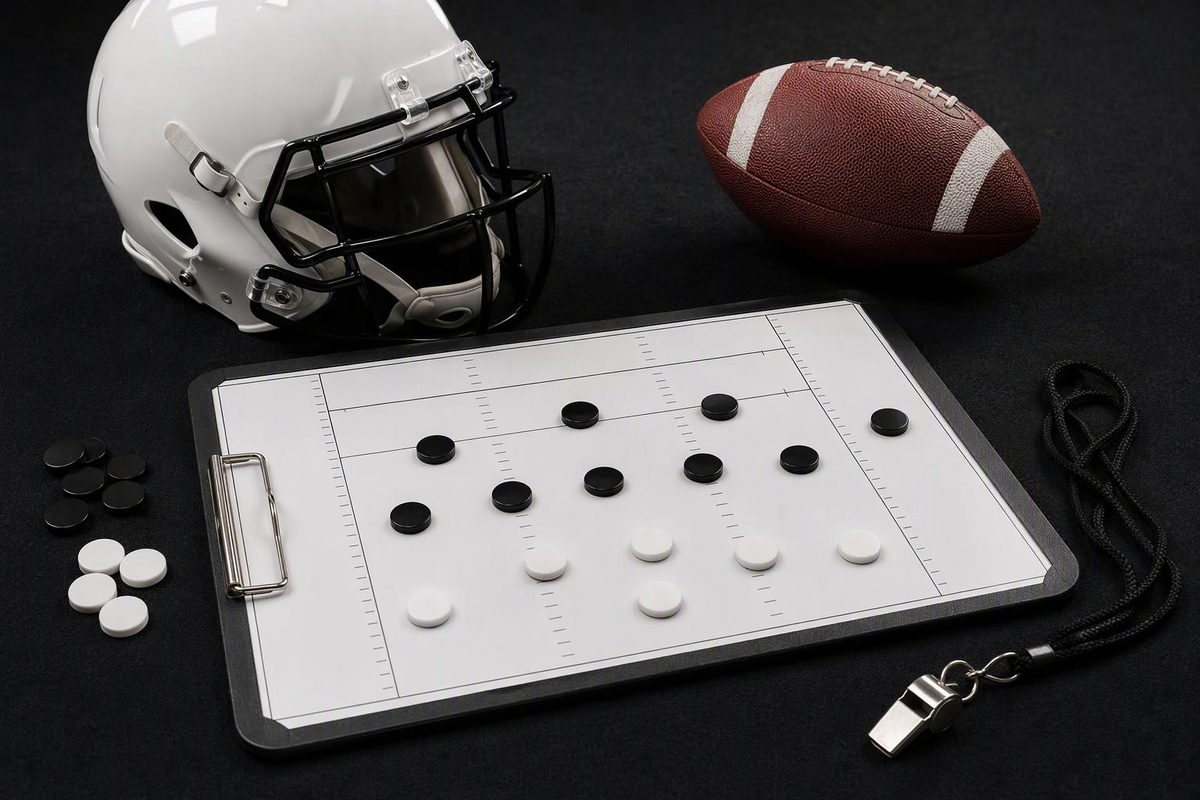
The 4-2-5 defense uses four defensive linemen, two linebackers and five defensive backs. The extra defensive back gives a staff another option for covering slots and defending space without removing a fourth lineman. But the numbers describe personnel—not a coverage, a fixed box count or a complete run-fit system. Joe Daniel’s position guide shows how those jobs fit together in his high-school-oriented system.
For your first install, answer four questions: Where does each player align? Which gap does he own? Who forces the run back inside? What coverage responsibility can keep him out of the fit?
Positions: name the job before the nickname
Staffs can organize the five defensive backs in different ways:
- Two corners, two deeper safeties and a nickel: the nickel is the hybrid slot defender.
- Two corners and three safeties: two safeties can work as overhangs outside the box, with a free safety behind them.
These are arrangements within the same personnel count. Joe Daniel teaches the second version, with strong and weak overhang safeties who combine linebacker and coverage duties. His system also includes split-field quarters packages, so “three safeties” does not require a one-high alignment. Source: Joe Daniel Football
For the starting package below, use two overhangs and one deep safety:
| Position | Starting job | Observable coaching checkpoint |
|---|---|---|
| Two defensive tackles | Control their assigned interior gaps | Neither abandons his gap chasing the back |
| Two defensive ends | Control the called edge gaps; rush with assigned contain rules | The end’s path matches the call, not just the ball’s movement |
| Mike and Will linebackers | Fit the remaining interior gaps; handle underneath coverage | Their first steps follow the assigned key, not backfield guessing |
| Two overhangs | Set outside leverage against the run; cover the curl-flat areas in this package | They do not squeeze inside and surrender the edge |
| Free safety | Protect the deep middle, then support the run when his key confirms it | He does not trigger downhill on an unconfirmed run look |
| Two corners | Protect the outside deep thirds | They keep their coverage responsibility through play-action |
Choose overhangs who can both tackle in space and execute the coverage you actually call. A player who can chase a sweep but cannot handle a slot’s route is not ready for every version of this position.
A starting alignment and six-man run fit
Use this teaching example against a detached 2x2 formation—two receivers on each side—with no tight end. Declare the offense’s right side as the strength for the drill; this is a practice convention, not a universal strength rule.
Set an Over front:
- Strong tackle: 3-technique, outside shoulder of the right guard.
- Nose: 1-technique, shaded to the left of the center.
- Both ends: 5-techniques, outside shoulders of the tackles.
- Mike and Will: start about 4–5 yards deep, positioned to reach their assigned gaps.
Joe Daniel’s Over-front example uses a strong-side 3-technique and weak-side 1-technique. His strength rules change with the formation, including the presence of a tight end. Source: Joe Daniel Football
For this walkthrough, start each overhang halfway between the offensive tackle and slot receiver, 4–5 yards deep. Put the free safety in the middle at 10–12 yards and corners over the outside receivers at 7–8 yards. These are drill starting landmarks, not alignment rules for every split or coverage.
For a static, one-gap walkthrough with no stunt, teach this ownership:
| Gap | Strong side | Weak side |
|---|---|---|
| A: center–guard | Mike | Nose |
| B: guard–tackle | Strong tackle | Will |
| C: outside tackle, with no tight end | Strong end | Weak end |
The overhang on each side is the force defender: he maintains outside leverage so the runner must turn back toward help. The free safety supplies alley support, working between the force defender and interior pursuit after confirming run. This fits the force-and-alley structure described in Joe Daniel’s system.
Teach the difference between alignment and gap ownership explicitly. A technique tells the defender where to start; the call tells him where to fit. Once you add slants, pullers or option reads, this static chart is no longer the entire answer.
Checkpoint: freeze the walkthrough as the runner approaches the line. Each interior gap should have its assigned defender, and the force player should remain outside the ball. Correct a duplicated fit even if the defense would have stopped the play.
Coverage and run support must agree
For this starter package, pair the front with basic spot-drop Cover 3: corners take the outside deep thirds, the free safety takes the middle third, overhangs work curl-flat areas, and linebackers work hook-to-curl zones underneath. Joe Daniel illustrates an Over front with Cover 3 as one base arrangement. Source: Joe Daniel Football
Quarters, man-free and split-field coverage are other options—not responsibilities to mix into the same call. In his 2011 college clinic notes, Gary Patterson describes quarters, man principles and pressure packages within TCU’s 4-2-5. He also describes adding run defenders when six cannot handle the offense’s run game. Source: Patterson’s clinic notes
That is the practical trade-off: five defensive backs give you coverage options, but an overhang can still be conflicted by a slot route and a run. Before adding a run-pass option (RPO) or quarterback-read period, assign the quarterback, running back and perimeter receiver. Do not assume “six in the box” answers all three.
Against trips, an attached tight end or motion, install a named adjustment before running full-speed reps. Confirm the new strength, edge gaps, force player and coverage distribution through your pre-snap communication loop.
A 12-minute no-contact install
This period checks the starting alignment and assignments; it is not a complete coverage or option-defense install.
Setup: use 11 defenders, a scout offense and cones marking the six gaps. Work at walkthrough speed, with no block engagement or tackling. Use the detached 2x2 formation above. Before starting, specify each defender’s run/pass key and script the scout offense’s blocking steps and receiver releases.
Minutes 0–3: alignment, four reps. Alternate the declared strength. Players state their technique, gap or coverage job before the snap. Correct the starting position before moving on.
Minutes 3–7: interior fits, six reps. Walk inside runs three times each direction. Freeze at the fit. Linebackers read the assigned guard, then locate the back; tackles and ends hold their called gaps. Mike Kuchar describes a guard-to-near-back reading sequence and emphasizes square shoulders against downhill flow in his USA Football linebacker article.
Minutes 7–10: edge fits, four reps. Walk an outside run twice each direction. Check outside leverage from the force player and the safety’s support angle. If both arrive inside the runner, reset their leverage—not their effort.
Minutes 10–12: run/pass recognition, four reps. Alternate a run look with play-action. Grade whether the secondary preserves its coverage assignments until the read permits run support. On play-action, correct a free safety who drives downhill and leaves the middle third exposed.
Record alignment, assignment and leverage separately. A defender who starts correctly but enters the wrong gap needs a different correction from one who owns the right gap but loses outside leverage.