
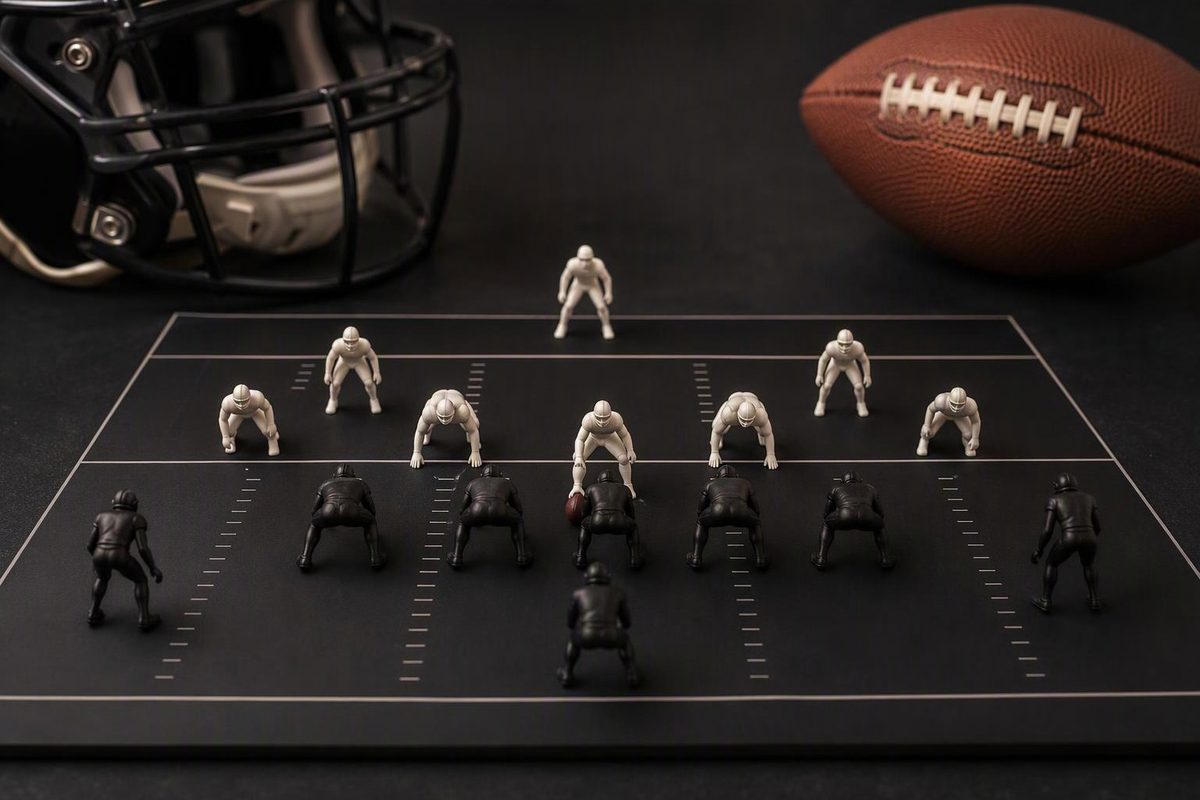
The Mike linebacker is the middle linebacker in common defensive terminology. In a traditional 4–3 defense, Mike identifies the middle player, Sam the strong-side linebacker and Will the weak-side linebacker. The Mike often communicates the defensive call and helps organize alignment. The Buccaneers’ position explainer describes those roles in their 2015 4–3 defense.
But when a quarterback or center points and says “52’s the Mike,” the offense is identifying a reference defender for its blocking assignments. That player does not have to be the defense’s actual middle linebacker. A college coaching example makes the distinction clear: in Dakota State assistant coach Jared Hottle’s outside-zone system, the offense designated the backside outside linebacker as the Mike. USA Football’s account of Hottle’s Mike Point system explains how that identification organized the blocking.
Those are two different uses of the same word: a defensive position name and an offensive assignment reference.
What the defensive Mike does
The Mike’s work combines communication with playing the called defense:
- Before the snap: Relay calls and help teammates get aligned. Exactly which checks he controls depends on the staff’s system.
- Against the run: Execute his assigned run fit—the lane or gap he must account for—rather than simply chase the ball.
- Against the pass: Execute the called coverage or pressure assignment. “Middle linebacker” does not mean “run-only player.”
In an interview about playing middle linebacker in the NFL, Luke Kuechly describes making calls, setting blitzes, sometimes changing responsibilities and handling both run and pass duties. He also emphasizes that other defenders can communicate adjustments; the Mike is not necessarily the only player directing the defense.
For coaching, separate the position label from the play assignment. “You’re the Mike” names the role. It does not, by itself, tell a player his gap, coverage landmark or rush responsibility. Teach those from the defensive call. Use the football gap map when explaining run-fit ownership.
What “52’s the Mike” means on offense
The useful translation is: “Use No. 52 as the reference for this blocking call.” It is not necessarily: “No. 52 plays middle linebacker on their depth chart.”
Who makes that identification depends on the offense’s system. Hottle put the responsibility on the center. His point told the offensive line where a combination block was working toward. The system also supported certain passing plays by clarifying blitz-pickup responsibilities for uncovered linemen. USA Football explains both applications.
Three coaching implications follow:
- Mike identification is not limited to pass protection. It can organize run blocking too.
- The point only works with installed rules. Naming a defender does not explain every blocker’s assignment without the rest of the scheme.
- The point is not a prediction that the defender will blitz. It identifies how the offense organizes its assignments, not what that defender will necessarily do.
Avoid teaching a universal rule such as “the center always blocks the Mike.” In Hottle’s outside-zone example, the point identifies the destination of a combination block, not a universal one-on-one matchup.
A short film-session checkpoint
Choose four clips from your own installed offense. Freeze each before the snap and ask players to distinguish:
- Defensive role: Which player is the defense’s Mike, if you know its terminology?
- Offensive point: Which defender should your offense identify under this play’s rules?
- Assignment consequence: What does that point tell the center, adjacent linemen and any back involved in protection?
Then play through the first blocking exchanges and check assignments—not just whether the play gained yards.
If a player answers only “that’s the middle linebacker,” have him name the point defender’s jersey number and explain his own blocking responsibility. The checkpoint is whether everyone applies the same installed rule, even when the offensive point and defensive Mike are different players.