
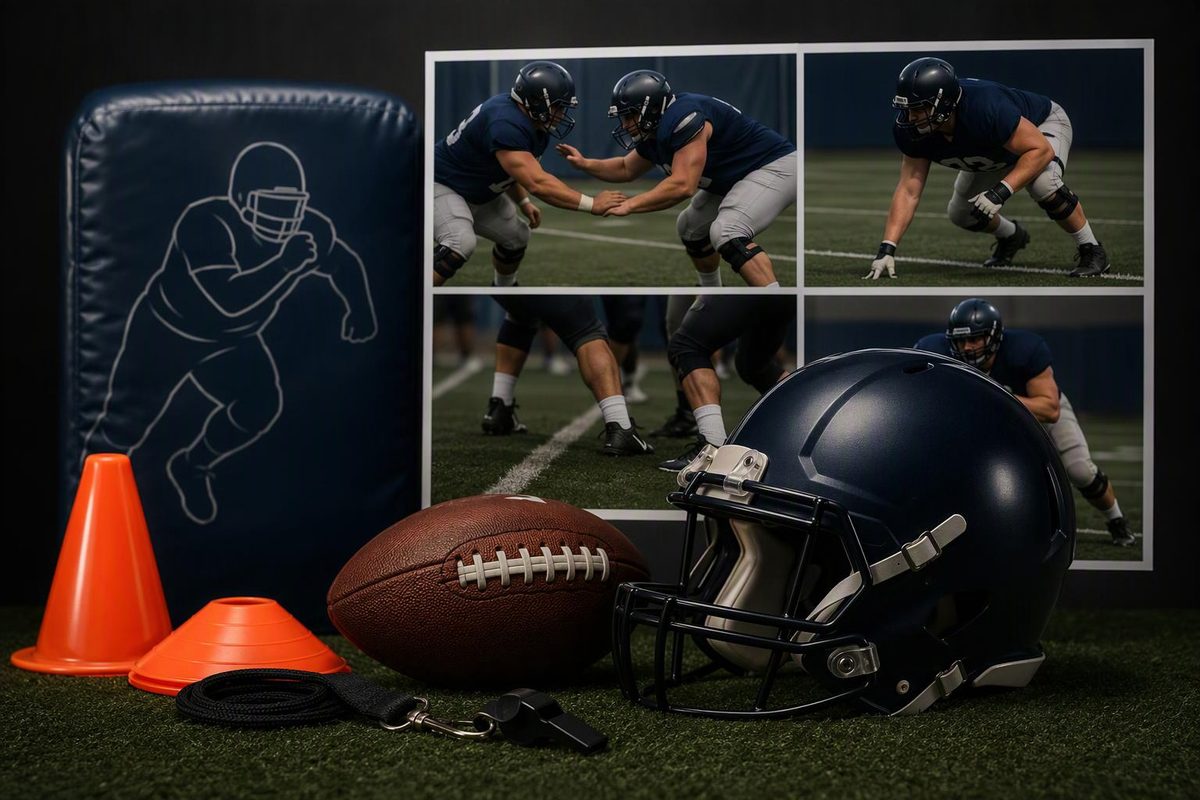
The right tackle (RT) is the offensive lineman immediately outside the right guard, viewed from the offense facing the defense. His jobs are to execute the called run block and protect the quarterback within the pass-protection scheme. That does not always mean blocking the nearest defender: tackles work with adjacent blockers and may climb to linebackers. Throw Deep Publishing’s position guide describes those run- and pass-blocking responsibilities.
For a high school or small-college install, establish three answers before coaching the movement: Who is mine? Where is my help? What is my first step? Once the assignment is clear, use the observed error to choose the next-rep correction.
Choose the right tackle’s observed error; use the cue and checkpoint for the next rep.
Choose the Next-Rep Correction
Footwork cues apply to the right-side vertical set taught here. Use your staff’s protection landmark.
Remove the Forward False Step
Cue: “Push left; kick right back toward your landmark.”
Checkpoint: The right foot does not step forward before the set.
Next rep: Reset and repeat an unopposed set to the staff’s marked landmark.
Source: Article coaching progression; vertical-set technique from Glazier Clinics. Protection assignments remain scheme-specific.
Right-Side Footwork Requires Its Own Repetitions
Do not treat right tackle as the less demanding pass-protection position. NFL coverage of Penei Sewell’s rookie transition to the right side highlights both the footwork adjustment and the importance of handling edge rushers on either side.
For the right tackle, inside is left, toward the guard; outside is right, toward the sideline. In the vertical set taught here, the left foot is the inside post foot—the foot that helps maintain position against an inside rush—and the right foot is the kick foot. A player moving from left tackle needs deliberate right-side repetitions, not just the instruction to “mirror it.”
The right side is not automatically the formation’s strong side. Before each rep, have the tackle identify whether a tight end is attached, detached or absent, then confirm the actual blocking call. An attached tight end does not automatically mean pass-protection help.
Use the broader offensive tackle assignment and technique guide for the full position progression; this period isolates right-side recognition and movement.
Establish the Assignment Before Coaching the Steps
Give the tackle a short verbal answer for each installed call:
| Call Element | Tackle’s Answer |
|---|---|
| Run | “Solo block, combination or release—and what is my landmark?” |
| Pass | “Man responsibility or gap responsibility—and who handles an exchange?” |
| Help | “Is the guard, tight end or back actually assigned to help me?” |
A combination means two blockers initially work together before one moves to a second-level defender. The partner depends on the play and defensive front. For example, Dave Christensen’s frontside zone “triple block” pairs the playside tackle with the tight end. That is one scheme example, not a universal right-tackle assignment. Glazier Clinics’ tackle–tight end combination lesson explains that approach.
On run walkthroughs, correct the first two steps against the called landmark. Do not praise a strong fit on the wrong defender. If assignment errors repeat, simplify the defensive picture before increasing speed.
Use a Vertical Set That Preserves the Inside Response
For this period, use a vertical set: gain depth with some width rather than immediately chasing the edge rusher sideways. Christensen teaches pushing from the inside foot, using a kick-and-drag action and keeping the shoulders square as long as possible. Staying square preserves the ability to close an inside move or exchange a defensive-line twist. Glazier’s vertical-set lesson provides the technique basis.
Translate that into right-side cues:
| Observable Problem | Coaching Correction | Next-Rep Checkpoint |
|---|---|---|
| Right foot steps forward before the set | “Push left; kick right back toward your landmark.” | No forward false step. |
| Feet cross or come together | “Kick, then recover your base.” | Feet stay separated. |
| Shoulders turn toward the sideline immediately | “Stay square while you gain depth.” | Inside response remains available. |
| Tackle reaches before moving into position | “Feet first; fit when you arrive.” | No waist lunge or lost balance. |
Set the depth landmark to your quarterback’s drop and protection. Do not prescribe one distance for quick game, dropback and play-action. Chris Landry’s pass-protection evaluation likewise emphasizes reaching the landmark, maintaining a base and preserving the inside post foot. Landry Football’s footwork evaluation supports those checkpoints.
Run a 12-Minute, No-Contact Right-Tackle Period
Use a ball or snap signal, flat markers for line splits and the staff’s quarterback landmark. Organize groups of no more than three tackles per lane to accommodate the rep counts below.
Mark separate lanes with enough clearance for the full set and redirect. Do not run adjacent groups whose paths overlap. Rushers demonstrate paths at walking pace only: no hand strikes, shields or body contact. Stop each path before players converge.
Run this under a qualified coach. Contact work belongs in a separately controlled progression consistent with your governing practice limits. USA Football’s Levels of Contact distinguishes no-contact teaching from contact stages.
Minutes 0–3: Identify the Assignment and Help
Show six pictures, changing the edge alignment and tight-end location. Give the play call. The tackle names his assignment and help, then walks the first two steps. Correct one error before changing the picture.
Minutes 3–6: Repeat the Right-Side Set
Give each tackle six unopposed reps to the marked pass-set landmark. Reset fully between reps. Grade the right foot’s first movement, base and shoulder position.
Minutes 6–9: Redirect Against Outside and Inside Paths
A shadow rusher starts in the edge alignment your offense commonly sees. Give each tackle three walking outside paths and three walking inside paths. The tackle sets and redirects without touching the rusher.
Stop and reset a crossed-foot or early-turn rep, then rebuild it slowly. The checkpoint is whether the tackle can respond to the path without losing his base—not whether he can touch the shadow rusher.
Minutes 9–12: Communicate the Guard–Tackle Exchange
Add the right guard and two shadow defenders. Walk four reps: two straight rushes and two twists, with defenders exchanging rush lanes.
Apply your installed protection rules; require the guard and tackle to confirm the exchange aloud. Rehearse the paths with separation before adding the blockers, and stop before contact.
Grade the Decision Separately From the Play Result
On film, record assignment, first two steps, base and communication. A completion can conceal a protection error; a sack can occur despite the tackle doing his job.
Keep the assignment grade tied to the actual call. A tackle passing a defender to the guard is not automatically wrong, and an attached tight end is not proof that help was available. Check the protection responsibility before grading the movement.
For the next practice, choose one correction the player can reproduce. “Keep the left post available against the inside move” gives the tackle a specific action to rehearse; “pass block better” does not.