
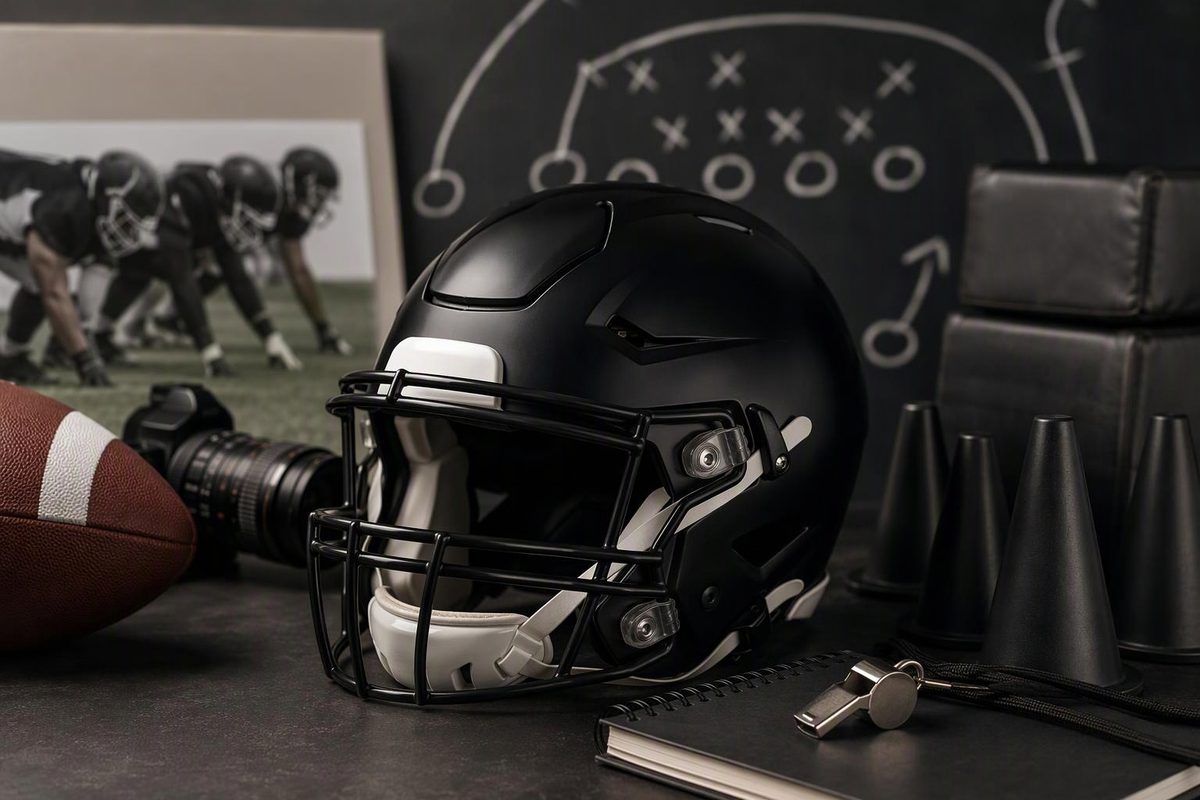
An offensive tackle lines up outside a guard, blocks edge pass rushers and creates or seals running lanes. As the NFL’s youth and high school glossary explains, the position is part of the offensive line. Coach it through four repeatable tasks: identify the threat, take the correct first step, maintain leverage and finish without losing balance.
Select the fault you see on film; the tool gives you the first checkpoint, correction and practice period.
Offensive Tackle Correction Finder
Check the set before correcting the hands
Confirm that the tackle did not overset and expose the inside path.
Practice period: Pass set and mirror.
Source: Corrections and practice periods are drawn from the coaching progression in this guide.
Where the Offensive Tackle Lines Up
A standard five-man offensive line is:
Left tackle — left guard — center — right guard — right tackle
A tight end may align outside a tackle, but that does not turn the tackle into an interior lineman. The tackle still needs to account for the edge defender’s width, the adjacent football gap and any linebacker threatening outside or inside.
Tackles operate in more space than guards and centers, often against the defense’s quickest front players. Left and right tackles have the same basic job categories. Their exact protection responsibility depends on the quarterback’s launch point, the protection call and whether a tight end or back provides help.
Do not teach “left tackle always protects the blind side” as the assignment. Teach the protection. The tackle must know where the pocket is supposed to form, which gap cannot be surrendered and where any help is coming from.
Before every snap, the tackle should answer:
- What is the play and direction?
- Am I covered or uncovered? Define the alignment that counts as covered in your system.
- Where is the nearest second-level threat?
- Is the front static, reduced or overloaded?
- What combination or protection call must I confirm with the guard or tight end?
Keep the vocabulary stable. One word should identify the same movement for the entire line. If the tackle and guard use different language for the same combination, the communication problem will appear in their first steps.
Build a Stance That Does Not Declare the Play
Use a two- or three-point stance according to the offense, but demand the same observable positions:
- Feet under a playable base, not so narrow that the player can be knocked sideways.
- Knees and hips flexed with the chest up.
- Weight distributed so the tackle can move forward, backward or laterally without a false step.
- Head up and eyes able to scan the front.
- Down hand, if used, light enough that its removal does not make the shoulders rise.
Test the stance by calling random run and pass starts. If the player must rock backward before a run step or pop upright before a pass set, the stance is declaring the play and delaying the block.
Evaluate the stance by what happens next, not by how it looks in a still image. The player must be able to take the required first step without transferring weight in the opposite direction first. A balanced stance also gives the tackle a chance to respond when the defense shifts late.
The first step should solve the assignment rather than merely create movement. USA Football coach Tom Bass recommends listing each required block, defining its first step and rehearsing that step from a stance; his examples distinguish forward, angle, hook and pass-protection starts (USA Football).
When correcting the start, name the intended path. “Step faster” is less useful than identifying the landmark, direction and leverage the step must establish.
Protect the Pocket Without Chasing the Rusher
The tackle’s pass-protection objective is to preserve the depth and width of the pocket for the called pass. It is not to chase the rusher wherever he wants to go.
Coach this sequence:
- Set to the landmark. Gain the width and depth required by the rusher’s alignment, the type of set and the quarterback’s launch point.
- Protect inside first. Stay inside-out on the rusher unless the protection sends help or changes that rule.
- Keep a usable base. Avoid clicking the heels, crossing over too early or letting the feet become wider than the player can recover from.
- Strike from balance. Hands arrive inside the defender’s frame while the head stays out of contact.
- Mirror the counter. Replace the feet instead of bending at the waist and grabbing.
The hands cannot repair poor positioning. USA Football’s pass-protection analysis makes the same point: a functional stance, strong base and half-man relationship put the blocker in position to strike; timing and placement matter more than maximum force (USA Football).
Film the set from an angle that shows both the tackle’s feet and the rusher’s path. Determine whether the loss began with the set, the base or the strike. Correct the earliest visible fault instead of reacting only to where the rusher finished.
Correct Common Pass-Protection Faults
- Rusher wins inside: Use the cue “Inside hand and inside foot stay alive.” Check whether the tackle overset before blaming hand speed.
- Rusher turns the corner: Use “Keep gaining depth; do not open the gate.” On a conventional kick or vertical set, the outside foot should not cross behind the inside foot during the initial set.
- Tackle lunges: Move the strike point closer and require one more foot replacement before contact.
- Bull rush collapses the pocket: Use “Drop the hips, restore the base, replace the hands.” Do not coach the player to lower his head into contact.
A useful correction preserves the rest of the technique. A tackle who loses outside does not automatically need a wider set; that change may expose the inside. Recheck the called landmark, the rusher’s alignment and the quarterback’s launch point before changing the set.
Connect Every Run Step to a Leverage Goal
A tackle may drive, reach, down-block, combination-block, climb or pull. The playbook determines the name; the coaching process should always connect the first step to a leverage goal.
- Drive or base block: Cover the defender, fit with hands inside and move him on the called track.
- Reach block: Gain outside leverage without stepping so wide that the defender penetrates through the tackle’s near hip.
- Down block: Deny penetration into the inside gap while keeping the head out of contact.
- Combination block: Work with the guard or tight end to secure the first-level defender before one blocker climbs. The linebacker’s movement and the security of the first-level block determine when the combination comes off—not a preset count.
- Backside cutoff: Beat the defender to the pursuit path; running past the target is not a win.
For drive-block work, useful checkpoints include short power steps, a flat back, hands inside and control of body angle (USA Football). USA Football’s contact system also emphasizes playing long to take the helmet out of contact, maintaining a balanced base and generating force through the hips rather than a large initial step (USA Football).
Combination blocks require a shared picture between the tackle and the adjacent blocker. Both players must know the first-level threat, the linebacker being tracked and which movement triggers the climb. If one blocker leaves early, correct the read and first-level security rather than assigning an arbitrary number of double-team steps.
At the high school level, remove any hand strike to an opponent’s head from the toolbox. For the 2026 season, NFHS Rule 9-4-7’s head-slap prohibition applies to offensive and defensive players (NFHS). Review the 2026 high school head-slap rule before building hand-fighting periods.
Run a Focused 20-Minute Tackle Period
Use bags or hand shields for the individual work. The combination and half-line segments require guards, tight ends or scout defenders. Add player-to-player resistance only under qualified supervision and within the team’s contact plan.
1. Stance and First Step — 3 Minutes
Place four cones one yard from the line: vertical, inside angle, outside angle and pass-set landmark.
- Coach calls the block and cadence.
- Player takes two steps, freezes and resets.
- Give each player two reps at all four starts: eight total reps.
Checkpoint: No rocking, false step or major change in pad level.
The freeze exposes an incorrect weight shift or first step before the player can hide it with later movement. Make the correction, then return immediately to the same call.
2. Fit and Six-Step Finish — 4 Minutes
Pair a tackle with a shield holder.
- Start one yard apart.
- Tackle takes the called run step, fits with hands inside and completes six short power steps.
- Give each player three drive reps and three angle reps, alternating direction.
Checkpoint: Head out of contact, hips under the chest and feet active after the fit.
The shield holder should provide a stable target rather than moving so much that the tackle cannot repeat the intended track. Grade the approach, fit and finish separately.
3. Pass Set and Mirror — 5 Minutes
Create a four-yard-wide lane with cones. A partner gives a speed, inside-counter or bull-rush track at half speed.
- Give each tackle one rep against each track from the left side and one from the right: six total reps.
- End each rep under control; do not finish the partner to the ground.
Checkpoint: The tackle reaches the called set point square enough to react, protects inside and strikes without lunging.
Do not let the partner choose a counter before the tackle can execute the set. Establish the set landmark first, then add the three tracks.
4. Tackle-Guard Combination — 4 Minutes
Align a defender on the tackle and a linebacker four yards deep. The linebacker scrapes inside, scrapes outside or holds.
- Guard and tackle call the combination before the snap.
- Run six reps to each side as a unit, rotating the linebacker’s reaction.
Checkpoint: Both blockers secure the first level. The climber leaves in response to the linebacker without abandoning the down defender early.
Listen for the call before watching the block. A correct physical rep reached through unclear communication is not yet dependable.
5. Half-Line Transfer — 4 Minutes
Run the day’s top run and protection against two fronts.
- Take four total snaps: one run and one pass in each direction.
- Change the defensive front after two snaps.
- Use the contact tempo scheduled for that practice; a teaching period does not require a live finish.
Checkpoint: Correct communication, assignment and first two steps at the called tempo. Stop immediately for a safety issue. For other errors, let the short rep finish and correct one observable fault before the next snap.
The final segment tests whether the individual work transfers when the tackle must process a front, communicate and execute with adjacent blockers. Keep the play selection narrow enough that the technique remains the coaching focus.
Grade Controllable Actions on Film
Score five items rather than recording only wins and losses:
- Correct alignment and stance.
- Correct assignment and communication.
- First two steps match the block.
- Base, leverage and hand placement remain usable.
- Legal finish while the ball is live, followed by a release at the whistle.
A tackle can execute the assignment while the ball goes elsewhere, and can survive a rep despite poor technique. Grade both result and process.
Start the correction with the first observable breakdown. An overset can produce an inside loss, crossed feet can prevent a recovery and an early departure from a combination can free the first-level defender. Naming only the result does not tell the player what to replace.
The next practice correction should contain one visible fault and one replacement action. Pair “you lunged” with “replace the feet once more before striking,” or pair “you left the combination early” with “secure the first-level defender and leave on the linebacker’s movement.” That creates a cue the player can rehearse and the coach can grade on the next rep.