
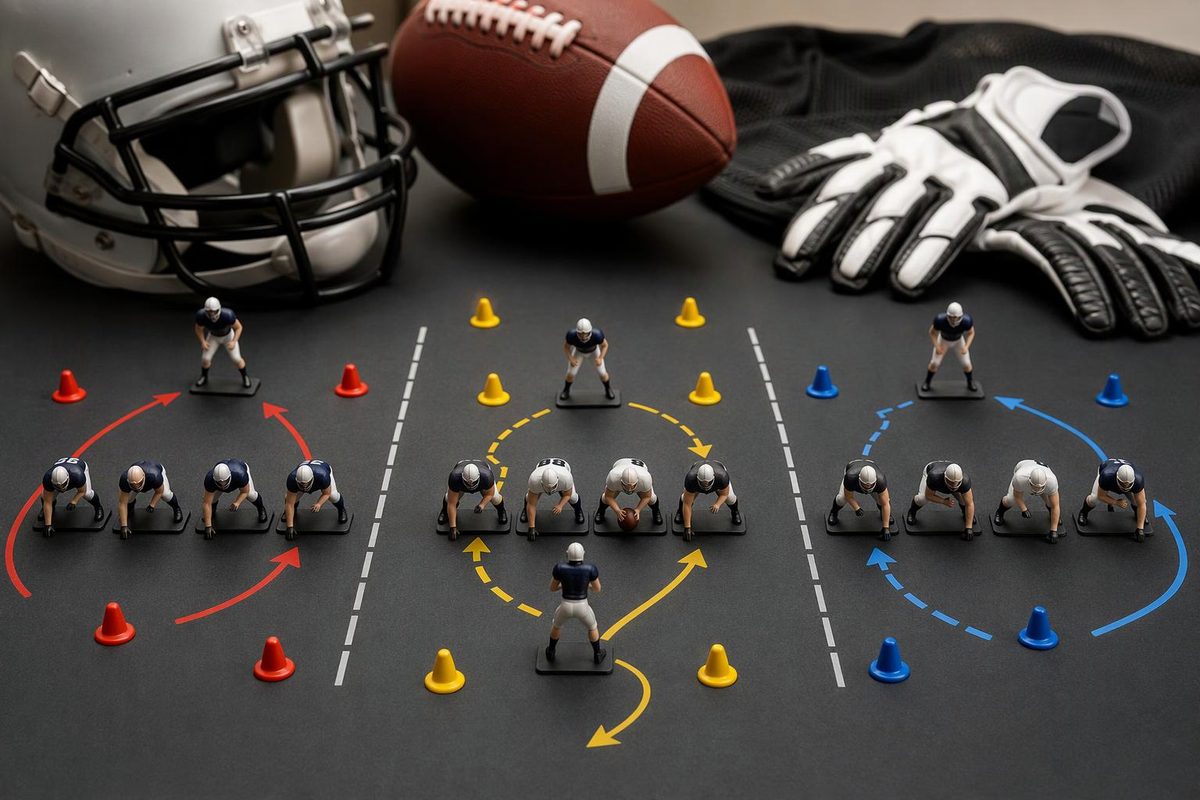
A pulling guard leaves his original offensive-line position after the snap and moves behind adjacent blockers to block somewhere else. The assignment may be to widen a running lane by trapping or kicking out a defender, or to lead through the lane toward a linebacker. USA Football’s pulling technique guide illustrates both jobs.
For high school and small-college players, teach three things before asking for speed: destination, path and leverage—which defender to reach, how to get there and which side of him to control. For the position’s broader responsibilities, see the offensive guard guide.
Separate the Assignment From the Pull Technique
“Kick out” and “wrap” describe jobs. “Square pull” and “skip pull” describe ways to reach those jobs. They are not interchangeable labels. A trap can use kick-out leverage; the distinction is the assigned target, not necessarily a different finish.
| Assignment | Guard’s job | Checkpoint |
|---|---|---|
| Trap | Pull to an assigned first-level defender whom the scheme leaves for the puller. | Reach the defender with the leverage needed to widen the called lane. |
| Kick out | Block the assigned edge defender away from the running lane. | Arrive inside the target rather than running around him. |
| Wrap or lead | Enter the running lane and block the assigned second-level defender, often a linebacker. | Clear adjacent blocks, turn downhill and arrive balanced. |
Those distinctions follow Keith Grabowski’s square-pull and power examples. They do not establish one target for every offense.
For example, on a power run to the right, the backside left guard can pull behind the center and enter toward the assigned linebacker. In a counter variation, a guard may instead be the first puller assigned to kick out the edge. Have the player say “right, kick-out, assigned edge” or “right, wrap, assigned linebacker”, using your terminology—not merely “I pull.”
Also identify who accounts for the space the guard leaves. In Grabowski’s power example, the puller must clear room for the center to block back.
Square Pull: Open Toward the First-Level Target
Despite its name, this technique does not keep the shoulders square to the line throughout the pull. Grabowski teaches an opening step that puts the hips approximately 45 degrees toward the target.
For a pull right:
- Open the right foot away from the line of scrimmage. Rip the right arm backward with that step.
- Travel toward the target with inside leverage. Work back toward the line rather than drifting around the defender.
- Fit with eyes up and the head out of contact. In this teaching version, use the right shoulder surface when pulling right and the left when pulling left. Grabowski describes an inside-number fit, adjusting the target with the defender’s body position.
- Keep the feet moving through the fit. If the defender goes upfield, adjust and turn him out rather than chasing the original spot.
These are the specific cues in USA Football’s square-pull instruction.
Observable correction: If the guard arrives outside the kick-out target, reset the opening step and approach angle. Mark an inside approach landmark and walk it. More speed will not repair the wrong leverage.
Skip Pull: Stay Square to Find the Lead Target
A skip pull emphasizes shoulders square to the line of scrimmage, allowing the guard to keep his eyes on the defense. One teaching version uses a short backward step with the pull-side foot, an opposite-foot gather step gaining width and depth, then recovery of the pull-side foot into the skip. Keep the shoulders low rather than popping up. Youth Football Online’s step-by-step progression describes this sequence.
Coach “clear, square, downhill.” Gain enough depth to avoid the adjacent blocks, keep the shoulders facing the defense, then enter at the installed landmark. Do not make the guard stay lateral after the entry opens.
Observable correction: If he turns his shoulders down the line and loses sight of the linebacker, freeze the gather step and restore square shoulders. If he loops deep, check the center’s block-back path before moving the landmark closer.
For two-puller counter work, teach the relationship between the pullers too. In Alex Atkins’ clinic explanation, the second puller reads the defender’s near hip: if it stays, he goes inside; if it goes away, he goes around. That is a scheme-specific read to install, not a universal rule. The wrap path must respond to the block, not just follow a cone.
Rehearse Both Pulls, Then Add Bodies
Use this eight-minute teaching period with two guards, three adjacent-line helpers and one shield holder. Work one guard at a time. Mark your normal line splits, kick-out target and wrap entry point.
- Minutes 0–2: Each guard takes two opening-step reps and two skip-step reps—one each direction for each technique. Freeze to check hips, shoulders and balance.
- Minutes 2–5: Each guard takes four square pulls, two each direction, finishing with a controlled shield fit at the kick-out target.
- Minutes 5–8: Each guard takes four skip pulls, two each direction. Helpers rehearse the adjacent blocks without contact; the shield holder now acts as a linebacker moving slowly. The guard stops balanced at the assigned fit without contact.
Use no-contact movement and bag contact within your program’s governing practice limits, consistent with USA Football’s Levels of Contact progression. No helmet-led fits or takedowns in this period. Cut remaining reps if correction time uses the block; shield fits rehearse positioning, not control against a resisting defender.
On film, grade target, clearance, leverage and arrival balance separately. A guard who reaches the wrong defender quickly still needs an assignment correction.