
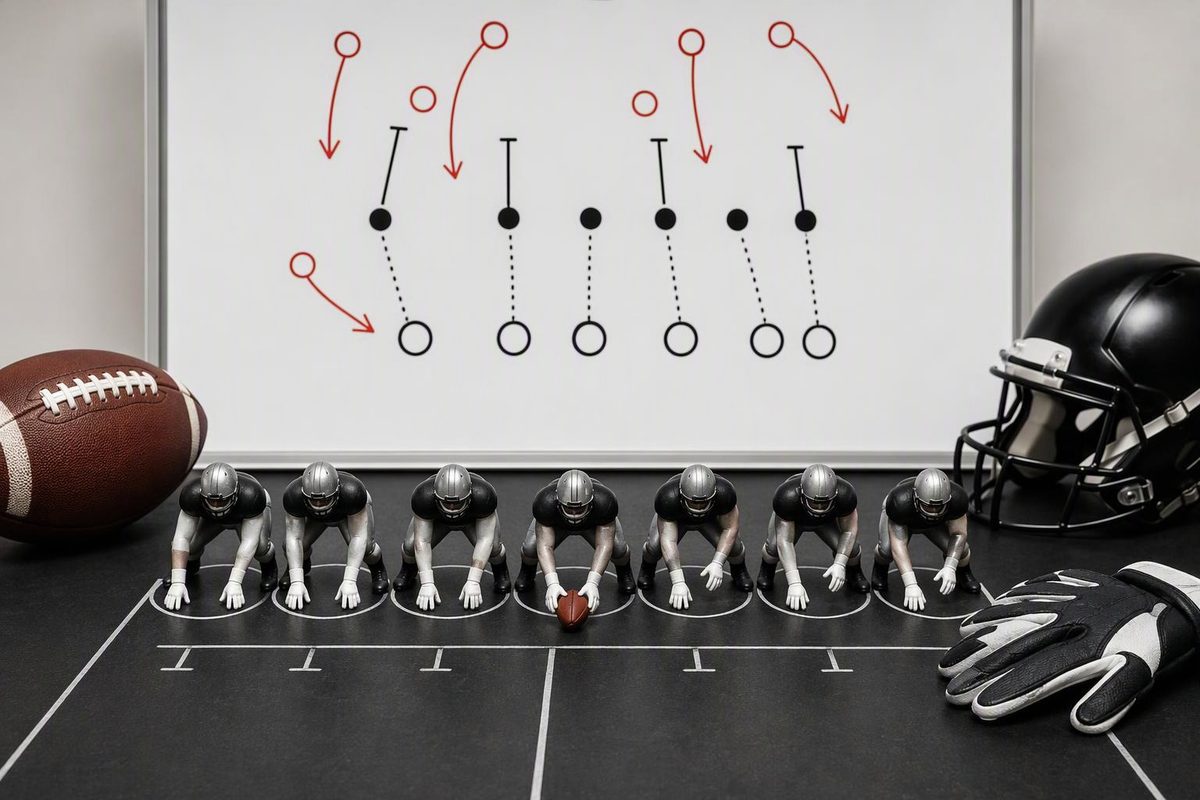
Pass protection is the offense’s plan for keeping rushers away from the quarterback through the intended throw. It includes the line’s assignments, any back or tight end staying in, and the quarterback’s answer when the defense brings a threat the protection cannot block.
For a high school or small-college practice, start with one installed protection and one quarterback launch point—the spot where he is expected to deliver the ball. The six-man half-slide example below gives you a manageable teaching period, not a complete answer to every front.
Put an assignment behind the call
Half-slide protection combines gap responsibility on one side with man assignments on the other. The center joins the slide side; the opposite guard and tackle take assigned defensive linemen, with the back responsible for an additional threat. VIQTORY’s protection guide explains that basic structure.
For this example, slide left against four down linemen and two linebackers, with no tight end blocking. Put the defensive tackles in the B gaps, the ends outside the offensive tackles, and one linebacker threatening each A gap. Define the A gaps as center–guard, B gaps as guard–tackle, and C gaps as outside the tackles.
| Protector | Assignment in this example | Pre-snap statement |
|---|---|---|
| Center | Left A gap | “Left A.” |
| Left guard | Left B gap | “Left B.” |
| Left tackle | Left C gap | “Left C.” |
| Right guard | Right defensive tackle | “I have the tackle.” |
| Right tackle | Right defensive end | “I have the end.” |
| Running back | Right linebacker first; if he drops, scan right A gap to B gap to edge for another threat | “Right linebacker first.” |
These slide-side gap assignments and man-side down-lineman assignments follow the structure described by Youth Football Online. The back’s scan above is the rule for this example; write your own installed scan order explicitly.
Have the center announce the direction and both guards echo it. Then require the back to identify his first threat. A direction call alone does not tell the back whom to block.
Teach two limits:
- An uncovered slide-side lineman can help inside, but must keep his eyes available for a threat entering his assigned gap. Youth Football Online specifically warns against helping away and missing a looper or blitzer.
- Six protectors cannot individually block seven simultaneous rushers. Before adding an overload, name your adjustment or the quarterback’s unblocked-rusher answer. Do not assume every pass concept automatically contains a usable hot route.
Man-side assignments also need an installed exchange rule for twists—rushers crossing paths. “Stay on your man” is not enough instruction for a guard and tackle sorting a stunt.
Coach the set, eyes and hands separately
For individual position work, use the offensive tackle practice plan alongside this unit period.
Set to the assigned threat without surrendering the inside path. In a staggered tackle stance, identify the inside post foot and outside kick foot. Keep the post foot ahead of the kick foot and avoid loading all the weight onto the kick foot. Coach Steve Ciocci describes those checkpoints in USA Football’s pass-protection fundamentals.
Do not demand identical set depth from guards and tackles. Match the set to the defender’s alignment and your quarterback’s drop.
Read the torso, not the fake. Ciocci recommends watching the defender’s chest and stomach rather than reacting to head or hand movement. On the slide side, pair that cue with awareness of the assigned gap.
Fit the hands inside the chest. Ciocci identifies the breastplates as the pass-blocking hand target. Use a shield to teach that target without reaching or initiating contact with the head. Watch for these corrections:
| What you see | Next-rep correction |
|---|---|
| Feet cross during the set | Shorten the steps; preserve the stagger |
| Tackle opens immediately and loses inside leverage | Reduce the opening turn; reset between the rusher and inside path |
| Blocker lunges before the rusher arrives | Keep the torso balanced over the base; bring the target closer for the next shield rep |
| Back releases while his threat is still unresolved | Repeat the scan aloud; remove the release until the check is correct |
Run a 12-minute progression
Use five linemen, a back and a quarterback, with scout defenders rotating in. Mark the quarterback’s intended launch point with a flat marker. Keep the area behind each blocker clear.
This period uses unopposed movement, shield contact and no-contact walkthroughs—not live pass rush. USA Football’s Levels of Contact separates those teaching stages from competitive contact. Follow your program’s equipment and contact requirements.
Minutes 0–4: Call and point — six walkthrough reps
Align the four down linemen and two linebackers in the example front. Alternate the linebackers’ showing and dropping positions before each snap.
The center calls left; guards echo; every protector points to his gap or first threat. Walk through the first two steps, then freeze.
Checkpoint: All six answers are correct before increasing speed. Correct the assignment, not the footwork, when a player points to the wrong threat.
Minutes 4–8: Set and fit — four reps per blocker
Work in pairs with shields. Each partner blocks for two reps, then switch roles; repeat once. Set each shield at the corresponding defender’s alignment rather than at one universal width.
The blocker takes his set and fits his hands to the shield. The holder supplies a stationary target; no competitive rush or drive follows.
Checkpoint: Stop after the fit. Check foot stagger, balance and hand placement before resetting.
Minutes 8–12: Sort the rush — six unit walkthroughs
Use the same front and script:
- Two straight four-man rushes.
- Two rushes adding the right linebacker, testing the back’s assignment.
- One left-side exchange: the defensive tackle enters left A while the end loops into left B.
- One seven-rusher overload: rush all four down linemen, both linebackers and an additional scout outside the right end.
Use the overload only if you have already installed an adjustment or quarterback answer for that extra right-edge threat. Otherwise, replace it with a six-man rush using both linebackers.
Scouts walk their paths without touching blockers or quarterback. On the exchange, check that the center and left guard account for threats entering their gaps rather than chasing original alignments. On the overload, have the quarterback state the planned answer before the snap, then rehearse its recognition and execution at walking speed.
Checkpoint: Freeze when rushers reach blocking depth. Each threat should have an assigned protector or a deliberately taught offensive answer.
Grade the cause of pressure
On film, record four items: call, assignment, technique and quarterback location/timing. Use the end-zone angle for gap relationships and the sideline angle for set depth and the quarterback’s launch point.
A free rusher with two blockers on one defender suggests an assignment or exchange problem. The correct matchup with an immediate inside loss suggests a technique problem. A quarterback drifting beyond the planned pocket or holding beyond the concept’s timing needs separate review—not an automatic loss charged to a lineman.
Take the clearest recurring error into the next period. Recreate its alignment and rush path, give one correction, then run the rep again.