
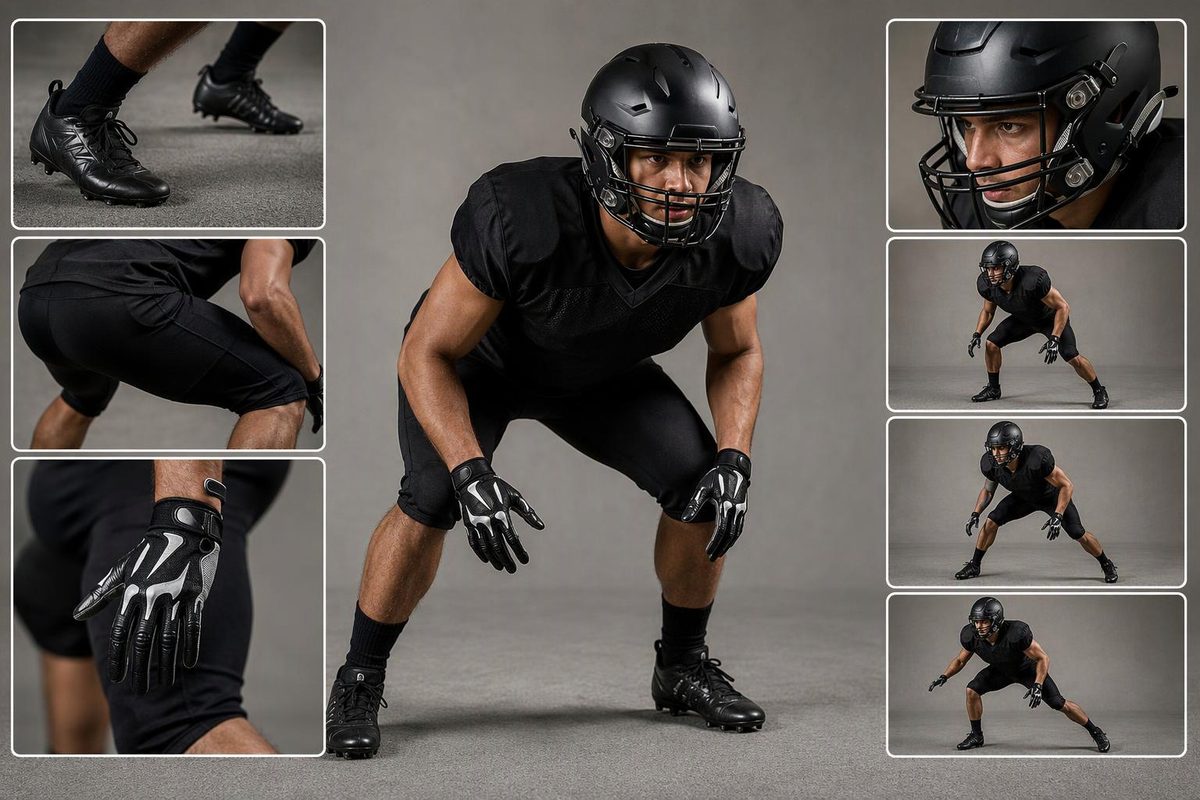
For an off-ball linebacker, start with a balanced two-point stance: feet about shoulder-width apart, knees and ankles bent, heels grounded, hands relaxed and eyes on the assigned offensive key. The checkpoint is movement: can he execute the taught first step without first standing up, sinking lower or rocking away from the play? These are central points in linebacker stance coaching guidance.
Use this setup for high school and small-college linebackers reading from depth, rather than as an edge pass-rush stance. Alignment and stance are separate coaching decisions: put the player where the defensive call requires, then check his starting position.
Build the stance from the feet up
- Set the base. Start with the feet parallel, approximately under the shoulders. Use this as a starting width, not a measurement every player must match exactly. Check whether the player can begin moving left and right without first gathering his feet.
- Bend the knees and ankles. Lower the hips into an athletic position, with a slight bend at the waist. Avoid both extremes: a deep squat and straight legs beneath a folded-over torso.
- Keep the heels down, with pressure toward the front of the feet. Do not cue the player to balance on his toes. He should look ready to move, not ready to fall forward.
- Keep the chest visible. Face the line of scrimmage with the shoulders square. Let the eyes reach the key without burying the chest toward the grass or craning the neck upward.
- Relax the hands. Let them hang near knee level, slightly in front of the body. Start without resting body weight on the thighs; the arms should be available when movement begins.
- Place the eyes. Name the offensive player or combined picture the linebacker must read. A good-looking stance with the eyes on the wrong key is not a completed setup.
This is a starting template, not a requirement for identical hip heights or hand positions. Talkfootball’s stance teaching uses a visible-chest cue, grounded heels and relaxed hands, while allowing individual variation.
Cue: “Feet set. Knees bent. Chest visible. Eyes on your key.” Give one correction at a time rather than repeating the entire checklist before every rep.
Correct what happens at the start
Judge the stance through the first movement, not just a still photograph. Talkfootball specifically warns that excessively low starting hips can make the first motion an upward rise instead of useful movement.
| What you see | What to check | Correction to try |
|---|---|---|
| Hips rise before the feet move | Starting squat may be too deep | Raise the starting hips slightly; repeat the same response. |
| Player sinks before moving | Knees may be nearly straight | Add knee and ankle bend before the cue. |
| Player rocks backward before a forward response | Starting balance and first-step length | Reset the weight distribution and shorten the taught step. |
| Feet gather before a lateral response | Base may be too wide | Bring the feet slightly closer and retest both directions. |
| Chest tips forward and eyes drop | Excessive waist bend or forward lean | Reset the torso and key-focused eyes without straightening the legs. |
Treat these as diagnostic adjustments, not automatic explanations. Change one feature and repeat the same cue. If movement does not improve, revisit the read and footwork instruction rather than continuing to reshape the stance.
Use a six-rep stance check
After the warm-up, try this short, no-contact check before the main linebacker period. Six reps are a suggested starting dose, not a pass–fail standard:
- Place one linebacker at his installed depth opposite a teammate representing his offensive key. Keep waiting players outside the movement area.
- Give two deliberate run-block steps left, two right and two pass-set pictures, in mixed order. If your read uses multiple keys, include those offensive roles.
- Have the linebacker execute only the first two steps of your installed response, then freeze. No blocking, tackling or pursuit finish.
- Watch from the front for base and shoulders; watch from the side for hip-height changes and rocking.
Record ready posture, correct key and no extra reset before movement. Do not replace your staff’s taught read step with a universal “always step forward” rule.
Once the stance holds through those different starts, move into the linebacker read-to-reaction progression. This check isolates the starting position; the longer period connects it to fits, blocks, tracking and coverage.