
How to Spot Long-Trap Structure Without Guessing the Play Call
Use three replay checkpoints: find the released defender, trace the puller’s origin and travel, then confirm contact as the runner enters behind the block.
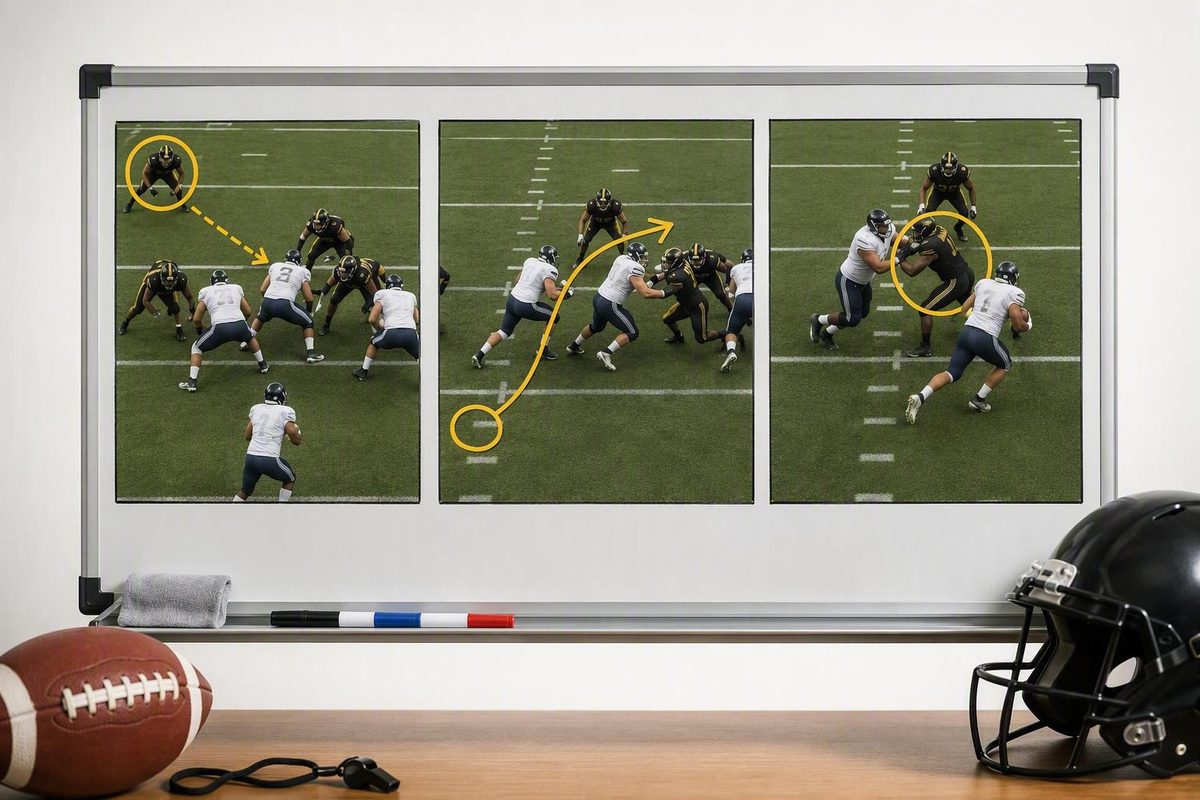
To identify a possible long trap on film, use three replay checkpoints: find the defensive lineman released immediately after the snap, trace the puller’s starting point and travel, then confirm where the puller makes contact as the runner enters behind the block. When those relationships align with the surrounding inside blocks, label the clip “likely long-trap blocking structure.” Film alone cannot prove the offense’s exact call, terminology, adjustment rules, or every assignment.
The quick answer: a three-checkpoint replay test
Run the replay slowly and stop it three times:
- Just after the snap — find the release. Mark the defensive lineman who is initially untouched. Check whether the offensive lineman across from him blocks down, pins inside, angles away, or climbs instead of engaging him.
- Midway through the play — trace the pull. Identify where the puller started, how far he crossed the formation, and how much width or depth he needed to reach the target area.
- At first contact — connect release, puller, and runner. Confirm that the puller contacts the released defender or a different defender presented by post-snap movement, while the runner enters behind the resulting block.
That is the core trap relationship: a defensive lineman is deliberately released by the blocker across from him, then blocked by an offensive lineman arriving from elsewhere. A likely long trap adds a farther cross-formation pull toward a wider target than a conventional interior trap.
Football Film Room describes the longer pull as generally crossing at least three defensive linemen or gaps. Treat that as a confidence-raising heuristic, not a universal threshold. The stronger evidence is the relationship among the release, extended pull, contact, and resulting lane—not a rigid gap count (Football Film Room’s long-trap breakdown).
Watch the offensive line before the backfield. Motion, mesh action, option reads, RPO attachments, and false keys can dress up the play, but they do not define its blocking structure. If you cannot connect the released defender to the approaching puller, do not upgrade the label merely because the formation or backfield action looks familiar.
Checkpoint 1: find the deliberately unblocked defender
Freeze the clip after the first one or two offensive-line steps. Look across the front for a defensive lineman who enters untouched while nearby blockers move with purpose elsewhere.
An intentional trap release normally fits a larger pattern:
- The adjacent lineman blocks down or pins an inside defender.
- Another blocker angles away or climbs to the second level.
- A puller has vacated his original position.
- The puller’s path leads toward the released defender’s area.
- The surrounding blocks preserve an entry lane rather than creating an unexplained free runner at the ball.
A single untouched defender is not enough. It may be a missed assignment, a stunt crossing the blocking pattern, poor camera depth, or a defender defeating contact too quickly to see. The practical question is: Is another blocker already traveling toward that defender’s area?
Record two separate players when the angle permits:
- Apparent pre-snap target: the defender whose alignment seems to define the pull.
- Defender actually contacted: the player the puller meets after the front moves.
Those players may differ. A slant can move the apparent target inside. A scrape or exchange can place a linebacker in the puller’s path. A squeezing defender can cross the expected aiming point. That does not establish a universal “block the first threat” rule; it only means defensive movement may change the final collision visible on film.
Describe the sequence before judging it:
The edge defender was released; the front slanted; the puller contacted the scraping linebacker.
That is better film work than declaring that a defender missed his fit. The release can help identify the offensive structure, but it does not reveal the defense’s call, fit rules, or individual responsibility.
The same discipline applies when the camera loses the initial steps. If the clip begins with the puller already moving, mark the release as hidden, not confirmed. Do not reconstruct an assignment merely because the eventual contact resembles a trap block.
Checkpoint 2: trace the puller’s origin and path
Rewind and isolate the puller. Mark four details:
- Origin: guard, tackle, or another position.
- Distance: the number of gaps or defensive alignments crossed.
- Width and depth: whether the puller stays tight inside or travels toward a wider target.
- Body position: how much the shoulders open to gain ground across the formation.
Long trap generally produces more travel toward a wider target than short trap. A blocker reaching a wide defensive lineman may open his shoulders and take a sweep-like path. A shorter interior trap can stay tighter and arrive sooner. Alignment changes the geometry: the wider the target, the more distance and shoulder opening the pull may require.
Do not make one position or footwork style mandatory. Some coaching examples feature a backside tackle taking a wider path. Other systems use a backside guard pulling tightly behind the center. Traditional Wing-T rules can alter the pull according to the defensive tackle’s technique and still emphasize a tight track near the line.
The practical resolution is straightforward: the puller’s position and exact footwork are system-dependent; the release-and-travel relationship is more dependable. Ask whether the puller crossed far enough to trap a deliberately released, relatively wide defender. A tackle pulling does not prove long trap, and a guard pulling does not rule it out.
A square pull provides another useful cue. USA Football’s instruction describes the blocker stepping away from the line before fitting the trap target. That movement supports the presence of a trap-blocking mechanism, but it does not establish the offense’s playbook term (USA Football’s square-pull instruction).
On the second replay, narrate only what the puller does:
Backside guard leaves from the left, gains depth, crosses the center and right guard, opens toward the edge, then squares to the defender presented in his path.
That description remains useful even if the team calls the concept something unexpected.
Checkpoint 3: confirm the target, block result, and runner path
At first contact, determine whether the puller reaches the initially released defender. If post-snap movement changes the picture, record the different defender contacted without assuming that player was the original assignment.
Then classify the visible block result:
- Kick-out: The defender remains upfield or outside, and the puller displaces him away from the inside lane.
- Log: The defender squeezes or crosses inside, and the puller seals him there so the runner can work around the block.
The defender’s reaction changes the final picture, so an inside seal does not automatically disprove a play that initially appeared designed to kick out.
Next, trace the runner. A confirming path is a bend behind the trap block followed by a vertical entry once the lane declares. Use that as supporting evidence, not as a standalone identifier. Counter, power, and other gap runs can also place the runner behind a kick-out block.
Finally, inspect the interior:
- Are defenders being pinned or down-blocked?
- Do angle blocks prevent penetration into the runner’s entry?
- Does a blocker climb or insert to the second level?
- Does the lane open inside the trapper’s contact?
Some long-trap systems use a playside double-team, but coaching descriptions differ on the participating linemen. Treat the combination as supporting evidence, not a universal requirement. Record the blocks visible on the clip rather than forcing them into a predetermined rule.
Decision table: long trap, short trap, or counter?
Because seven separate fields are useful for diagnosis, the comparison is divided into three compact tables. Read each concept across all three before labeling the clip.
The long-versus-short distinction is primarily geometric: a long trap reaches a wider target from farther away, while a short trap reaches a tighter interior target more quickly. One spread-offense comparison also describes long trap as wider and slower developing than short trap (Coach Kou’s long- and short-trap comparison).
| Concept | Initially released defender | Pull distance | Target width |
|---|---|---|---|
| Likely long trap | Relatively wide defensive lineman or edge threat | Farther cross-formation travel | Wider than a conventional interior trap target |
| Short trap | Tighter interior defensive lineman | Shorter, quicker travel | Interior target |
| Counter | Commonly an end or edge defender | First puller crosses to the edge | Usually an edge kick-out point |
Counter commonly adds a second puller who wraps through the crease for the playside linebacker. Long trap does not inherently contain that second lineman, although another position can handle the linebacker. Utah’s documented version uses a backside guard for the kick-out and an inside tight end as the insert blocker (The Board Drill’s long-trap and counter comparison).
| Concept | Number of line pullers | Second-level blocker |
|---|---|---|
| Likely long trap | Commonly one | May be a climbing lineman, tight end, or another insert blocker |
| Short trap | Commonly one | Other blockers use angles or climb according to the system |
| Counter | Commonly two | Second puller wraps through the crease for the playside linebacker |
General trap instruction describes the runner bending toward the kick-out before accelerating vertically. That path supports the diagnosis but does not separate every trap variation by itself (Throw Deep Publishing’s trap overview).
| Concept | Timing | Runner path |
|---|---|---|
| Likely long trap | Wider and generally slower developing than short trap | Bends behind the trap block, then turns vertical |
| Short trap | Quicker downhill hit | Tighter bend into an interior lane |
| Counter | Misdirection entry with time for the blocking pattern to develop | Follows the kick-out and wrapper through the crease |
The second puller is the best initial separator between long trap and counter, but it is not conclusive. A non-lineman may insert on a linebacker in long trap, and camera framing may hide a wrapper. Record second puller: no only when the relevant backfield and line action are visible; otherwise record hidden.
Do not stretch the tables beyond the available angle. The available evidence does not provide a universal method for separating long trap from power, wham, or sweep in every camera view.
Assign a confidence level, not a definitive label
Use a three-level decision rule in your film notes.
High confidence
- The initially released wider defender is visible.
- The puller’s origin and extended path are visible.
- Puller-to-defender contact is clear.
- Interior pin, down, or angle blocks preserve the lane.
- The runner enters behind the trap block.
Medium confidence
- The pull and contact are visible.
- Pull distance and target width fit long trap.
- The initial release or surrounding interior blocks are obscured.
Low confidence
- Only a pulling lineman is visible.
- Only the edge collision is visible.
- The clip starts late, ends early, or hides the line.
- You cannot establish that the contacted defender was deliberately released.
Common false positives include any pulling tackle, any wide pull, an edge kick-out by itself, a familiar formation, deceptive backfield action, a playside double-team, or an option/RPO attachment. Each can accompany long trap, but none defines it.
Short clips also invite two different questions to collapse into one. A football-strategy discussion of a possible long trap illustrates the boundary: viewers can use visible releases, pulls, and contacts to discuss the likely concept family, but disagreement about defensive fits does not reveal the offense’s terminology or prove who made an error (community film discussion).
Keep three conclusions separate in your report:
- Observed actions: what the blockers and defenders visibly did.
- Likely concept family: the structure those actions most closely resemble.
- Unresolved information: the team’s call, intended target, adjustment rules, and individual responsibility.
A sound conclusion might read:
The backside tackle crossed the formation and kicked the initially released edge defender while the interior line pinned inside and the runner entered behind the block. Likely long-trap blocking structure; exact call and linebacker assignments unresolved.
Use this copyable format on every clip:
Released defender: ; puller/origin: ; path: ; target contacted: ; kick/log: ; second puller: yes/no/hidden; runner entry: ; confidence: high/medium/low.
Frequently asked questions
Can either a guard or tackle be the long-trap puller?
Yes. Football Film Room’s documented example uses a tackle as the long-trap puller, showing why tackle action can be a useful clue without becoming a definition (Football Film Room’s tackle long-trap example).
A documented Utah design instead uses the backside guard to kick out the released end, with a tight end inserting on the linebacker (The Board Drill’s Utah example). Classify the structure by the release, extended travel, contact, and lane—not by the puller’s position alone.
Does the puller have to cross three gaps for it to count as long trap?
No. There is no universal pass-fail threshold. The approximate gap count is a specialist heuristic for distinguishing a longer pull from a conventional quick trap. Target width, pull geometry, contact, surrounding blocks, and runner entry are more dependable than the exact count.
Can defensive movement change which player the puller blocks?
Yes. Slants, squeezes, scrapes, and exchanges can change the player who receives the block. Record the apparent pre-snap target and the defender actually contacted as separate observations.
Do not assume the post-snap defender was always the intended target, and do not turn the changed contact into a universal assignment rule. If the clip cannot reveal the adjustment, mark the intended target as unresolved.
The repeatable film habit is release, pull, contact, lane, confidence. When those relationships align, call the clip likely long-trap blocking structure. When a checkpoint is hidden or contradictory, record what is visible and leave the team’s actual call unresolved.