
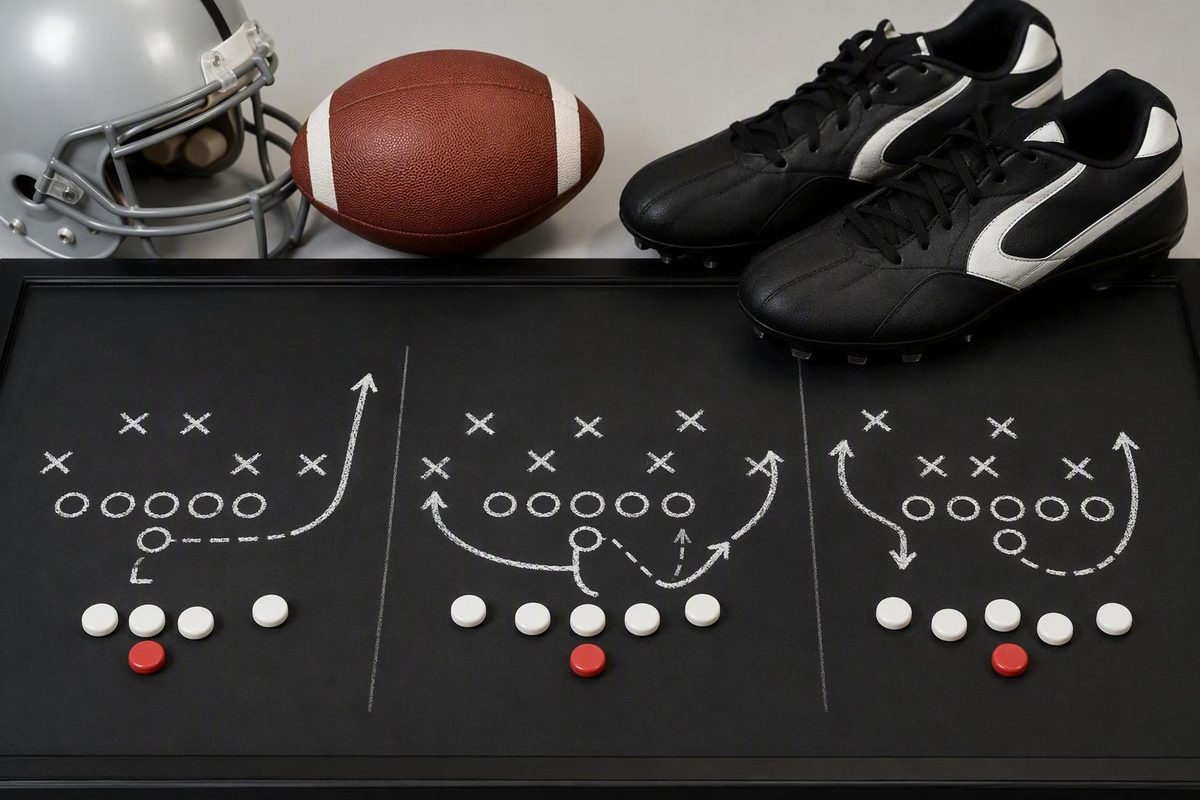
The Wing-T offense makes the most sense when taught as a system of connected actions, not as a folder of unrelated plays. Trap, Buck Sweep, and Waggle matter because they can begin with related quarterback mechanics and backfield movement, then attack the interior, perimeter, or space behind defenders reacting to the run.
That organizing idea has practical consequences. The quarterback’s pivot must be repeatable. The fullback must hit a disciplined landmark. Pulling guards must travel efficient paths. Players without the ball must fake with the same urgency they show when carrying it. The line must understand blocking rules well enough to handle changing fronts without receiving an entirely new diagram every week.
For a youth or high-school coach, the practical starting point is therefore small: a base formation, a complementary series, a counter, and a limited passing answer. That is an editorial recommendation rather than a universal formula. Expansion should follow execution, not precede it.
What the Wing-T Offense Is—and What It Is Not
The Wing-T is a family of run-originated, series-based offensive systems. It is not simply a formation with a wingback, and it does not have one universal playbook.
The Delaware Wing-T is associated with Harold “Tubby” Raymond and the University of Delaware in multiple coaching accounts. Those accounts describe a system in which related plays preserve similar initial movement while threatening different points of attack. Lew Johnston’s explanation of the Delaware system identifies Fullback Trap, Halfback Buck Sweep, and quarterback Waggle as the dominant plays in its 20 series and describes the broader approach as sequence football—plays organized in complementary series rather than calls that must occur in a fixed order (Wing-T Youth Football Coach).
Consider what a linebacker might see immediately after the snap:
- The quarterback reverse-pivots.
- The fullback heads toward an interior landmark.
- Another back starts toward the perimeter.
- Guards step or pull according to the concept.
- The quarterback continues away after the mesh.
On Trap, the fullback receives the ball inside. On Buck Sweep, the fullback’s interior path becomes a fake and another back carries outside. On Waggle, the quarterback preserves the run action before booting away. The opening movement is related even though the eventual point of attack changes.
Recurring Wing-T characteristics include:
- Misdirection and key conflict
- Multiple credible ball carriers
- Down blocks and other angle blocks
- Pulling linemen
- Complementary interior and perimeter runs
- Counters against fast pursuit
- Play-action passes built from established run action
- Rule-based adjustments to defensive fronts
None of those characteristics belongs exclusively to the Wing-T. Other offenses use wings, traps, pullers, counters, bootlegs, and play action. A team does not become a Wing-T team merely because it uses one of those tools.
Traditional Wing-T, single wing, double wing, flexbone, and Gun-T are also not interchangeable labels. They may share blocking techniques or misdirection principles, but their formations, backfield mechanics, option responsibilities, and play families can differ. Shotgun and pistol adaptations can retain Wing-T concepts while changing the timing and footwork of an under-center version.
Terminology creates another complication. “Buck” may identify a series in one system and a particular run in another. Delaware numbering such as the 20 series is recognizable, but it is not universal. Coaches also use different labels for halfbacks, tailbacks, wingbacks, H-backs, and slots. Formation names, line splits, backfield depths, hole numbers, and blocking rules vary.
Every alignment and assignment below is therefore a representative teaching model. It is not a claim that all Wing-T coaches use the same rule.
Base Alignment and the Personnel Each Role Demands
A representative traditional Wing-T alignment includes:
- A quarterback under center
- A standard offensive line
- A tight end creating a strong surface
- A split end away from the tight end
- A wing outside and slightly behind the tight end
- A fullback behind the quarterback
- Another back offset in the backfield
That is a useful starting picture, not a mandatory spacing template. Exact splits and depths should support the team’s exchange timing, pull paths, formation structure, personnel, and applicable competition rules.
| Position | Approximate role | Pre-snap coaching check |
|---|---|---|
| Quarterback | Operates cadence, exchanges, pivots, boots, and play action | Is the formation set as called, is the front recognized, and is the mesh path clear? |
| Fullback | Immediate interior runner, faker, blocker, and occasional receiver | Is the depth consistent, and can the landmark be hit without drifting? |
| Halfback | Sweep or counter runner, faker, blocker, and route participant | Does the stance permit the required first step and mesh? |
| Wingback | Changes the surface; can block, carry, fake, motion, or release | Does the alignment match the call and the applicable formation rules? |
| Tight end | Edge blocker and play-action receiver | Is the surface declared correctly, and is the first inside threat identified? |
| Split end | Stretches coverage, blocks support, and runs complementary routes | Does the alignment match the formation and route responsibility? |
| Guards | Pull, trap, kick, log, wrap, double, or block down | Is the defensive technique identified, and is the pull lane available? |
| Tackles | Down-block, secure gaps, climb, or protect an edge | Who threatens the inside gap, and how does the call alter the base rule? |
| Center | Secures the snap and coordinates interior work | Is there a nose, shade, or gap threat affecting the play? |
Coaches should check every formation, shift, motion, receiver alignment, and eligibility detail against the current rulebook governing their competition. Terminology used in a playbook does not determine whether a formation is permitted.
The wing and the surface
The wing is more than an extra back standing near the tight end. The alignment changes the offensive surface and can alter how the defense distributes support. The wing may block a linebacker or safety, insert into the run fit, carry on a sweep or counter, fake perimeter action, motion, or release into the flat.
A credible wing gives the defense another potential ball carrier or receiver to account for without requiring the offense to abandon its base structure.
The quarterback
A Wing-T quarterback does not have to win solely through arm strength. The role commonly demands:
- Reliable quarterback-center exchanges
- Precise reverse-pivot and boot footwork
- Fast, secure handoffs
- Consistent ball presentation
- Convincing fakes
- Front recognition and check responsibility
- Sound decisions on run-pass concepts
- Enough accuracy and movement ability to support play action
A detailed coaching overview similarly describes the quarterback as needing sound footwork and enough athletic and passing ability to execute Waggle, rather than requiring an elite dropback passer. It also recommends multiple credible runners in addition to the quarterback (Throw Deep Publishing).
The quarterback is central to the deception, but the deception must remain mechanically sound. A dramatic fake that disrupts the exchange or delays the boot is counterproductive.
The fullback
The fullback supplies an immediate interior threat. The player must accelerate toward a tight landmark, protect the mesh, respond to the trap block without stopping, and cut decisively.
Many coaches prioritize decisiveness at this position because a quick trap depends on the runner reaching the block on time. If the fullback bows the path to inspect the hole, a quick interior concept becomes slower and easier for pursuit to reach.
Multiple credible runners
Several credible ball carriers strengthen the series. The defense cannot safely treat the fullback’s path as empty movement if Trap is established, ignore the sweep runner if that player receives the perimeter handoff, or disregard the quarterback if Waggle includes a keep threat.
“Credible” does not require equal carry distribution. It means each player can execute the assigned concept well enough that the defense must respect the possibility.
The offensive line
Common line requirements include:
- Guards who can pull without gaining unnecessary depth
- Tackles and tight ends who can block down with leverage
- Interior linemen who communicate against noses, shades, and gap threats
- Players who can apply rules instead of memorizing isolated diagrams
- Enough strength and balance to resist penetration
- Enough quickness to reach the intended point of attack
Angles can help a smaller or quicker line, but they do not make size, strength, technique, or matchups irrelevant. A poor first step still loses leverage. A puller who cannot handle the edge defender still leaves the runner exposed. Scheme creates opportunities; players must complete the blocks.
The Core Series: Trap, Buck Sweep, and Waggle
To understand the Wing-T offense, place the core calls side by side from the same representative formation. Assume the tight end and wing are aligned right, another back is offset left, and the quarterback is under center. The directions and labels can be mirrored.
The shared picture
Across the calls, the offense tries to preserve several visual cues:
- A common stance and cadence
- Similar first-step urgency
- A quarterback reverse pivot
- An interior fullback path
- Sweep action by another back
- Quarterback continuation away from the apparent run
- Consistent ball carriage by runners and fakers
The plays separate only after the defense has begun processing that shared picture.
| Player | Fullback Trap | Buck Sweep | Waggle |
|---|---|---|---|
| Quarterback | Reverse-pivots, gives inside, fakes sweep, and boots away | Reverse-pivots, shows interior action, hands outside, and continues the boot fake | Shows Buck-like action, keeps, and boots away as a run-pass threat |
| Fullback | Takes the quick interior handoff | Fakes the interior run | Carries out interior action before protection or route duty |
| Halfback | Fakes sweep | Takes the perimeter handoff | Sells sweep action, then performs the assigned protection or route |
| Wing | Blocks the second level or support by rule | Helps secure the edge or second level | Blocks, releases, or crosses according to the pass design |
| Guards | Backside guard traps while the remaining linemen secure interior rules | Commonly pull to handle the edge and outside support | Sell run action, then protect the boot according to the scheme |
Fullback Trap: attack inside now
In Lew Johnston’s documented Trap system, the quarterback reverse-pivots, hands to the fullback, fakes to the halfback, and boots away. The halfback fakes Buck Sweep. The backside guard pulls tightly and traps the first appropriate defender past the center, while the fullback attacks near the center and cuts behind the trap block.
A representative fullback landmark is near the center’s backside foot or heel. The purpose is to keep the run direct and bring the runner to the trap block. Exact steps and aiming points remain system- and front-dependent.
A typical teaching sequence is:
- The quarterback clears the midline with the reverse pivot.
- The fullback takes a direct first step and secures the handoff.
- The halfback accelerates on a believable sweep fake.
- The backside guard pulls flat and tight.
- The guard traps the designated defender beyond the center.
- The fullback presses the landmark and cuts behind the trap block.
- The quarterback completes the sweep fake and boot continuation.
The play loses much of its quick-hitting character if the fullback drifts laterally, the guard loops deep, or the quarterback delivers the ball late.
Buck Sweep: show inside, attack outside
Buck Sweep preserves the fullback’s interior action but gives the ball to the perimeter runner. A common version combines front-side down blocks with a pair of pulling guards: one handles the edge through a kick-out, log, or seal rule, while the other leads or wraps toward the next support defender. This two-puller structure appears in documented Wing-T Buck and Buck Sweep examples, although assignments change with the formation and defensive technique (Youth Football Online).
The ball carrier must stay connected to those blocks.
The fullback’s interior path must remain believable. If interior defenders move laterally with Sweep, Trap may attack their movement. If edge defenders widen immediately, the offense may gain a better interior picture. These are possible conflicts, not guaranteed reactions.
Specific edge assignments change by formation and front. A tight end may block down, release, or combine with the wing. The wing may secure a linebacker, safety, or difficult edge player. The durable principle is coordinated interior angle blocks with pullers constructing the perimeter lane.
Waggle: preserve the run, boot away
Waggle is the play-action answer. The quarterback presents Buck-like action before booting away from the apparent sweep. Depending on the design, the concept may include:
- A quarterback run threat
- A receiver in the flat
The route structure varies, but the intended conflict is recognizable. A defender who pursues the sweep may leave boot responsibility. A linebacker who steps downhill on the fullback action may create space behind the run fit. A flat defender may have to account for both the quarterback and a receiver.
Waggle is not automatically open. The quarterback still needs protection rules, route spacing, a progression, and a safe response when the defense remains disciplined.
The conflict created by the series
The calls complement one another by attacking different reactions:
- Interior defenders run with Sweep: Trap may attack the space or leverage created by their lateral movement.
- Edge and second-level defenders collapse inside: Buck Sweep may challenge their outside leverage.
- Defenders overcommit to the run action: Waggle may attack space away from the flow.
- Defenders remain disciplined against the boot: The offense can return to its runs, counter the pursuit, or use another pass answer.
No play guarantees the desired reaction. Coaches must observe the front, pursuit, force technique, linebacker keys, and backside discipline.
Most importantly, deception depends on execution. Matching get-off, pad level, mesh timing, ball carriage, fakes, and quarterback footwork matters more than the traditional names. If the fullback slows down only when faking or the quarterback changes pivot speed on Waggle, the offense gives the defense useful information.
Blocking Language and Answers to Common Defensive Fronts
Players need a shared vocabulary before they can apply front-based rules.
| Term | Plain-language meaning |
|---|---|
| Down block | Block a defender aligned inside, usually with an angle step that protects the inside gap. |
| Pull | Leave the initial line position and travel to a new assignment. |
| Trap | Initially leave a defender unblocked, then block that defender with a puller from elsewhere. |
| Kick-out | Strike with leverage intended to widen the defender and create an inside lane. |
| Log or seal | Get around or pin the defender inside when that defender squeezes too hard to be kicked out cleanly. |
| Wrap | Pull around the initial blocks and turn up into the lane for a linebacker or support defender. |
| Double team | Two blockers combine on one down defender, sometimes with one later climbing to the second level. |
| Gap-down-backer | Check the inside gap, then a defender aligned down inside, then a linebacker if neither immediate threat appears. |
These terms describe intentions, not universal techniques. Coaches must still define aiming points, footwork, hand placement, eye discipline, and responses to movement.
Why rule-based blocking matters
A rule system gives each blocker an order of operations. Instead of memorizing a different drawing for every defense, a player can ask:
- Is there an immediate gap threat?
- Is there a defender in the down-block area?
- Is there a linebacker in the progression?
- Has the call or tag changed the normal rule?
This can reduce diagram overload, but it does not eliminate front recognition. Players must identify defensive alignment, communicate combinations, and know when a base call is a poor fit.
A system-specific Trap example
In Johnston’s version of Fullback Trap, the backside guard pulls to trap the first defender past the center. The fullback attacks near the center while the quarterback reverse-pivots, delivers the ball, fakes Buck Sweep, and boots. His package also uses Influence, Gut, On or Wedge, and Down as front-specific alternatives rather than requiring one base rule to solve every structure (Wing-T Youth Football Coach).
Several details support the quick interior run:
- Tight pull path: The guard cannot loop unnecessarily into the backfield.
- Useful line alignment: The guard needs a workable path that complies with the applicable rules.
- Center-guard coordination: A nose, shade, or gap threat can disrupt the snap and the pull lane.
- Decisive fullback landmark: The runner must bring the play to the trap rather than searching sideways for daylight.
A bounded front-response matrix
The following is a planning guide based on that documented family of calls, not an automatic answer sheet.
| Defensive picture or behavior | Possible response | Coaching purpose | Caution |
|---|---|---|---|
| Suitable even front | Base Trap | Create a defined trap target and hit inside quickly | Confirm interior-gap security |
| Suitable odd front | Base Trap or an odd-front adjustment | Preserve the interior hit through center-guard coordination | Nose movement may alter the pull lane |
| Linebacker reading the play-side guard | Influence | False-pull the guard to affect the reader | The remaining blockers must account for the changed reaction |
| Tackle aligned inside the guard | Influence variation | Manipulate the inside defender or key | Practice the resulting gap picture before using the tag |
| Desired wrap to a linebacker | Gut | Leave a selected defender and wrap the backside guard inside | Center leverage and timing are critical |
| Odd 50 structure | On or Wedge | Block covered defenders and let the fullback press the crease | This changes the nature of the base trap |
| Congested center-and-guards structure | Down or another checked concept | Avoid forcing the base Trap into a poor interior picture | Recheck the surface and edge count |
| Threats in both A gaps | Check away from this base Trap version | Protect the exchange and pull path | Use a practiced alternative |
| Favorable 3-technique | Check Trap toward it in the cited system | Give the puller a defined target | The remaining interior rules still must be sound |
Johnston specifically recommends checking Trap toward a 3-technique and identifies defenders in both A gaps as a reason not to force his base version. Another Wing-T family may define the target or check differently.
Buck Sweep rules must also adapt
“Kick the end and lead through” is not a complete Buck Sweep rule. The edge defender may align wide or tight, squeeze, box, spill, or wrong-arm the puller. The wing may be responsible for a linebacker, defensive back, or combination block. Defensive movement may also change the pull lane.
The offense needs practiced rules for:
- A squeezing edge defender
- A wide force player
- A walked-up linebacker
- A defender threatening the wing’s inside gap
- A stunt across a down block
- Pressure entering the pull lane
Sometimes the first puller kicks out. Sometimes that player logs or seals. The runner’s read must match the blocker’s technique.
Diagnosing penetration
When Trap or Sweep is hit in the backfield, resist the urge to install another formation. Check the earliest possible failure:
- Alignment: Was every player positioned consistently for the call?
- Line position: Did the puller have a clear path?
- First steps: Did blockers protect their inside gaps?
- Pull path: Was it tight, direct, and urgent?
- Center-guard work: Was the nose or shade secured?
- Exchange speed: Did the quarterback and runner meet at the intended point?
- Running landmark: Did the runner bring the play to the block?
- Call versus front: Was the chosen variation suitable?
- Communication: Was a defensive stem identified?
- Finish: Did the blocker arrive correctly but lose leverage?
The correction may be technical, schematic, or both. No adjustment is an automatic answer against every defense.
Building a Complete but Manageable Play Menu
A manageable starting package can be built around:
- A base formation
- An interior run
- A perimeter run
- A complementary boot or play-action pass
- A counter
- A simple quick-pass answer
That is a recommended framework, not a validated minimum. Trap, Buck Sweep, and Waggle can fill the first three conceptual needs. A counter punishes over-pursuit.
What to add—and why
Belly or Down: This family provides another interior or off-tackle entry point with different blocking geometry. Depending on the system, the fullback may run behind a pulling guard, cross-block, or isolation structure. Its value is not merely another play name; it changes how the point of attack is constructed.
Counter: A counter attacks defenders who fast-flow toward established action. It should borrow familiar motion or backfield steps long enough to influence pursuit, then return toward the space being vacated. It is useful only if the base action is credible and the additional exchange or pull can be executed securely.
Power: It can provide a more direct path than Sweep or a different edge answer.
Buck Pass or Waggle: These calls convert familiar run action into play action. Their value depends on whether the protection and routes attack the defenders being influenced.
Counter Pass:
Quick game: Hitch, slant, flat, arrow, or another compact concept can attack available leverage or provide an immediate outlet. The concept should match the quarterback’s ability and the protection the team can practice.
Complementary passing is not a complete passing system
Waggle may support the running game without solving obvious passing situations. A team still needs explicit plans for:
- Known passing downs
- Pressure identification
- Quick answers against loaded fronts
- Sideline access
- End-of-half or comeback situations
- Clock procedures
- Routes that can reach the necessary line
- A safe outlet when deeper routes are covered
A coach does not need a massive dropback menu, but these situations cannot be left to improvisation. If the team expects to throw under pressure, it must practice protection and timing under pressure.
Expand only after the core stays recognizable
Formation changes, motion, tags, Jet or Rocket concepts, and situational calls can improve the package. They can also dilute repetitions.
Add a variation when it:
- Creates a needed surface or numbers advantage
- Forces the defense to declare an adjustment
- Answers a recurring problem
- Places a strong player in a useful role
- Improves passing access without breaking core timing
Do not add it merely because it looks different on the whiteboard.
A terminology sheet should accompany the playbook. “Delaware 20 series,” “Buck series,” “Trap,” and “Waggle” may describe related ideas, but numbering is not universal.
| Team call | Generic function |
|---|---|
| 20 Trap | Quick fullback interior run with a trap block |
| 20 Sweep | Perimeter run off related fullback action |
| 20 Waggle | Bootleg play action away from sweep action |
| Counter | Change of direction against fast flow |
| Quick pass | Immediate access or pressure answer |
This translation helps players learn concepts rather than mistake vocabulary for football knowledge.
Traditional, Double-Tight, Unbalanced, and Shotgun Variations
The Wing-T can change its presentation while preserving series logic. The important question is not whether every player stands in a classic location. It is whether the offense still connects its runs, counters, and passes through repeatable action and coherent rules.
| Variation | What changes visually | What can remain consistent |
|---|---|---|
| Classic wing | A tight end and wing create a strong surface; a split end aligns away | Trap-Sweep-Waggle relationship, angle blocks, pulls, and fakes |
| Wing-Slot | Receiver distribution creates a more open-side or slot picture | Interior-perimeter complements and play-action structure |
| Double-tight | Both edges have tight-end surfaces; a wing or H-back declares strength | Core blocking rules, backfield action, and series calls |
| Unbalanced | Personnel shift to create a heavier surface | Core plays and pull concepts, subject to revised formation checks |
| Shotgun or pistol | The quarterback leaves the under-center position and backs may be offset | Trap, Sweep, Counter, Belly, motion, and play-action ideas |
Classic and Wing-Slot
The classic look creates an obvious wing surface and a split receiver away. A Wing-Slot variation redistributes an eligible receiver, which can change spacing, passing access, and how the defense declares strength. The series can remain intact, but perimeter blocking and route responsibilities may change.
Double-tight and Rip/Leo
A double-tight structure can create sturdy surfaces on both sides while using the wing or H-back to declare the active side. In one documented system, “Rip” places the H-back to the right and the opposite back to the left; “Leo” reverses those locations. The same clinic runs Buck toward the H-back and Trap away from that player, illustrating how a system can change strength without rewriting every assignment (Youth Football Online clinic).
The names themselves are not important. The teaching value comes from identifying what moves, what remains fixed, and which rules follow the declared strength.
Unbalanced
An unbalanced formation can add strength to one surface and force the defense to relocate support. It also requires a careful pre-snap audit.
Coaches should confirm:
- Each player’s location in the formation
- Which receivers are eligible under the applicable rules
- How the defense has set its strength
- Whether the backside has become vulnerable
- How any shift or motion affects the formation
The payoff may be a stronger surface or a clearer defensive declaration. The cost is additional formation teaching and the possibility that the defense recognizes the intent immediately. All eligibility, shift, motion, and formation decisions should be checked against the current rules for the team’s governing body.
Shotgun and pistol
Shotgun and spread versions can retain Trap, Sweep, Counter, Belly, motion, and play-action concepts. Moving the quarterback away from center nevertheless changes the mechanics:
- Snap and exchange timing changes.
- Backs may begin at different depths.
- Interior landmarks may move.
- The traditional reverse pivot may disappear or be replaced.
- Mesh points change.
- Pull timing must be coordinated with the snap.
- Protection responsibilities may change.
- The quarterback may gain different access to quick throws or reads.
These changes may be worthwhile, but they are not mechanically neutral. A quick-hitting under-center Trap should not simply be copied into shotgun with the assumption that its timing remains identical.
Jet, Rocket, RPO, and spread elements are optional adaptations. They are not requirements for a “true” Wing-T. Conversely, an offense using a trap, a puller, a wing, or a bootleg is not necessarily a Wing-T. Classification should follow the system’s organizing logic rather than an isolated feature.
A Practice-First Installation Progression
Before choosing Buck-first or Belly-first, conduct a personnel and time audit.
Ask:
- What are the players’ ages and experience levels?
- Can the quarterback execute the chosen exchanges and pivots?
- Which guards can pull on an efficient path?
- Does the roster have multiple credible runners?
- Can the tight ends and wings execute the required edge rules?
- How many players work on offense, defense, and special teams?
- How many coaches can teach separate position groups?
- How much offensive practice time is actually available?
- What contact and acclimatization restrictions apply?
- How much passing and situational work can be protected each week?
The answers should determine the installation pace more than the desired size of the playbook.
Buck-first or Belly-first?
Both are documented coaching approaches.
Buck-first introduces the signature Trap-Sweep-Waggle relationship early. It also front-loads quarterback footwork, multiple meshes, pulling guards, and coordinated fakes. At Triton High School, David Weathersby’s installation begins with the Buck or 20 series, limited formations, and a finite opening menu because that program considers Buck its most demanding series to install (Throw Deep Publishing).
Belly-first can narrow the initial teaching for younger players. In one experience-based youth installation plan, the coach recommends beginning younger teams with a single formation concept and the Belly series while warning that younger players may need substantially more teaching time than older youth players (Wing-T Youth Football Coach).
Neither sequence is established as universally superior. Choose the first series that the available staff can teach and the roster can repeat.
A conservative teaching sequence
-
Terminology and alignment Teach formation strength, position labels, receiver responsibilities, and the language of each rule.
-
Cadence and stance Require a unified start without visual tells.
-
Position-specific first steps Work down-block steps, pull openings, fullback tracks, sweep starts, wing releases, and quarterback pivots separately.
-
Quarterback-center exchange Stabilize the snap before adding complex backfield action.
-
Backfield mesh and fakes Rehearse Trap, Sweep, and boot paths on air. Coach the ball carrier and every faker.
-
Pull paths on air or shields Mark the puller’s path and destination before introducing congested traffic.
-
Static-front walkthrough Align a known front and require every player to identify the rule before moving.
-
Controlled team work Add movement and contact progressively under the team’s applicable policies and rules.
-
Multiple-front recognition Stem between bounded looks, move the edge, cover interior linemen, or threaten gaps.
-
Game-tempo execution Test whether the mechanics survive speed, motion, noise, and defensive movement.
An example practice architecture
Durations should reflect the program’s schedule, age group, staffing, and governing rules. The periods can be organized as follows:
| Period | Primary objective |
|---|---|
| Individual | Stance, first step, ball security, pivot, down block, and pull start |
| Group | Backfield mesh, line combinations, and receiver or wing assignments |
| Walkthrough | Formation, assignment, landmarks, and front identification |
| Controlled contact | Fit blocks, shields, or another permitted progression |
| Team | Run the series against changing but bounded defensive looks |
| Correction | Fix the earliest failed step and immediately re-run the concept |
Rehearse backs, receivers and linemen separately before a team walkthrough. Keep backfield mesh work and line fundamentals distinct until each group understands its assignment.
These are program-specific illustrations, not universal schedules. Their available time, staffing, roster structure, age group, equipment status, and contact rules should not be assumed elsewhere.
One formation, one series, then expansion
For a new team, a sound editorial starting point is one formation and one complementary series before multiplying motions and tags. The useful checkpoint is not “How many plays do we know?” but “Can our shared action survive a moving front?”
A call is approaching game readiness when players consistently demonstrate:
- Correct formation
- Correct assignment after a defensive stem
- Unified cadence
- Secure quarterback-center and backfield exchanges
- Ball security through traffic
- Tight, correctly timed pull paths
- Disciplined running landmarks
- Convincing fakes
- Defined protection responsibilities
- Recovery after a late front change
- Execution at game tempo against varied practiced looks
There is no universal completion percentage or repetition threshold. Expansion should occur only when coaches can identify errors precisely and players can correct them without rebuilding the play.
Football training carries injury risk, and written instruction does not replace qualified in-person coaching or athletic-training oversight (Down the Tunnel). Contact, equipment, drill progression, and practice structure should be set by qualified personnel using the current rules and policies applicable to the program.
Strengths, Limitations, Scheme Fit, and Common Failure Points
The Wing-T offers potential advantages, not guarantees.
Connected plays can force defenders to account for the interior, perimeter, counter, and boot from similar looks. Multiple ball carriers can distribute defensive attention. Down blocks and pullers can create useful angles. Play action can attack space affected by aggressive run reactions.
Multiple formations can also force defensive communication while preserving core plays. But every formation adds alignment checks, motion timing, eligibility review, and defensive-adjustment practice. Variation is valuable only while players still recognize the underlying series.
The execution cost
The offense asks players to coordinate:
- Reverse pivots
- Exchanges
- Ball fakes
- Pull paths
- Running landmarks
- Down-block leverage
- Front recognition
- Edge adjustments
- Play-action protection
- Route timing
That is a substantial practice demand. The ball may emerge quickly after the snap, but producing that picture requires synchronized work.
Coaches should practice the handoff pocket, runner clamp, quarterback placement, and exit path. Fakes must not interfere with possession, and ball-security corrections should take priority over added deception.
Common ways the offense breaks down
Immediate penetration: A nose, shade, slant, or gap pressure disrupts the exchange before the pull develops.
Poor down-block leverage: The blocker steps too flat, opens the inside gap, or allows the defender to cross face.
Slow or wide pull paths: The guard arrives after the runner or collides with backfield action.
Weak fakes: Defenders can distinguish the runner from the decoy too early.
Inconsistent timing: The quarterback, fullback, and sweep runner reach the mesh at different moments from rep to rep.
Drifting landmarks: The runner widens toward perceived space and separates from the intended block.
Unclear front rules: Players know a diagram but cannot apply it after the defense stems.
Unpracticed protection: Waggle looks convincing, but the quarterback has no time or no defined pressure answer.
The passing tradeoff
Play action can complement the running game. It is not a substitute for practicing obvious passing situations.
A team that devotes little time to protection, quick game, dropback concepts, receiver releases, sideline routes, and clock procedures may struggle when score and time reduce the run threat. That does not mean the Wing-T inherently forbids passing. It means the offensive plan must allocate practice time honestly.
Scheme-fit checklist
The roster is a plausible fit when it has:
- Multiple credible runners
- A quarterback with precise footwork and secure ball handling
- Guards capable of pulling efficiently
- Tackles, tight ends, and wings who can execute edge and down-block rules
- A fullback willing to hit tight interior landmarks
- Receivers willing to block as well as run routes
- Enough practice continuity to synchronize the series
- Staff capacity to teach front recognition and complementary passing
A missing trait does not automatically disqualify the offense. It identifies an area that will consume coaching time or require adaptation.
Evaluate the offense by game situation
| Situation | Potential value | Question the plan must answer |
|---|---|---|
| Early downs | Several points of attack from similar looks | Can the offense avoid penetration and negative plays? |
| Short yardage | Direct interior runs and off-tackle variations | What is the answer when the interior is congested? |
| Red zone | Condensed space may strengthen run-action conflict | How do routes and formations adjust when vertical space disappears? |
| Long-yardage downs | Play action may carry less influence | What protection and route concept reaches the required line? |
| Possession-closing offense | The run menu may support clock use | Can the offense handle loaded fronts without becoming predictable? |
| Hurry-up offense | Familiar quick game may provide access | Has the team practiced tempo, signals, sideline throws, and clock procedure? |
Results depend on personnel, coaching, execution, opponent quality, and game context. Anecdotal championships do not prove that a scheme caused success, just as an individual loss does not establish a hard ceiling for the offense.
Troubleshooting priorities
When the system stalls:
- Shrink the menu.
- Restore the shared action of the core series.
- Find the earliest failed step.
- Correct alignment and assignment before changing scheme.
- Repair exchange and ball security before emphasizing fakes.
- Tighten pull paths and running landmarks.
- Recheck whether the call fits the front.
- Rehearse the passing answer required by the game situation.
- Avoid adding formations to conceal unresolved technique.
The Wing-T’s central idea is disciplined repetition, not novelty. Begin with a limited formation menu and a complementary series. Measure alignment, assignment, cadence, exchange, pull path, landmark, fake, protection, and ball security. Add complexity only after those elements survive game-speed work against the fronts the team expects to encounter.
Frequently Asked Questions
What are the three core plays in the traditional Wing-T Buck series?
Fullback Trap, Buck Sweep, and Waggle are the traditional inside-outside-play-action trio in the Delaware 20 or Buck series. Trap attacks the interior, Buck Sweep attacks the perimeter, and Waggle boots away from related run action. Some systems add counters or other passes to the broader series.
Should a new team install the Buck series or the Belly series first?
Either can work. Buck-first establishes the Trap-Sweep-Waggle relationship but carries substantial footwork, mesh, and pulling-guard teaching. Belly-first may provide a narrower starting point for younger or less experienced players.
Choose according to age, practice time, quarterback readiness, guard mobility, staff capacity, and the series the team intends to feature. Whichever comes first, keep the initial formation and call menu limited.
Does a Wing-T quarterback need to be an elite passer?
No, but the position cannot be treated as a non-passing role. The quarterback needs precise exchange and pivot mechanics, convincing fakes, boot footwork, sound decisions, and enough accuracy to make play action and quick answers credible.
If the offense expects to function in long-yardage or hurry-up situations, the quarterback and protection unit also need dedicated passing practice.
Can the Wing-T offense be run from shotgun?
Yes. Shotgun and pistol versions can retain Trap, Sweep, Counter, Belly, motion, and play-action concepts. They are adaptations rather than exact mechanical copies of the traditional under-center offense.
The shotgun alignment changes snap and exchange timing, backfield depth, mesh locations, interior landmarks, quarterback footwork, pull timing, and protection responsibilities. Coaches should rebuild those details deliberately instead of assuming every assignment remains unchanged.
What are the main weaknesses or risks of the Wing-T?
The principal risks are execution and preparation costs. Frequent exchanges create ball-security exposure; mistimed pulls and poor down blocks allow penetration; weak fakes reduce deception; and inconsistent quarterback-back timing can disrupt an entire series.
A run-heavy team may also be underprepared for obvious passing or hurry-up situations if it neglects protection, quick game, dropback answers, and clock procedures. Excessive formations can consume the repetitions needed to master the base package.
The system’s fit ultimately depends on personnel, practice capacity, passing preparation, and qualified in-person supervision—not on a claim that one offense guarantees results.