
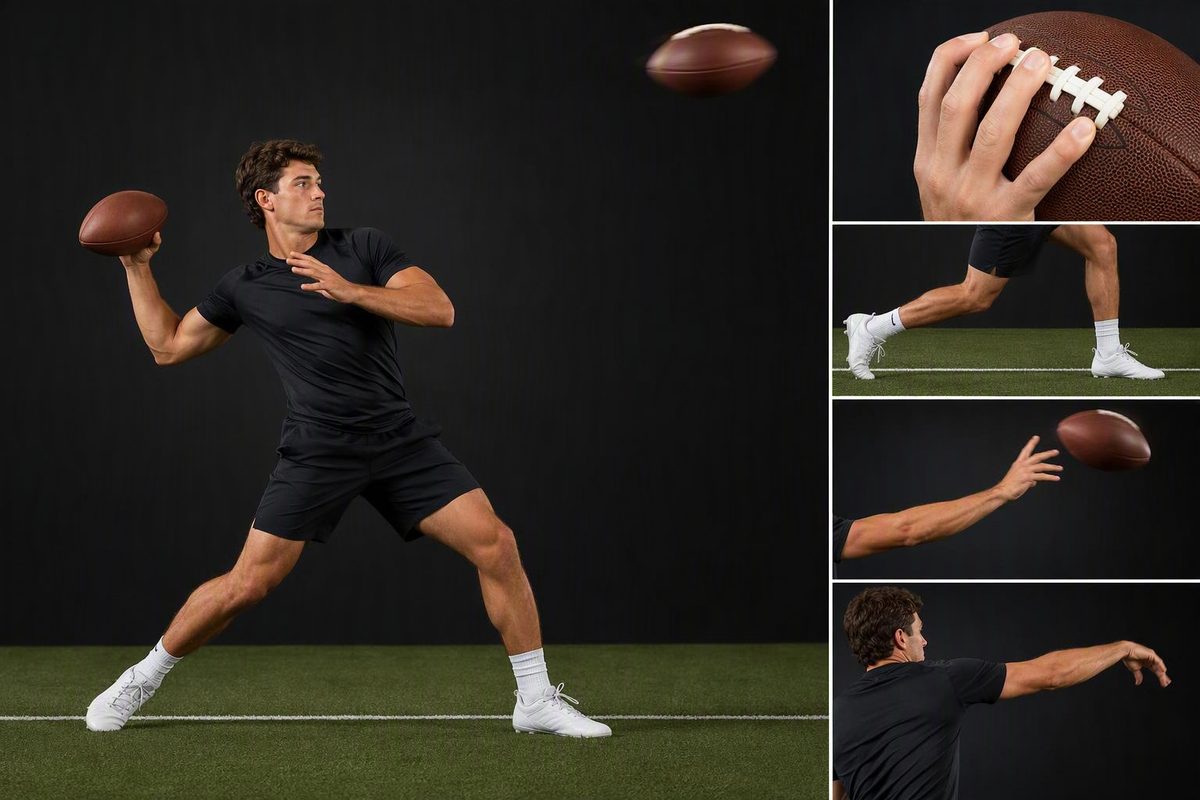
To throw a spiral football, grip the ball mainly with your finger pads, step toward the target with your opposite foot, and let the ball roll off your fingertips as your wrist turns down through the release. Keep the throwing arm moving after the ball leaves your hand.
For a young quarterback, start with short, controlled passes—not maximum-distance throws. Grade two things separately: does the ball spin cleanly, and does it reach the intended target? A tight spiral that misses the receiver is still a missed pass.
Teach the throw in four pieces
These directions describe a right-handed quarterback. Reverse left and right for a left-handed player.
1. Find a grip you can repeat
Hold the back third of the football, with the thumb underneath and the fingers spread across the upper surface. Try the ring and little fingers on the laces as a starting point; adjust for comfort and control rather than forcing everyone onto the same lace numbers. NFL FLAG’s throwing guide treats the number of fingers on the laces as an individual preference.
Keep pressure mainly in the finger pads rather than clamping the ball deep into the palm. Spread the index finger slightly farther from the other fingers, toward the rear point. Coach Jerry Campbell’s grip guidance through Glazier Clinics allows slight palm contact and emphasizes fingertip control.
Cue: “Secure, not squeezed.”
Checkpoint: The quarterback can reset the grip between throws without shifting it during the delivery. If the player cannot control the ball comfortably, check the ball size before adding more mechanical instructions. For more detail, use the throwing-grip guide.
2. Give the throw a balanced base
Start with feet about shoulder-width apart, knees soft and the left shoulder generally toward the target. Hold the ball near the chest with both hands before beginning the delivery.
Take a comfortable left-foot step toward the receiver while turning the body into the throw. NFL FLAG teaches stepping with the foot opposite the throwing arm and continuing through the delivery in its beginner passing progression.
Cue: “Step to your target.”
Checkpoint: The quarterback finishes balanced rather than falling backward or sideways. Shorten an oversized step before asking for more power.
3. Deliver without a big windup
Bring the ball back and up into a comfortable throwing position, then move it forward in one continuous motion. Do not drop it to the waist before throwing. Campbell’s throwing-motion guidance identifies that low windup as an unnecessary delay while allowing a slight dip as the ball comes back.
Cue: “Back, then through—not down and around.”
Checkpoint: From a side view, the ball does not swing down to waist level during the delivery. Do not force every quarterback into an identical arm angle.
4. Finish through the fingertips
As the arm comes forward, let the wrist turn down and the ball roll off the fingers. Use the index finger as the final-contact cue. Keep the arm moving through a relaxed finish rather than stopping at release. These release cues are supported by Campbell’s grip instruction and NFL FLAG’s spiral guidance.
Cue: “Off the fingers; finish through.”
Checkpoint: Watch the ball immediately after release. It should spin around its long axis without the nose making a wide circle. Do not turn the wrist cue into a forced twist.
An eight-minute spiral progression
Use this suggested no-contact block after the normal team warm-up. Pair players with one football per pair, leave clear throwing lanes, and stop for shoulder or elbow pain. A player with pain should be assessed by a qualified healthcare professional rather than coached through it.
| Block | Setup and action | Checkpoint |
|---|---|---|
| 2 minutes: grip and release | Partners 5–7 yards apart. Each player makes six easy standing throws with a small step. Reset the grip each rep. | Finger-pad control and a continuous finish. |
| 3 minutes: full delivery | Move to 8–10 yards. Each player makes six throws, using the opposite-foot step and targeting the partner’s chest. | Balanced finish, clean spin and target location. |
| 3 minutes: reset and repeat | Stay at that distance. Between throws, relax, rebuild the grip and return the ball to the chest-level ready position. Set the feet before each of six throws. | Can the player reproduce the throw without searching for the grip? |
That is 18 throws per player, not a race or a required workload. Stay closer if the player must strain to reach the partner, and reduce repetitions if fatigue disrupts the delivery.
Correct the visible miss
- The ball wobbles: Check grip security and fingertip release first. Move closer and change only one cue for the next three throws.
- The spiral is clean but misses sideways: Check the step direction and balance before changing the grip.
- The player falls backward or heaves the ball: Reduce distance and effort; rebuild a comfortable step-through delivery.
- The motion stalls at release: Rehearse a relaxed follow-through, then return to an easy pass.
Film three throws from the side and three from behind the quarterback, outside the throwing lane. Chart clean spin and target accuracy separately. Once both are repeatable at short range, move into the football passing-drill progression rather than spending the whole period chasing a prettier spiral.