
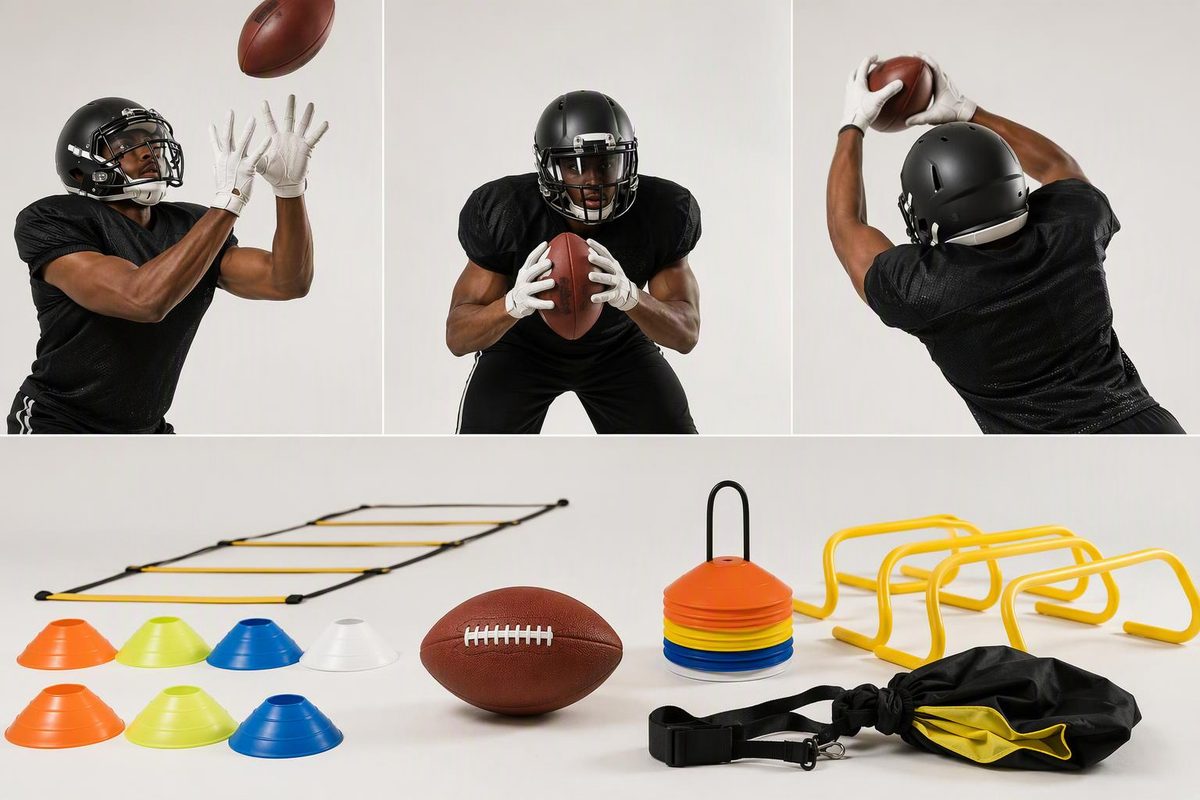
To catch a football, track it into your hands, match your hand position to its flight, receive it with relaxed fingers and slightly bent elbows, then secure it against your body before turning upfield. For receivers, tight ends and backs, coach the sequence as “track, catch, tuck.”
Start with predictable throws. Add movement only when the player can finish the catch without looking away or trapping every ball against the chest.
Coach the catch in four parts
1. Find the ball and track it through reception
On a stationary catch, face the passer with balanced feet and slightly bent knees. On a route, locate the ball without unnecessarily stopping or turning your whole body toward the quarterback.
Keep your eyes on the ball until it is secured. Coach Bill Hewitt’s USA Football receiving guidance emphasizes maintaining concentration from the moment the receiver picks up the flight through the finish.
Cue: “See it into your hands.” Checkpoint: The receiver does not turn toward the running lane while the ball is still arriving.
2. Match your hands to the throw
For a ball arriving above the waist while you face the passer, present your hands with thumbs and index fingers forming a loose diamond-shaped window. Spread the remaining fingers; do not lock the hands into a rigid shape.
For a low ball, turn the palms up and bring the pinkies toward each other, forming a receiving basket. Adjust your feet and bend your knees to meet the ball rather than reaching down with stiff legs. NFL FLAG teaches these high- and low-ball hand positions in its youth catching progression.
Cue: “Thumbs for high; pinkies for low.” Checkpoint: Both hands are presented to the ball’s path, rather than one hand reaching while the other trails.
These are starting positions, not a rule for every angle. A ball dropping over your shoulder requires a different receiving position from a chest-high pass coming straight at you.
3. Receive, rather than slap, the ball
Reach to meet the pass with slightly bent elbows. Let your fingers receive and grip the ball, then allow your arms to give as you bring it inward. “Soft hands” means relaxed reception followed by a firm grip—not leaving the ball loose.
NFL FLAG emphasizes fingers rather than hard palms; Hewitt describes the arms working like a shock absorber.
Cue: “Reach, give, squeeze.” Checkpoint: The ball is controlled by the hands before it is pulled against the torso on routine, unobstructed passes.
4. Secure before accelerating
Bring the ball high and tight against your body, supported by your hand, forearm and upper arm. Finish the tuck before making the upfield move. NFL FLAG includes this protected finish as the final step of catching.
For a closer look at the carry, use our football grip and ball-security guide.
Cue: “Catch first, tuck, then go.” Checkpoint: No loose swing of the ball during the first steps after reception.
Catching over your shoulder
Keep running along the ball’s path and track it over the appropriate shoulder. For a descending pass arriving ahead of you, receive it with a palms-up basket. Avoid holding your arms out for the entire chase; present your hands as the ball approaches, with enough time to make a controlled catch.
Both NFL FLAG and USA Football’s receiving guidance caution against reaching too early on downfield catches. Practice over both shoulders before increasing speed.
A 10-minute, no-contact catching progression
Setup: Use pairs, one football per pair and separate throwing lanes with at least 6 yards between lane centers. Keep spare balls and waiting players outside the lanes. Use a ball each player can comfortably grip. The spacing and workload below are a suggested practice plan, not a performance or safety standard. Count attempts, including drops, and move on when the allotted time ends.
| Time | Action and repetitions | Checkpoint |
|---|---|---|
| 0–4 minutes | Partners stand 5 yards apart. Each receives 6 controlled passes above the waist and 6 low passes. Alternate passer and receiver after each attempt. | Correct hand position, eyes through reception, secure tuck. |
| 4–7 minutes | From the same spacing, the receiver takes two lateral steps before the throw. Each receives 3 passes moving right and 3 moving left. Stay within the lane. | Adjust feet to the throw; do not turn away before securing it. |
| 7–10 minutes | Receiver starts 5 yards ahead of the passer and jogs through a clear 10-yard receiving zone. Throw ahead for an over-the-shoulder catch. Each takes 3 reps over each shoulder. | Maintain the running path, track the ball and finish the tuck. |
Use controlled throws and no defender, collision or strip attempt. Leave room beyond the receiving zone to slow down, and wait for the receiver to reset before throwing again. Stop nearby throws before retrieving a ball from another lane. If the receiver cannot track the pass comfortably, reduce throw speed or return to stationary catches.
Correct the miss you actually see
- Ball rebounds from stiff hands: Reduce velocity. Rehearse slightly bent elbows and receiving the ball inward.
- Low pass slips through: Reset with palms up and pinkies close; check that both hands reach the ball’s path.
- Routine pass hits the chest first: Return to short throws and ask the receiver to meet it with the hands.
- Catch is lost during the turn: Require a visible tuck before the first upfield step.
- Deep-ball tracking breaks down: Return to a jog and predictable placement before adding speed.
On film or during the period, record the catch result separately from the technique error. Note off-target throws rather than treating every incompletion as a receiver drop. Choose one observable correction for the next rep; do not replace it with “concentrate harder.”