
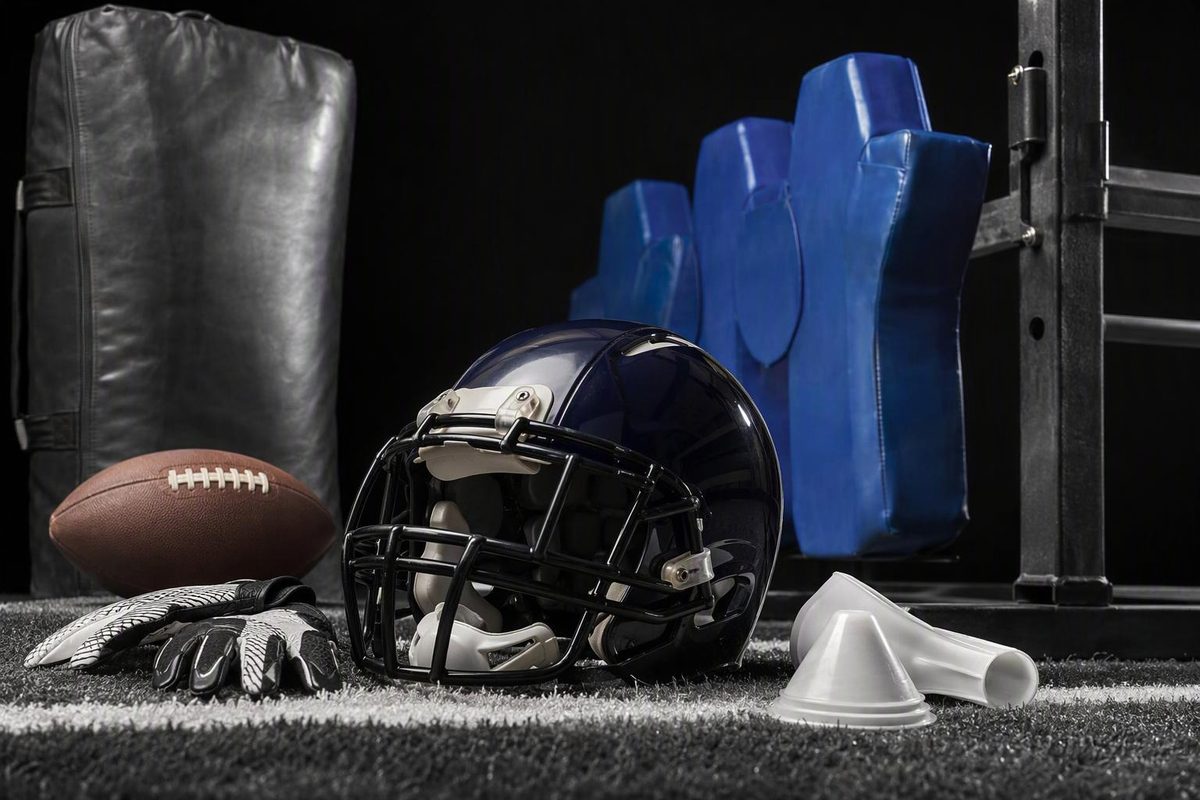
The football nose guard position, also called nose tackle, is the interior defensive lineman aligned on or next to the center, between the offense’s two A-gaps. A nose may control both A-gaps, attack one A-gap, or move after the snap; the defensive call determines the assignment.
Choose the nose’s assignment and first failed checkpoint; the drill and correction update beside it.
Stance and First Step
Setup: Use a one-gap call and mark the assigned A-gap.
Next correction: Take a short first step through the assigned A-gap without crossing the feet. Land the second step under the hips.
Next-Rep Drill Selector
Use the first failed film checkpoint, not the most visible late mistake.
Source: Timings and checkpoints come from the 15-minute practice plan on this page; the technique framework follows the cited USA Football guidance.
Position, Alignment, and Assignment Are Different
Separate three terms when teaching the position:
- Position: Nose guard or nose tackle
- Alignment: Where the nose lines up
- Assignment: The gap or blocker the nose must control after the snap
Two common alignments are:
- 0-technique: Head up on the center
- 1-technique: Shaded on one shoulder of the center
A 0-technique is commonly associated with an odd front, but the nose position is not exclusive to a 3-4 defense. NFL coaching analysis distinguishes a two-gap 3-4 nose from an attacking 4-3 nose, while PFF’s technique review notes that a head-up 0-technique can be assigned one gap rather than both (NFL; PFF). Teach the call, not an assumption based on where the player’s helmet starts.
For a fuller map of A- through D-gaps, see Football Gaps Explained.
The Run Assignment Changes the Technique
One-Gap Nose
A one-gap nose often shades the center and attacks the assigned A-gap. The sequence is:
- Key the center without guessing the play.
- Take a short first step into the called gap.
- Strike with the hands while keeping the head out of contact.
- Maintain the gap until the runner commits.
- Separate and pursue.
The goal is not merely to enter the backfield. Penetration that opens the assigned A-gap is a loss for the defense. USA Football’s defensive-line guidance makes the same distinction: escape the block only when the ball commits, because escaping early can surrender gap integrity (USA Football).
Observable correction: If the nose crosses the center’s face but the runner cuts through the original gap, coach, “Own the gap before you escape.”
Two-Gap Nose
A two-gap nose normally aligns head up and controls the center before fitting the ball into either A-gap. The sequence is:
- Take a short step into the center without overstriding.
- Strike and extend to control the blocker.
- Keep the shoulders square and find the ball.
- Close both A-gaps until the runner declares.
- Shed toward the runner.
This player protects the linebackers as well as the line of scrimmage. Drawing a combination block only helps if the nose prevents the center or guard from climbing cleanly to the second level.
Observable correction: If the center turns the nose’s shoulders before the runner declares, shorten the first step and reset the fit with square hips.
Read the Center Before the Backfield
Give the nose one primary key: the center. One USA Football progression keys the “V” of the blocker’s neck while using peripheral vision for ball movement. It teaches the defender to react to base, down, and reach blocks rather than guess (USA Football).
Translate the center’s first movement into a response:
| Center’s Action | Likely Problem | Nose’s Response |
|---|---|---|
| Comes directly at the nose | Base block or vertical double-team | Anchor the assigned gap; expect pressure from a guard |
| Steps laterally toward the nose | Reach block or zone combination | Gain hand control and avoid being stretched out of the gap |
| Steps away | Down, back, or zone-away action | Squeeze space under control; locate the next blocker and the ball |
| Sets in pass protection | Pass | Begin the called rush without abandoning the A-gap lane |
| Releases immediately | Screen, draw, or protection variation | Retrace to the ball instead of continuing blindly upfield |
Teach these block categories before asking a player to memorize dozens of play names.
Vertical and Horizontal Double-Teams Require Different Answers
A nose will feel two different kinds of pressure:
- A vertical double-team tries to move the defender off the line of scrimmage.
- A horizontal combination tries to stretch the defender laterally before one blocker climbs to a linebacker.
Against vertical pressure, attack the initial blocker as a base block, then drop the leg on the side from which the second blocker applies pressure. Against a zone combination, fight to remain in the assigned gap and reduce the blocking surface by turning the hips and dropping a shoulder without exposing the gap. USA Football’s double-team progression separates vertical gap-scheme doubles from horizontal zone combinations because each applies pressure differently (USA Football).
Do not grade “occupied two blockers” as an automatic win. Check the result:
- Did the nose remain in the assigned gap?
- Did the double-team gain vertical movement?
- Did a blocker climb cleanly to the linebacker?
- Could the nose separate when the ball arrived?
Use a Power Rush Without Vacating the A-Gap
Rush-lane responsibilities must come from the defensive call. For a basic nose-guard install, use a compact power rush before adding games and counter moves:
- Attack one half of the center rather than the middle of the chest.
- Win hand position and extend from the hips.
- Stay in the assigned rush lane; do not create an easy A-gap escape.
- Retrace when the center’s release and the backfield action indicate draw or screen.
- If the rush stalls, maintain vision and put the hands into the throwing lane without jumping into another rusher.
USA Football’s contact system emphasizes hand-delivered contact, hip-generated force, and playing long to keep the helmet out of the contact area (USA Football). Install those principles at fit tempo, then add speed only while stance, balance, and hand placement remain sound.
Choose the Nose for Movement Skills, Not Weight Alone
Do not automatically assign the position to the heaviest player. Look for a defender who can:
- Take a short, balanced first step
- Strike and control a blocker with the hands
- Keep the feet underneath vertical pressure
- Recognize blocks without peeking into the backfield
- Move laterally without turning the shoulders too early
- Repeat a physically demanding assignment
Mass and strength help, especially in a two-gap system. A lighter player with leverage, quick hands, and reliable gap discipline may still be the better one-gap nose.
Install the Position in a 15-Minute Practice Period
Use one center, one guard, and one nose in each pod. Start with shields or fit-and-freeze work. Add controlled resistance only after players consistently maintain balance and keep their heads out of contact.
Stance and First Step — 2 Minutes
Give each nose four starts to each side.
- One-gap call: Step through the assigned A-gap without crossing the feet.
- Two-gap call: Step into the center and remain square.
Checkpoint: The second step lands under the hips, not behind the first step.
Center-Key Recognition — 4 Minutes
The center gives a base, reach, or away step on the coach’s signal. The nose reacts but stops after the initial fit. Run six to eight reps per nose.
Checkpoint: The nose responds to the center’s movement and names the block after the rep.
Combination-Block Fits — 5 Minutes
Add a guard. Alternate a vertical double-team and a horizontal zone combination. Start with two fit-and-freeze reps of each, then give each nose four controlled-resistance reps.
Checkpoint: Mark the assigned A-gap with a cone. Stop the rep if the nose leaves it before the coach declares the ball.
Power Rush and Retrace — 4 Minutes
The center gives either a pass set or a quick release. On a pass set, the nose compresses one half of the blocker for three controlled steps. On a release, the nose retraces toward a coach holding the ball. Give each nose four reps of each response.
Checkpoint: The nose finishes in the rush lane with vision on the ball—not beyond the quarterback’s level.
Grade the First Point of Failure on Film
Grade five items in order: alignment, first step, hand placement, gap ownership, and finish. Stop the grade at the first failure.
This keeps a late mistake from hiding its cause. A poor finish may begin with the wrong alignment, an overextended first step, or lost hand position. Give the player one correction for the earliest failure, then build the next practice rep around that correction.