
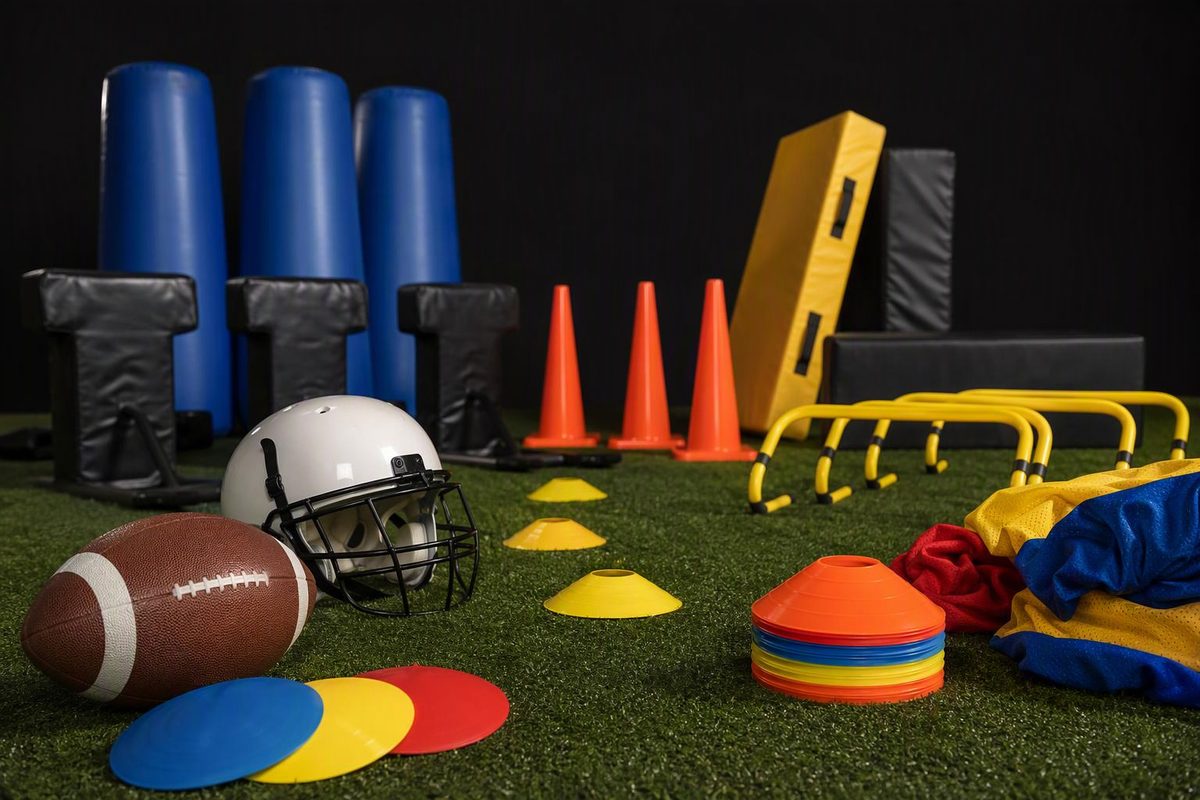
A productive football practice for 10-year-olds can fit into 75 minutes: nine drills covering movement, snaps, catching, routes, ball security, leverage, blocking and team play. That sits at the bottom of USA Football’s recommended 75–105-minute practice range for ages 10 and older.
Check off each drill as you coach it; the tracker shows elapsed time and the next activity.
75-Minute Practice Checklist
Nine drills · Air, Bags and Control work · No full-contact period
Movement + Ball Warmup
Setup, Workload And Corrections
Athletic position, acceleration and ball familiarity. Make two 8-yard lanes with one ball at each lane. Use groups of four or fewer.
Two trips each: march, skip, shuffle, backpedal and build-up run. Finish with four 20-second partner exchanges around the waist.
“Knees bent, chest over toes; eyes where you are going.”
If feet cross during a shuffle, slow the player and place two cones 2 yards apart to reinforce a square base.
Snap-And-Seat Exchange
Setup, Workload And Corrections
Center/QB operation. Work in pairs 3–4 yards apart with one ball. Rotate center and quarterback every five snaps.
Take five shotgun snaps each, then five snap-and-set repetitions: catch, secure and bring the ball to the throwing shelf. Score one point when the QB catches without moving either foot.
Center: “Finish hands to the target.” QB: “Show hands, watch the point.”
For a sideways snap, freeze the center’s finish and check that the shoulders stay square. If the QB traps the ball, restore a relaxed hand target before adding speed.
Partner Catch Box
Setup, Workload And Corrections
Hands, eyes and tuck. Partners stand 5 yards apart; four cones make a small box around each receiver. Use one ball per pair.
Each receiver takes five chest throws, five to each side and five low throws—20 catches total. Switch roles after the set.
“See the front point; catch, tuck, reset.”
For body catches, shorten the throw to 3 yards and require the hands to meet the ball. If feet leave the box, reduce throw width and then widen gradually.
Three-Route Station
Setup, Workload And Corrections
Stance, release and break. Make three lanes, each 12–15 yards long. Assign hitch, slant and out, with one passer and no more than three receivers per lane.
Run two routes per player in each lane and rotate after three minutes. The quarterback throws on the receiver’s break, not after the receiver stops.
Receiver: “Burst, sink, stick.” QB: “Set the front foot at the target.”
For a rounded break, put one cone at the break and another 1 yard toward the exit. For a late pass, let the QB rehearse one no-ball rep with the receiver.
Ball-Security Traffic
Setup, Workload And Corrections
Carry and change direction. Create a 10-by-5-yard lane with three staggered cones. One runner works while two teammates stand outside as visual distractions only.
Attack each cone, make one cut and keep the ball away from the nearest traffic. Take two trips on each side and finish with a 5-yard burst.
“Five points of pressure; elbow tight; ball away from traffic.”
For a loose elbow, stop and show the five-point fit before restarting. For a wide cut, move the next cone closer and demand one decisive foot plant.
Mirror-To-Leverage
Setup, Workload And Corrections
Defensive tracking. Make 5-by-5-yard boxes. Pair a runner and defender facing each other 3 yards apart, with an escape gate on each side.
For three seconds, the runner moves laterally and the defender mirrors. On the whistle, the runner chooses a gate and the defender closes under control. Take four turns each, then switch partners. Flag teams finish with a pull; tackle teams tag the near hip or fit on a shield.
“Near hip, near shoulder; keep the runner on your help side.”
If the defender crosses their feet, narrow the box and slow the runner. If the defender overruns, require a near-foot breakdown before the tag, pull or fit.
Two-Point Block Fit And Shed
Setup, Workload And Corrections
Legal body position without collision. Pairs work in a 3-yard lane with one player holding a hand shield. Match players by size and readiness. Without a shield, rehearse the approach and hand strike in the air rather than fitting on a teammate.
The blocker takes two approach steps, fits hands to the shield and runs the feet for two controlled steps. The shield holder provides a stable target; do not turn it into a contest. Take three reps per role before rotating.
Blocker: “Eyes up, hands first, feet alive.” Shield holder: “Base and balance.”
If the head enters contact, stop immediately, remove speed and return to a stationary shield fit. If the feet stop, shorten the rep to one fit plus two steps. Use assigned speed and stay upright.
4-On-4 Find-The-Space
Setup, Workload And Corrections
Decisions and assignment football. Use a 20-by-15-yard field. Offense has a center, quarterback and two eligible receivers; defense plays four. Adjust eligibility to local rules.
Offense gets four plays to cross midfield. Require a snap, one route break and a throw within five seconds. Rotate positions every four plays. Defense ends a play with a flag pull or two-hand tag. Do not use blocking collisions or tackling.
Offense: “Align, assign, execute.” Defense: “Find your player or zone before the snap.”
Mark starting spots if players bunch. Require a different first read each series if one player dominates touches. If players are confused before the snap, walk through alignment and restart the clock.
Review Competition
Setup, Workload And Corrections
Recall and clean execution. Keep the team in two lines, each with a ball.
Relay a clean snap, 5-yard route, catch, tuck and return. Each player goes once; rerun only if time remains. Ask one player to name the day’s strongest cue.
“Clean beats fast.”
After a dropped ball or poor exchange, have the player repeat that skill once at walking speed rather than restarting the entire relay.
Sources: USA Football Youth Play Recommendations, Practice Guidelines, Levels of Contact, and Heat and Hydration; CDC HEADS UP. USA Football says the head should not initiate a block and recommends two-point stances for non-contact, limited-contact and modified-tackle youth formats. Give players unrestricted water access and modify equipment, work time or conditions for heat.
This plan uses Air, Bags and Control work rather than full contact. Follow USA Football’s youth play recommendations, Practice Guidelines, Levels of Contact and heat and hydration guidance, plus league rules. Suspected concussion requires immediate removal, no same-day return and healthcare-provider clearance under CDC HEADS UP. Extend route work with these football passing drills, or use the flag-pulling progression for a non-contact finish.