
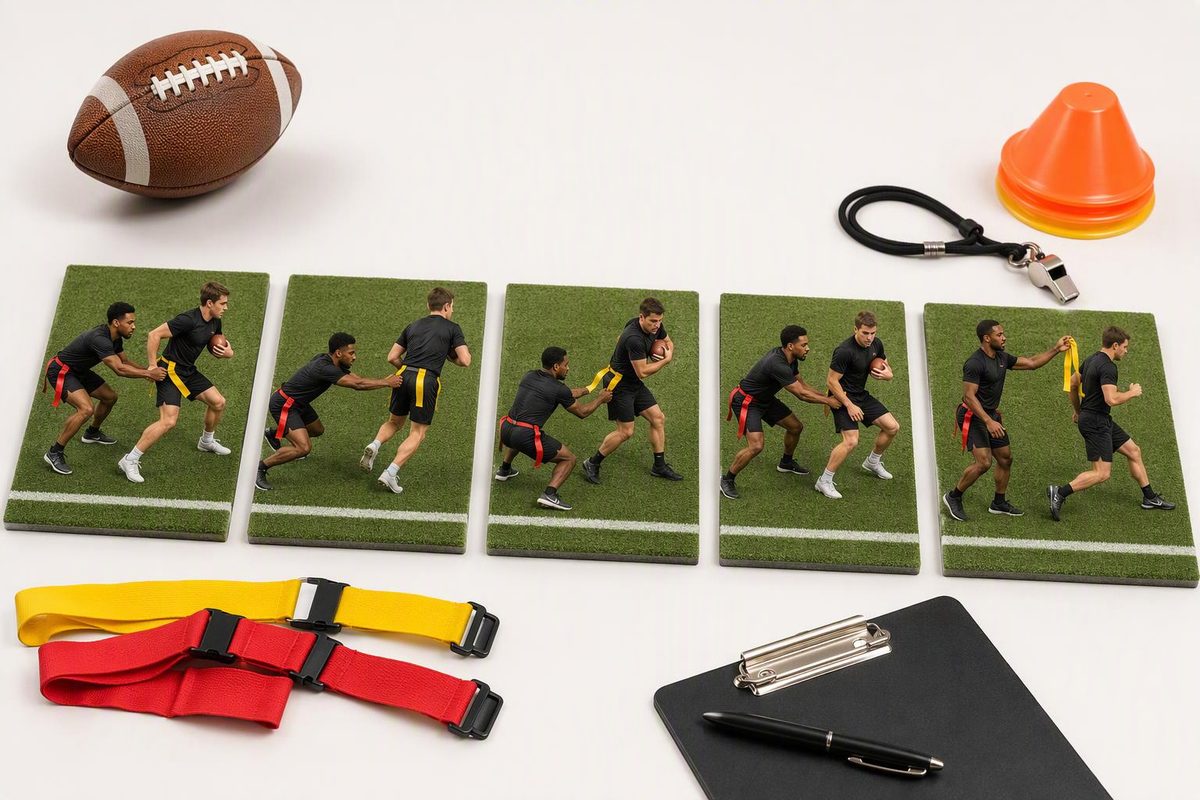
Flag pulling is not tackling without pads. The defender must close space, stay balanced, track the flag and remove it without grabbing clothing, wrapping up or running through the ball-carrier.
Use this five-drill progression to move from a controlled pull to a live-space finish. It needs six cones, game belts and one ball per working group. Run each drill at walk-through pace first, then increase speed only when defenders can finish without unnecessary contact.
Establish the standard before the first rep
Teach four actions:
- Close under control. Sprint while there is open grass, then shorten the stride before reaching the runner.
- Track the belt line and near hip. Focus on the flag closest to the defender rather than the runner’s head, shoulders or ball fake.
- Square and shuffle. Keep the chest in front of the runner, knees bent and feet underneath the body.
- Pull and clear. Grip near the flag’s attachment point, pull in the direction that releases your league’s flags, display the flag and move away from the runner.
NFL FLAG’s technique guidance similarly tells defenders to align in front, break down, use two hands toward the two side flags and grip near the flag’s base. It also notes that belts use different release systems, including hook-and-loop, pop-socket and whole-belt designs (NFL FLAG). Practice with the same equipment players will wear in games.
Check the governing rules before teaching the finish. NFL FLAG describes its game as non-contact and prohibits tackling and diving. The 2026–27 NFHS points of emphasis says intentional contact is a foul; slight incidental contact may occur during a legitimate flag-pull attempt, but contact without an attempt to pull is a foul (NFL FLAG; NFHS). Do not let “slight contact” become permission to launch, wrap, hold clothing or drive through the runner.
Drill 1: Fit, track and pull — 3 minutes
Setup: Pair players five yards apart. One player wears a belt and holds a ball. The defender begins in a balanced stance directly in front.
Action: The runner walks forward, then takes one lateral step. The defender closes, shortens the final two steps, squares the chest and pulls the available flag. Alternate the runner’s direction.
Reps: Four pulls to each side, then switch jobs.
Coach: “Near hip. Short steps. Pull the flag—not the shorts.”
Checkpoint: The defender’s head and shoulders remain up, the feet are underneath the hips, and the hands arrive at the belt line without wrapping the runner.
If a defender lunges, reduce the starting distance to three yards and require a balanced freeze immediately after the pull.
Drill 2: Mirror, release and pull — 4 minutes
Setup: Make a 4-by-4-yard box. Runner and defender face each other one yard apart. Place an exit cone three yards beyond the box.
Action: The runner shuffles laterally inside the box for two seconds. The defender mirrors without crossing the feet. On the coach’s “go,” the runner exits toward the cone and the defender closes for the pull.
Reps: Four live exits per player, alternating the exit side.
Coach: “Own the middle. Match the hips. Don’t guess.”
Checkpoint: At release, the defender should be square enough to reach either flag. A defender who turns the shoulders too early has surrendered the opposite exit.
This constrained mirror period follows the same basic purpose as USA Football’s four-cone Flag Pursuit drill: give the runner limited room to juke before releasing so the defender can work on mirroring, pursuit and angles (USA Football).
Drill 3: Angle-pull alley — 4 minutes
Setup: Build an alley four yards wide and eight yards long. Put the runner at one end. Align the defender two yards inside the alley and three yards behind the runner’s level.
Action: The runner goes straight through the alley at three-quarter speed. The defender takes an angle that puts the near shoulder on a path toward the runner’s near hip, flattens the path before contact and pulls the flag before the runner crosses the finish line.
Reps: Three from each side, then switch jobs.
Coach: “Aim ahead of the hip. Flatten late. No chase from directly behind.”
Checkpoint: The defender’s path should intersect the runner’s path, but the defender should arrive under control and off the runner’s body. If the defender follows the runner’s footprints, move the starting point one yard farther inside and rehearse the angle at half speed.
Do not reward a desperate dive. A missed pull followed by balanced pursuit is a better practice rep than contact produced by leaving the feet.
Drill 4: Sideline-leverage pull — 4 minutes
Setup: Mark a five-yard-wide, eight-yard-long alley. One boundary represents the sideline. The runner starts two yards from that boundary; the defender starts three yards away with inside leverage.
Action: The runner may cut inside or continue toward the sideline. The defender protects the inside lane, closes the available space and pulls without shoving the runner out of bounds.
Reps: Two reps with the sideline to the defense’s left and two with it to the right, then switch roles.
Coach: “Keep the ball on your outside shoulder. Use the line as help.”
Checkpoint: The defender must not overrun the runner’s upfield hip. If the runner cuts inside untouched, the defender likely attacked the flag before securing leverage.
Drill 5: One-on-one finish box — 5 minutes
Setup: Create an 8-by-8-yard box. The runner starts on one end line and the defender starts three yards away. Use multiple boxes if roster size permits.
Action: On the whistle, the runner has five seconds to cross the opposite line. The defender earns the rep by pulling a flag while remaining on the feet and avoiding illegal contact.
Reps: Four defensive attempts per player, switching jobs after each rep. Give the runner one point for crossing and the defender one for a clean pull.
Coach: Correct only the first breakdown in the rep: bad angle, uncontrolled close, early reach or missed grip. Do not give four corrections at once.
Checkpoint: Grade a pull only when the defender produces the flag. Being in position is progress, but it is not the finish.
Grade what transfers to team defense
Use a four-point card during the final drill or team period:
- 1 point: correct pursuit angle
- 1 point: balanced breakdown
- 1 point: clean flag removal
- 1 point: no avoidable contact
Record the first miss, not just the final result. A defender may pull the flag after taking a poor angle; another may execute the approach correctly and miss at the belt. Those players need different corrections.
Before every practice, expose each flag fully and secure the belt as the competition requires. NFHS rules for 2026–27 use three flags—one at each hip and one over the tailbone—and prohibit clothing or hair from covering them (NFHS). Other organizations use different belt layouts and dead-ball procedures, so match the progression to the local rulebook rather than assuming one format. Coaches organizing new players can also clarify who handles force, pursuit and underneath coverage with this guide to flag football positions.