
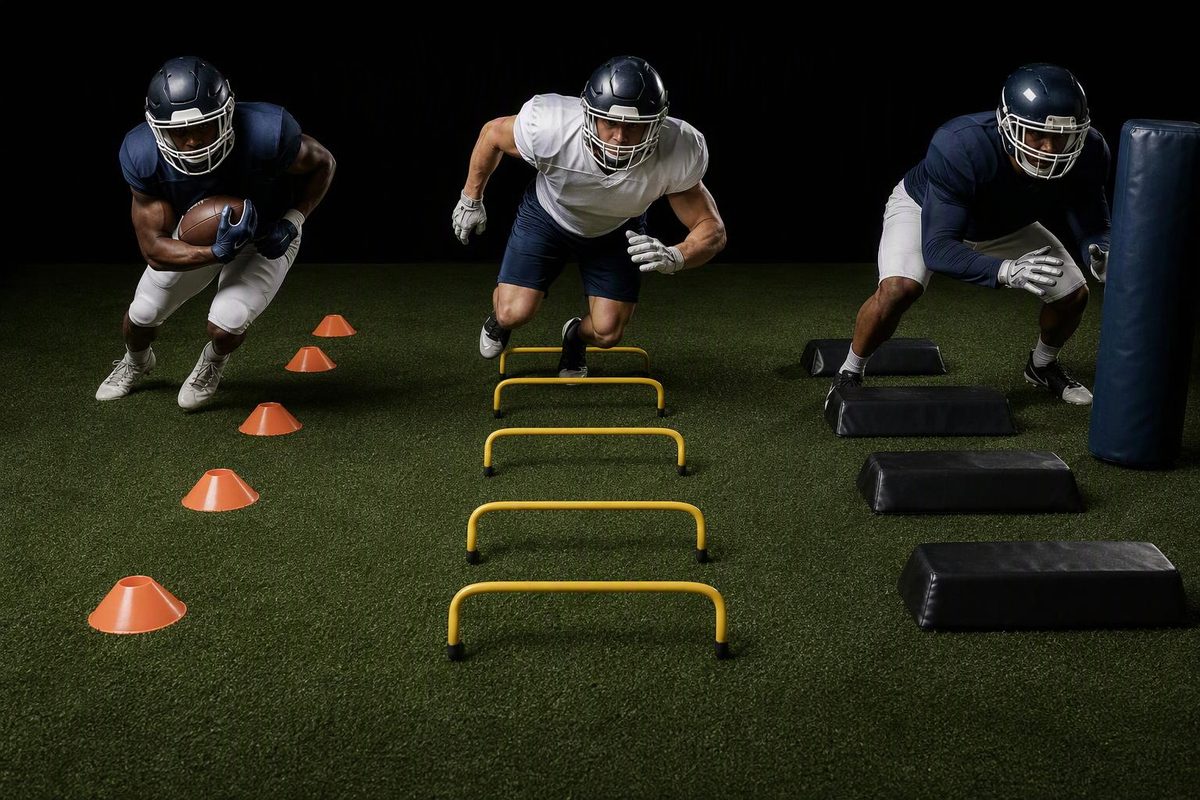
Plan football conditioning around repeating useful efforts, not seeing who can survive the longest run. Give each drill a work limit, a recovery interval and a reason to stop.
American football consists largely of short, high-intensity efforts separated by breaks. A Gatorade Sports Science Institute review reports an older college estimate of about 5.5 seconds per play, while cautioning that historical timing data are only approximations. Use your own film to understand your team’s demands—not one universal sprint distance for every position.
The following are sample practice designs for medically cleared, already-conditioned high school and small-college players—not validated protocols or conditioning tests. Have your strength coach and athletic trainer adjust the distances, effort and recovery to the individual and the day’s total workload. Choose one drill, rather than stacking all three into a finishing circuit.
Before the first rep
Use a progressive warm-up: easy movement, dynamic mobility, position footwork and several build-up accelerations. Players should have rehearsed the movements before doing them repeatedly under fatigue. For teaching braking and cutting, use the separate football agility progression; this period is about work and recovery, not learning a new cut.
Mark clear lanes and runoff space. Keep water accessible, identify who controls the clock and follow applicable school, state-association or collegiate heat and equipment policies. The NFHS heat-acclimatization guidance calls for gradual activity, individual adjustments and longer recovery during initial practices or increasing heat stress. Have a rehearsed, venue-specific emergency action plan in place before activity starts.
1. Straight-line repeat accelerations
Use for: Receivers, defensive backs and running backs who already have regular running exposure.
Setup: Mark a start and a finish 20 yards apart, with at least 15 additional yards available to slow down. Give each runner a separate lane, approximately 5 yards wide. Extend the runoff if players need more room. Split the group into waves so nobody returns through an active lane.
Action: Accelerate from a familiar two-point stance, run through the finish and gradually slow in the runoff area. Walk back outside the lanes. This is a fast, controlled effort—not an all-out timed tryout or a race against the whole team.
Sample dose: One set of six reps, with 45 seconds of recovery after each finish. Extend recovery if the walk back leaves insufficient time to reset.
Cue: “Push out, run through, slow down beyond the cone.”
Checkpoint: Watch every rep, especially the final two. If a player starts reaching far ahead with the feet, slows before the finish or cannot control the runoff, end that player’s set. Correct the setup or recovery before adding work. Shorten the distance to 15 yards when appropriate; do not demand the fastest receiver’s time from every body type.
2. Short lineman movement bouts
Use for: Offensive and defensive linemen, in a planned position period—not automatic post-practice sprints.
The NFHS’s June 2026 lineman guidance recommends position-specific conditioning and gradual progression. It excludes linemen from certain preseason tests, including mile runs and serial sprints, during the first few weeks, and warns that post-practice sprinting increases heat-illness risk.
Setup: Give each player a 5-yard-wide lane. Mark the start and a 3-yard working landmark. For DL get-offs, leave at least 10 additional yards of clear runoff, extending it as needed. No opponent, blocking collision or ground-contact exercise is needed.
Action: On the snap cue:
- OL: Take two familiar run-block steps, then continue short, balanced drive steps toward the landmark. Stop forward travel there and maintain controlled foot movement until the whistle, no longer than six seconds after the start.
- DL: Execute the familiar get-off, accelerate through the 3-yard landmark, then gradually slow in the runoff. The rep ends with that short burst; do not keep sprinting to fill six seconds.
Walk back and reset; do not add up-downs between reps.
Sample dose: Four bouts, with 60 seconds of recovery after each bout ends.
Cue: OL: “Keep your base; don’t cross your feet.” DL: “First steps forward; stay in your lane.”
Checkpoint: Stop the set when the player cannot maintain the rehearsed movement. A shorter running distance does not make repeated exertion automatically safe; monitor the individual throughout.
3. Noncontact six-play series
Use for: Receivers, defensive backs and running backs who need repeated-effort work integrated into familiar assignments.
Setup: Use separate 5-yard-wide lanes. For receivers and backs, use the 20-yard run and runoff from Drill 1. For defensive backs, mark a 3-yard pedal landmark behind the start and a finish 10 yards ahead of the start, followed by at least 15 yards of runoff. Keep return traffic outside active lanes. Rehearse each action once at easy speed.
Action: Run six simulated plays. Receivers take a familiar straight release and run; backs accelerate from their usual stance; defensive backs pedal to the rear landmark, transition forward and run through the finish. Keep each effort to no more than six seconds, ending sooner when the player reaches the finish. Allow 45 seconds of recovery after the effort ends. Players walk back, hear the next assignment and reset. Do not turn that reset into another conditioning task.
Sample dose: One six-play series. This is a conditioning format, not a claim that every offense operates at that tempo.
Cue: “Same assignment, same finish, every rep.”
Checkpoint: Chart completed reps and movement quality. If a player forgets the assignment or loses control, stop that player’s work and reassess rather than speeding up the next snap.
Progress the workload—not the punishment
Record the drill, completed reps, effort duration, recovery and any modifications. Count running from individual, team and special-teams periods before adding a separate block. Two-way players and heavily used starters should not automatically receive the same extra work as reserves.
Do not increase work simply because players finished. Once the current dose is consistently well tolerated, your strength coach can plan a small change—for example, one additional rep while keeping distance and recovery unchanged. Returning players need an individualized progression. The NCAA’s interassociation recommendations emphasize gradual conditioning, appropriate work-to-rest intervals, documented sessions and special care during transitions after breaks, injury or illness. Exercise should never be punishment.
Stop activity and get medical evaluation for unusual weakness, muscle pain or breathlessness; these are among the warning symptoms identified in NCAA sickle-cell-trait guidance. Stumbling, confusion or collapse requires immediate emergency action—not another recovery lap. Activate emergency medical services and follow the rehearsed medical plan, including immediate rapid cooling for suspected exertional heat stroke, as directed by the NFHS heat-illness guidance.