
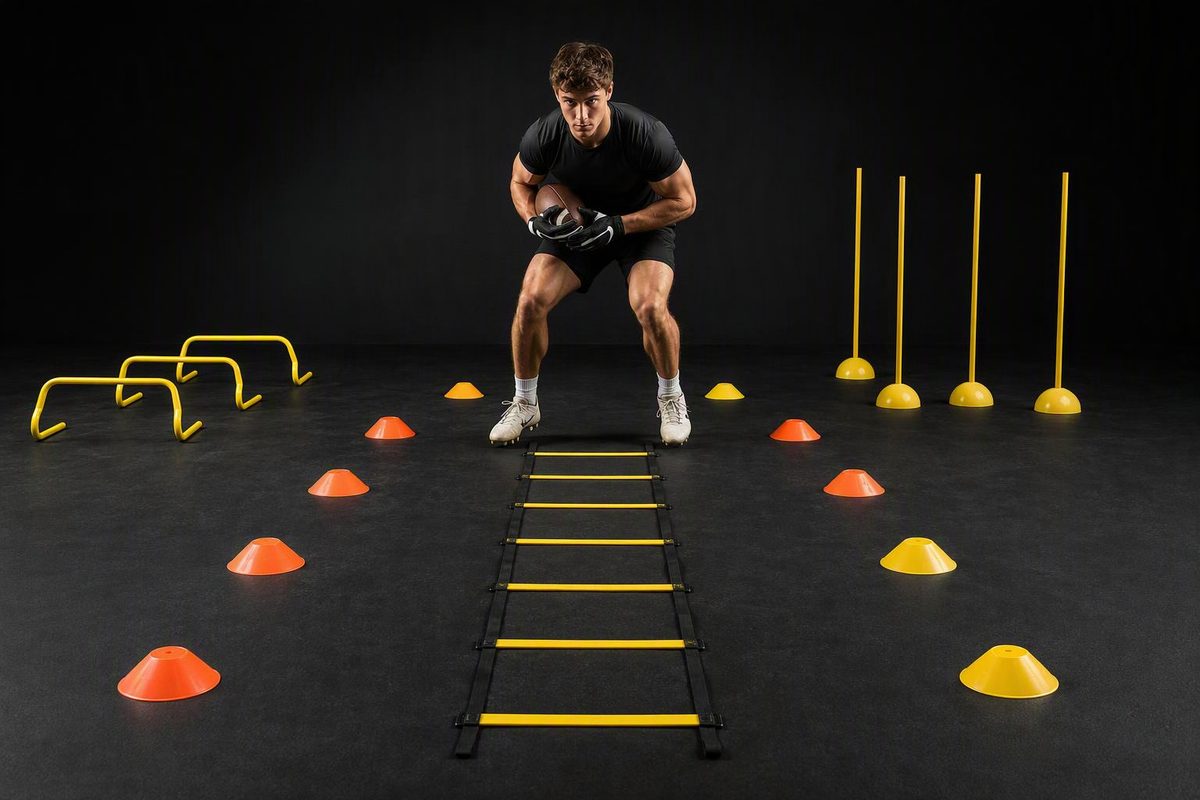
Use this progression for high school or small-college players: teach the stop, rehearse the cut, then make players respond to a cue or opponent. The goal is a controlled change of direction that serves an assignment—not simply fast feet around cones.
A known cone pattern rehearses change-of-direction technique. Reactive work adds a decision. The NSCA describes progressing proficient athletes from planned drills to unpredictable cues, eventually using opponent or ball movement relevant to the sport.
Set the period
These are suggested practice prescriptions, not a standardized test or conditioning workout.
- Time: Five four-minute blocks, after your normal dynamic warm-up. Include instruction within each block; the rep counts are targets, not quotas.
- Equipment: Flat cones, a football and a stopwatch.
- Organization: Groups of four per station; duplicate stations for larger groups. Keep waiting players outside the running and exit paths.
- Contact: None. No tackling, blocking, grabbing or diving.
- Recovery: Allow roughly 30–45 seconds between a player’s efforts; extend recovery when execution deteriorates. The clock is a ceiling, not a reason to rush reps.
Begin at a controlled pace. Increase approach speed only when players can brake and leave under control. Check footing and provide clear run-out space. Stop a player with pain or a limp and involve the athletic trainer; this period does not replace individualized coaching or medical guidance.
1. Accelerate, brake and hold — 4 minutes
Setup: Mark a straight lane with a start, a braking-zone entrance five yards ahead and an exit three yards beyond that. Leave another five yards clear beyond the exit.
Action: From a two-point stance, accelerate to the braking zone, slow within it and hold a balanced athletic position for two seconds. Walk out rather than sprinting into the next group.
Dose: Three reps per player. Start comfortably below full speed.
Cue: “Brake before the exit; finish ready to move.” Watch the ankle, knee and hip bend together rather than the player folding only at the waist. The NSCA’s deceleration guidance emphasizes absorbing force through those joints and cautions that an excessively deep squat can compromise the next movement.
Checkpoint and correction: The player holds without stumbling or hopping forward. If they repeatedly overshoot, reduce approach speed or lengthen the braking zone. Do not demand an abrupt stop from a faster run before they control the easier version.
Football use: A receiver settling into a route break or a linebacker arriving under control before a separate fit drill.
2. Planned angle cut — 4 minutes
Setup: Put a cut marker five yards ahead of the start. Place two exit gates, each two yards wide, another four yards upfield and four yards left or right of the marker. Keep five yards clear beyond each gate.
Action: Announce the exit before the rep. Approach the marker, reduce speed before the turn and accelerate through the assigned gate. The marker is a landmark, not an object the player must touch.
Dose: Four reps per player, two each direction.
Cue: “Control the approach; push into the new lane.” Look for a balanced plant and a purposeful first step out, not a long sideways reach followed by recovery steps.
Checkpoint and correction: The player exits through the gate without drifting around the marker in a wide arc. If the turn becomes a loop, slow the approach and rehearse the final approach steps and exit. If they lose balance, reduce speed rather than demanding a harder plant.
Football use: Running backs working a single cut; receivers rehearsing a change in route direction. Set the final angle to match the technique your staff teaches.
3. Backpedal-to-break reaction — 4 minutes
Setup: Mark a five-yard backpedal lane. Put two two-yard-wide gates level with the starting line, four yards left and right of it. Leave five yards clear beyond each gate along the exit path. The coach stands ahead of the starting line, visible to the player.
Action: The player faces the coach and backpedals. Before the player reaches the end marker, the coach points to one gate. The player transitions forward toward it and runs through. Begin with an early cue; move it later only after controlled reps.
Dose: Four reps per player. Vary the sequence instead of alternating predictably.
Cue: “See the signal, then break.” USA Football describes a backpedal-to-forward-sprint drill to rehearse that transition; this adaptation removes resistance, uses a visual cue and limits the choices to two.
Checkpoint and correction: The player chooses the correct gate without turning to look behind. If they guess, change the cue timing and direction sequence. If they stumble during the transition, return to a slower, announced break.
Football use: Defensive backs and linebackers. Coach the transition footwork required by your coverage system, then connect it to a receiver or quarterback cue in position work.
4. Lateral mirror — 4 minutes
Setup: Make a box five yards wide and three yards deep. Partners face each other about two yards apart, with one designated leader.
Action: For five seconds, the leader moves laterally within the box while the partner mirrors. No forward charge, contact or full-speed escape. Alternate roles and provide recovery between efforts.
Dose: Four five-second bouts per player: two leading, two mirroring.
Cue: “Track the trunk; keep your base.” In this short-range shuffle drill, keep the feet from crossing or clicking together. That constraint is not a universal rule for running or coverage turns.
Checkpoint and correction: The follower stays approximately aligned with the leader’s torso. If they chase head or shoulder fakes, direct their eyes back to the trunk and slow the leader. Widen a stance that has collapsed into feet touching.
Football use: Offensive linemen rehearsing short pass-protection adjustments without hands. Carry the movement into your blocking fundamentals progression, rather than treating mirroring as a complete pass-protection drill.
5. Ball-carrier gate read — 4 minutes
Setup: Mark two parallel lanes, each six yards wide and eight yards long, separated by a two-yard buffer. Place a two-yard gate at each far corner of each lane. The carrier and defender start centered in their own lanes, level with each other and facing downfield. Leave five yards clear beyond all gates.
Action: At controlled speed, the carrier moves forward, chooses either gate in their lane and makes one cut. The defender watches the carrier and responds toward the corresponding gate in their own lane. Do not announce the choice. Both run out within their separate lanes; nobody enters the buffer or crosses into the other lane.
Dose: Four reps per player: two carrying and two defending.
Cue: Carrier: “One cut, then go.” Defender: “Read the hips, then change direction.” The carrier supplies the movement cue; this is shadow tracking, not a live pursuit or leverage drill.
Checkpoint and correction: Grade whether the defender responds to the actual cut and exits under control. If they guess, vary the carrier’s choice and cut timing. If they lunge or overrun, reduce speed. Return to an announced direction if they cannot control the reactive version.
For linebackers, carry that read into the linebacker read-to-reaction progression. For defensive backs, use the appropriate movement and coverage cues from your DB practice progression.
Grade the next rep
Record three things: correct decision, controlled direction change, purposeful exit. Correct one visible error at a time. When a player can execute only with the direction announced, keep the planned version; when they control it reliably, restore the reaction cue. A faster rep with the wrong read is not the result this period is designed to reward.