
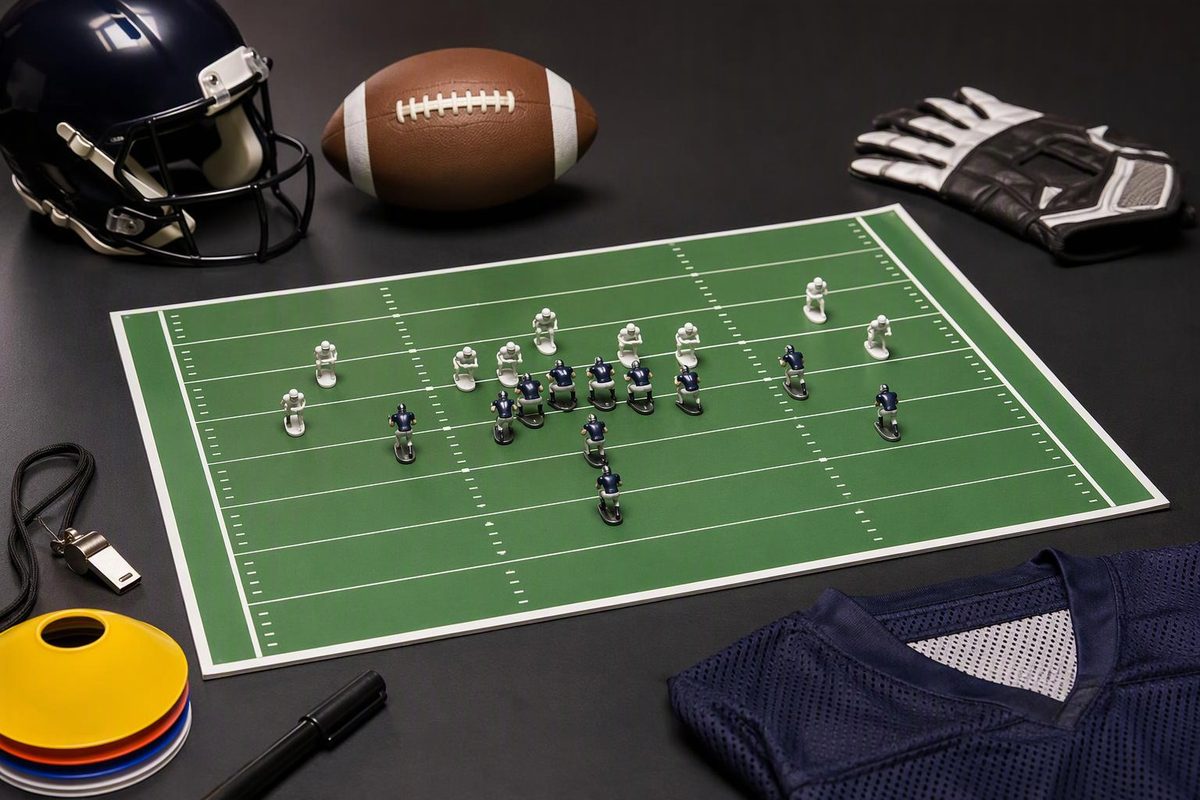
11 personnel means one running back, one tight end and three wide receivers. The first digit counts running backs; the second counts tight ends. Three receivers are implied because the quarterback and five offensive linemen leave five skill-position spots (GoRout). Alignment does not change the personnel label.
Enter the running back and tight end counts to identify the personnel group.
Personnel Grouping Counter
Count players by position, not by alignment.
Personnel group
11 personnel
1 RB + 1 TE + 3 WR
Moving the Y or back does not change this label.
Method: the first digit counts running backs and the second counts tight ends; remaining skill spots are shown as receivers. Source: GoRout personnel grouping guide.
Keep three terms separate:
- Personnel tells you who is on the field.
- Formation tells you where they align.
- The play call tells them what to do.
An offense can remain in 11 personnel while moving from balanced 2x2 to trips, a condensed set or empty. Do not label every three-receiver picture “11” without confirming the back and tight end.
The Five Skill Players in 11 Personnel
| Position | Count | Jobs to establish |
|---|---|---|
| Running back | 1 | Carry, protect, release and adjust to motion or empty |
| Tight end/Y | 1 | Attach, detach, insert, sift and release |
| Wide receivers | 3 | Set the formation, threaten coverage and block on the perimeter |
The Y can align attached to the tackle, as a wing, in the slot or across the formation without changing the personnel grouping. Flexing the running back outside creates an empty formation without changing the package either.
Set classification rules before charting film. If an opponent uses one player as a fullback, sniffer and attached tight end, decide whether your staff will classify him by listed position or game-by-game role. Apply that choice consistently and note hybrid players separately.
Four Formations That Preserve 11 Personnel
Balanced 2x2
Place two receiving threats to each side, with the back beside or behind the quarterback. The Y can be attached on one side while a slot receiver creates the second threat opposite him.
Start with: inside zone, quick game, bubble screens and mirrored concepts.
Checkpoint: Both sides reach their called splits, and every eligible knows whether he is on or off the line. Two receivers to each side does not by itself make the formation legal.
Trips With a Backside Y
Align the three wide receivers to one side and attach or flex the tight end backside. That creates a 3x1 picture while preserving a run surface next to the Y.
Start with: zone toward or away from the tight end, backside isolation routes and three-receiver concepts.
Quarterback cue: Identify the middle-of-field structure, then compare the trips-side numbers with the box. Use a consistent pre-snap sequence, not a guess based on the personnel label.
Y-Off or Sniffer
Move the tight end off the line and near the core. From there, the Y can slice across the formation, insert on a linebacker, lead to the perimeter or release.
Start with: split zone, counter, play-action boot and protection help.
Checkpoint: Keep the Y’s stance and depth consistent enough that they do not announce block or release. Film his first two steps from behind the offense.
Empty Without Substituting
Flex the running back into the slot or outside. The defense must account for five eligible receivers, and its adjustment may provide a coverage clue, although it can still disguise the final coverage. The offense can return the back to the backfield through motion.
Start with: quick throws, a coverage indicator and motion back into a one-back run.
Checkpoint: Teach the back one exact split and one motion landmark before expanding the package. An empty check is not useful if alignment consumes the play clock.
11 Personnel Preserves Runs and Passing Threats
With the Y attached, the offense can build a six-player blocking surface while presenting four receiving threats before the back releases. It can also change the picture without replacing its core blocking system.
In one USA Football coaching example, an offense ran power from 11 personnel in trips while retaining the line’s rules across changes in backfield, formation and motion (USA Football). That is the practical value: varied presentations for the defense and repeated rules for the offense.
It does not make 11 personnel an automatic passing set. The Y’s blocking ability, receiver splits, back location, down and distance, and actual tendencies provide better evidence. On film, chart the result instead of assigning intent from the package name.
Build the Package Around Five Concepts
Use concepts that survive the formation changes:
- One inside run: inside zone or power.
- One edge constraint: bubble, fast screen or jet action.
- One quick pass: stick, spacing or hitch access.
- One intermediate pass: Drive or another concept with a fixed quarterback progression.
- One play-action answer: pair it with the backfield action of the core run.
Avoid installing a different run for every formation. Change alignment or motion first; change the blocking scheme only when the existing rules cannot solve the front.
Install the Package in a 15-Minute Period
Setup: Put the ball on a hash and use seven defenders or a full scout look. Place a formation card behind the defense. Use two footballs so the next rep can be spotted immediately.
Minutes 0–3: Alignment Tempo
Call 2x2, trips, Y-off and empty in random order. Snap only after every player is set correctly. Fix splits, on/off status, Y depth and back alignment.
Minutes 3–8: Core Run
Run the same scheme from 2x2, trips and Y-off. Give the line one front first, then add a second. Grade the assignment and first two steps, not yardage.
Minutes 8–12: Run-Pass Conflict
Pair the core run with its screen or quick-game answer. Change one observable defensive cue—box count, apex leverage or corner cushion—and require the quarterback to state his decision before the snap.
Minutes 12–15: Move the Formation
Begin in trips, motion to 2x2 or empty, and run the same call. Repeat any rep with late alignment or an illegal formation.
The period should look repetitive to the offensive line and varied to the defense. If every formation requires new rules, the package is too large for the available practice time.
Chart Personnel Before Formation on Film
For each snap, record:
- personnel;
- formation and receiver distribution;
- Y location: attached, wing, slot or backside;
- back location and motion;
- defensive box count and shell;
- run or pass concept;
- direction, target and result.
Chart personnel before formation, then split tendencies by Y location and back alignment. “They run from 11” is not usable. A report such as “From 11 trips with the Y attached backside, they ran weak on 8 of 11 early-down snaps” gives the defense an observable tendency it can practice against.
Keep personnel terminology separate from formation legality and receiver eligibility. Under the 2026 NCAA rules, an eligible lineman must be on the end of the line and wear an eligible number; an eligible back must also wear an eligible number. NCAA formations may have no more than four backs and generally require at least five linemen numbered 50 through 79 (2026 NCAA Football Rules, Rule 7).
High school staffs should build and rehearse each formation under the NFHS and state-adoption rules that govern their competition.