
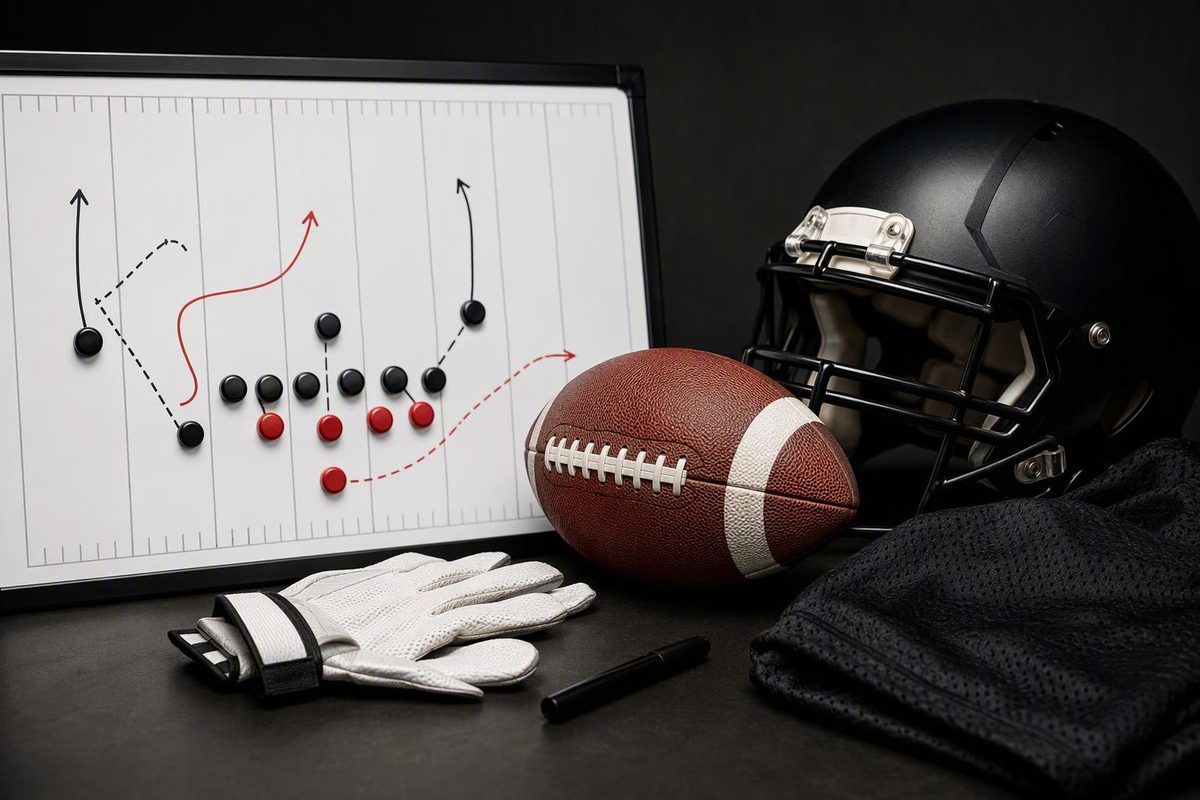
The Drive concept pairs a shallow route with a dig behind it to create a low-high stretch on an underneath defender. It gives the quarterback a short answer against pressure or man coverage and an intermediate answer when a linebacker drives downhill.
Terminology is not universal. Some staffs reserve Drive for a shallow and dig originating from the same side; others use the name for a broader shallow-dig combination. Put the routes, landmarks and progression on the call sheet instead of relying on the concept name. A practical starting point is a shallow at 3–4 yards and a dig at 10–12, with the other routes clearing space or providing an outlet (Throw Deep Publishing).
One Trips installation
This version runs the shallow and dig from the three-receiver side. The backside post is an alert, not part of the core high-low.
Backside X: post alert                 Trips Right
                                       #1: vertical clear
                                       #2: dig at 10–12 yards
                                       #3: shallow at 3–4 yards

                 LT  LG  C  RG  RT
                          QB   RB: check, weak flat
| Player | Assignment | Observable checkpoint |
|---|---|---|
| Trips #1 | Vertical clear | Runs to win and does not look back early |
| Trips #2 | Dig at 10–12 yards | Vertical stem, square break, stays above the shallow |
| Trips #3 | Shallow at 3–4 yards | Crosses flat without drifting toward the dig |
| Backside X | Post alert | Maintains inside leverage and stays above the dig window |
| Running back | Protection check, then weak flat | Scans the assigned threat before releasing |
The backside route can change with formation and game plan. In one documented high school Drive installation, the X can run a post, vertical or China route; the post creates an answer when the weak safety drives the dig (USA Football). If your formation places the post elsewhere, keep the same rule: it is an alert above the dig, not another stop in a long progression.
Shallow receiver
Take enough vertical stem to avoid being rerouted directly into the line, then cross at the offense’s 3–4-yard landmark. Run across the quarterback’s vision with the shoulders nearly square to the opposite sideline.
Use one adjustment system consistently:
- Man: keep running and expect the ball in front.
- Zone: settle only when uncovered between underneath defenders—and only if that rule has been installed.
- Pressure: show the quarterback immediately; do not improvise a sit route.
A shallow that climbs to 6 yards compresses the throwing lane. One that fades backward gives up ground and lets pursuit recover.
Dig receiver
Push vertically to 10–12 yards before making a firm inside break. The stem must threaten the defender’s cushion; rounding the route lets a hook defender overlap both levels.
Against spot-drop zone, the receiver can throttle in an open window if that is part of the call. Against man, stay on the move. The quarterback and receiver must use the same rule—an unplanned stop produces a throw behind the target.
Clear and outlet routes
The clear route is not a jog. It must threaten the outside defender vertically to preserve space underneath. The back checks the called protection threat before releasing to the weak flat. Protection determines whether and when that outlet appears.
Quarterback read: alert, shallow, dig, outlet
Identify one post-snap conflict defender, usually the first hook player inside the concept:
- Check the post alert. Note the leverage and safety picture before the snap, then confirm the alert during the drop. Take it only when the route wins and the protection provides time.
- Read the shallow-dig defender. If that defender gains depth under the dig, throw the shallow. If the defender drives the shallow, replace him with the dig.
- Find the outlet. If both windows close or the rush changes the timing, deliver the ball to the back or use the offense’s escape rule.
A shallow-first, dig-second, flat-third structure is also used in Whitworth University’s Shallow Cross presentation (Coaches Insider). It keeps the primary routes in the quarterback’s vision rather than asking a young passer to name the entire coverage after the snap.
Tie the drop to your protection and formation. A useful checkpoint is: reach the final plant ready to throw the shallow, then make one controlled reset to the dig. Multiple hitches usually mean the spacing and protection timing are expiring.
Before adding coverage adjustments, teach the quarterback to identify the shell, corner leverage and box with a repeatable pre-snap sequence.
Coverage answers and trouble spots
Man coverage: Favor the shallow when it can run away from trail leverage. The dig remains available if its receiver wins across the defender’s face, but a low-hole robber can undercut it.
Spot-drop zone: Read the designated hook defender rather than throwing to a memorized patch of grass. Depth by the hook creates the shallow throw; a downhill drive can open the dig behind him.
Cover 3: Do not assume the high-low wins automatically. A traditional four-underneath structure gives the defense enough bodies to squeeze the shallow and dig (Throw Deep Publishing). The outlet or a tagged backside answer may be the correct throw.
Quarters and match coverage: Film how the defense carries, cuts or exchanges crossers. The coverage label alone does not tell the quarterback who will take each route. A safety driving the dig can also create the post-alert opportunity, provided the post has leverage and the quarterback has time.
Pressure: Set the hot answer through the protection, not through guesswork. The Massillon Washington installation slides protection toward the shallow and throws hot off the Will linebacker, but that is one system’s answer—not a universal Drive rule (USA Football).
Do not coach either receiver to seek a collision as a “natural rub.” Under the 2026 NCAA rule, offensive pass interference includes contact by a Team A player beyond the neutral zone that interferes with a defender during a legal forward-pass play when the pass crosses the neutral zone; the offensive player is responsible for avoiding opponents (2026 NCAA Football Rules, Rule 7-3-8). High school staffs should teach routes to win without contact and confirm the applicable NFHS and state-association interpretation.
A 12-minute Drive period
Minutes 0–2: Landmark walk-through Place cones at 4 and 12 yards. Align all five eligibles and walk the concept in both directions. Correct splits, route ownership and outlet direction before adding a ball.
Minutes 2–5: Routes on air Run the shallow, dig and outlet together. Throw four group reps to the shallow and four to the dig, rotating quarterbacks as needed. Grade depth and spacing at the catch, not merely completions.
Minutes 5–8: Conflict-defender drill Use one coach as the hook defender. On the snap, the coach either gains depth or drives downhill. The quarterback throws shallow versus depth and dig versus drive. Get four to six decisions for each quarterback over this period and reverse the concept’s direction halfway through.
Minutes 8–12: Scripted coverage Run six competitive snaps: two man, two spot-drop zone and two quarters or match. Substitute pressure for one look when it is part of the week’s plan. Tell the defense the call but not the offense. Include the protection so the quarterback cannot treat Drive as a 7-on-7-only answer. Moving from routes on air to quarterback drills and then team pass follows the installation sequence described by USA Football; the period can also fit into a broader football passing drill progression.
Grade each rep on four yes-or-no items:
- Shallow crossed at 3–4 yards without drifting.
- Dig broke square at the called depth.
- Quarterback read the designated conflict defender.
- Ball left on the plant or one controlled reset.
A completion with failed spacing is not a winning rep. Correct the landmark before the same error lets one defender cover both routes on Friday.