
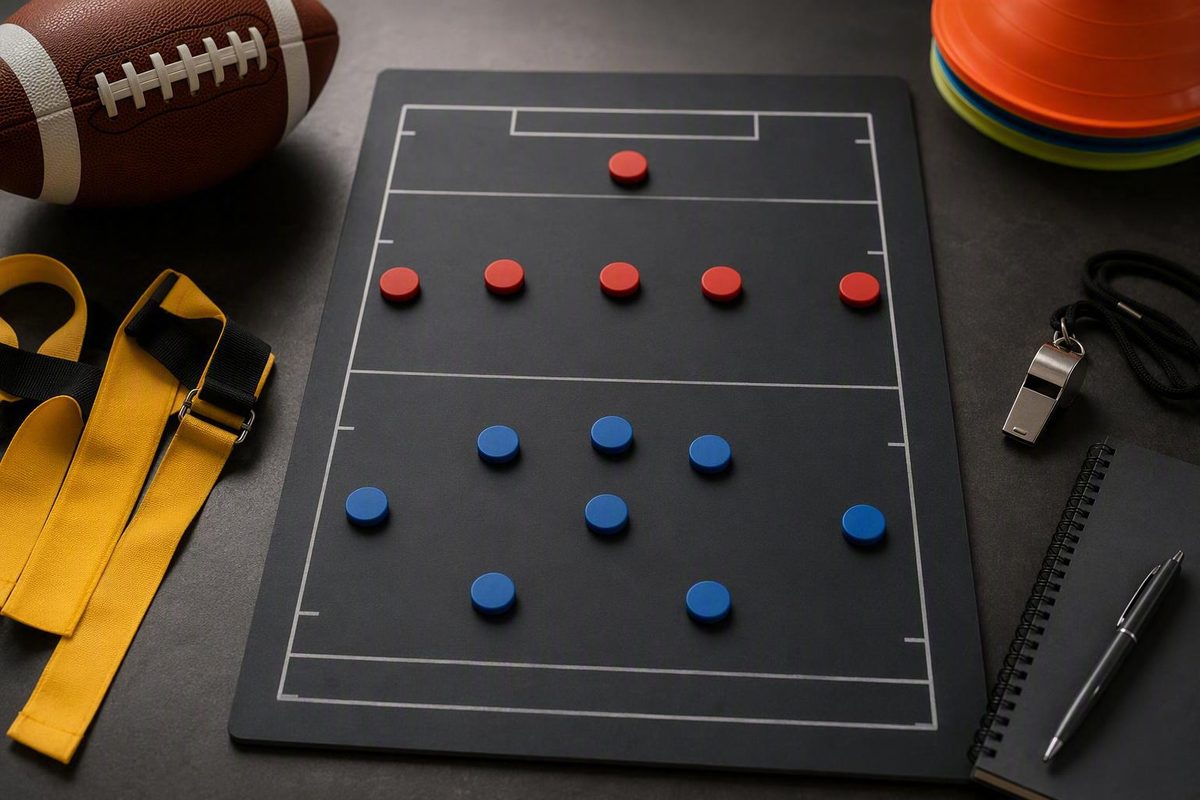
Flag football has six core positions. On offense: quarterback, center, and wide receiver, with a running back as an optional fifth player. On defense: rusher and defensive back, with one defensive back usually playing deeper as the safety. A standard 5-on-5 offense is a quarterback, a center, and three receivers, or two receivers and a running back; the defense across from it is one designated rusher and four defensive backs. The NFL FLAG position guide lists exactly those roles. What each player may legally do, and whether extra roles such as linebacker or tight end exist at all, depends on the player count, age division, and the governing rulebook.
Tap any player in the diagram or the table to see where that position aligns and its first job after the snap; switch the personnel button to swap the running back for a slot receiver.
5-on-5 lineup: one rusher and four defensive backs against a five-player offense
Quarterback
- Aligns
- Behind the center and receives the snap.
- After the snap
- Reads the coverage, then passes or hands off. In NFL FLAG the snap recipient has a seven-second pass clock and may not advance the snap straight across the line without a qualifying exchange.
- Rule to check first
- Whether the snap recipient may run, the pass clock length, and no-run zones.
| Position | Aligns | First job after the snap |
|---|---|---|
| Behind the center | Read coverage; pass or hand off inside the pass clock | |
| Over the ball | Snap, then release into a short route if eligible | |
| Outside, both sides | Release on time, reach called depth, catch, keep spacing | |
| Inside, 3-WR lineup | Attack interior space; quick answer against pressure | |
| Backfield, offset | Take the handoff or catch from the backfield | |
| League rush point | Pressure on a controlled angle; contain; pull the flag | |
| Near a receiver or in a zone | Hold leverage, contest the throw, pull the flag | |
| Underneath, inside | Cover the slot or back, or a short zone | |
| Deepest defender | Stay deeper than the deepest threat; call changes |
Roles and lineups from the NFL FLAG position guide and rules (seven-yard rush line, seven-second pass clock, eligible center). Other leagues use different distances and eligibility rules. Diagram not to scale.
Small Lineups Fold Several Jobs Into Broad Position Groups
Flag football keeps the familiar labels, but a five-player side compresses several tackle-football jobs into wide groups. A slot receiver is still a receiver. A cornerback and a safety are both defensive backs. The designated rusher may be a different athlete from one snap to the next.
| Side | Position | Primary job | Where it appears |
|---|---|---|---|
| Offense | Quarterback | Receive the snap and distribute the ball | 5-on-5 and larger |
| Offense | Center | Snap, then execute the assigned post-snap job | 5-on-5 and larger |
| Offense | Wide or slot receiver | Run routes, catch, preserve spacing | 5-on-5 and larger |
| Offense | Running back | Take exchanges or receive from the backfield | Optional in many 5-on-5 lineups |
| Defense | Rusher | Pressure and contain the passer | 5-on-5 and larger |
| Defense | Defensive back or corner | Cover receivers, pull flags after completions | 5-on-5 and larger |
| Defense | Safety | Protect deep space and communicate | Often a defensive-back assignment |
| Format-specific | Linebacker, tight end, lineman, shield | Coverage, receiving, protection, or legal positioning | Larger formats |
Linebacker, tight end, offensive lineman, and shield are not universal flag football positions. They appear in some larger or differently governed formats.
Slot receiver, cornerback, safety, and designated rusher often name an alignment or an assignment on one call rather than a permanent roster spot. A defender might play outside corner on one call, deep safety on the next, and rusher later if the rules and the defensive call permit it.
Offensive Positions: Alignment, Snap, and Post-Snap Job
Teach every offensive role in three stages: where the player starts, what happens at the snap, and what the player does next.
| Position | Alignment and snap | Post-snap responsibility | Skills and rule check |
|---|---|---|---|
| Quarterback | Behind the center; receives the snap | Reads coverage; passes, hands off, or executes another legal exchange | Accuracy, footwork, timing; verify running restrictions |
| Center | Over the ball; delivers the snap | Releases into a route or performs another permitted assignment | Snap consistency, awareness; verify eligibility |
| Receiver | Outside or in the slot; releases into a route | Creates separation, catches, advances securely | Route detail, spacing, catching; verify motion and formation rules |
| Running back | Backfield or offset | Carries, catches, or executes another legal backfield action | Exchanges, vision, cuts; verify pitches, laterals, and passing authority |
Quarterback. The quarterback receives the snap, manages the play, reads the defense, and normally distributes the ball by passing or handing off. Do not teach that the quarterback can never run as a universal rule. Some formats restrict the player who receives the snap; others handle quarterback movement and exchanges differently.
Center. The first job is an accurate snap. Unlike a blocking center in tackle, the center may release as an eligible receiver after the snap under the NFL FLAG rules. Build that route into a concept only after confirming the applicable league also permits it.
Wide receiver. Outside receivers stretch the defense across the field and downfield. Slot receivers begin closer to the formation and often attack interior space. Both must release on time, reach the called depth, create separation, secure the catch, and keep useful spacing.
Running back. An optional personnel choice in many five-player offenses. The running back may take a handoff or catch from the backfield. Permission to pitch, lateral, or throw comes from the ruleset, not from the label.
Two clean 5-on-5 personnel groupings are quarterback, center, and three receivers; or quarterback, center, two receivers, and one running back. Both are recognized in the NFL FLAG position materials. Neither requires finished skills. Throwing accuracy, clean snaps, route detail, catching, spacing, and ball security are development priorities, not prerequisites for trying a position.
Defensive Positions: Pressure, Coverage, and the Deep Assignment
A five-player defense must account for pressure, short routes, width, and deep space. Position names organize those jobs, but the defensive call determines who owns each one.
| Role | Usual depth | First responsibility | Common mistake and practice focus |
|---|---|---|---|
| Rusher | League-defined rush location | Pressure while containing quarterback movement | Overrunning the passer; train starts, angles, breakdowns, flag pulls |
| Defensive back or corner | Near a receiver or within a zone | Deny the assigned route or area | Watching the ball and losing the receiver; train leverage and footwork |
| Safety | Deeper than other defenders | Protect the deepest space | Driving too early; train depth, angles, communication |
| Linebacker | Underneath or intermediate | Read backfield action and cover inside space | Chasing outside the assignment; train reads, drops, pursuit |
| Hybrid defender | Varies by call | Rush or cover as assigned | Missing a changed assignment; confirm the job before every snap |
Rusher. When the league uses a defined rush line, the designated rusher starts from that location and attacks on a controlled angle. The job is not to sprint at the quarterback. The rusher contains movement, avoids opening an easy escape lane, and finishes with a legal flag pull or forces an early decision.
Defensive back or cornerback. Aligns near a receiver in man coverage or begins in an assigned zone. The defender maintains leverage, recognizes the route, contests the throw, and gets into position for a legal flag pull if the pass is completed.
Safety. In 5-on-5, safety is usually the deepest defensive-back assignment rather than a separate mandatory position. The safety protects against deep throws, tracks routes entering deep space, communicates changes, and takes a sound pursuit angle when a receiver breaks free.
Linebacker. Appears more often in some 7-on-7 or larger formats. It can combine underneath pass coverage, run-pass reads, pursuit, and communication with nearby defenders.
A hybrid defender may rush on one call and cover on another. Make that assignment explicit in the huddle. “You are the rusher on this snap” is clearer than relying on a permanent position label.
A Worked 5-on-5 Lineup From Snap to Flag Pull
The diagram above shows one practical arrangement, not a mandatory formation. On offense, two outside receivers align wide on the line, the center is over the ball, the quarterback stands behind the center, and the running back sits offset in the backfield. Swap the personnel and the running back becomes an inside slot receiver between the center and one outside receiver.
On defense, the designated rusher starts at the distance the rules require, three defensive backs work underneath across the width of the formation, and the fourth defensive back plays deepest as the safety. The underneath defenders can match receivers man-to-man or divide short zones. The diagram is not to scale; the rusher must align at the distance required by the applicable rules.
On a simple pass concept, the play unfolds by role:
- The center delivers the snap and releases into a short route if eligible.
- The outside receivers run at disciplined widths and depths.
- The running back or slot provides an inside or backfield answer.
- The quarterback identifies pressure, works through the concept, and delivers within any applicable pass clock.
- The rusher attacks under control while maintaining containment.
- The defensive backs preserve leverage, exchange routes when the coverage requires it, and rally for the flag pull.
- The safety stays deeper than the deepest threat until the route distribution or the throw removes that danger.
When possession changes, the same athletes take new jobs. A receiver might cover, the center might rush, and the quarterback might play deep. No two-way pairing is inherently standard or best. Small rosters make communication, shared terminology, and multi-position ability more useful than rigid tackle-football specialization.
How Positions Change From 5-on-5 to 7-on-7
Adding two players creates room for more specialized assignments, but it does not create one standardized 7-on-7 depth chart. The added roles depend on eligibility, contact, formation, and rush rules.
| Unit | Common 5-on-5 core | Possible 7-on-7 additions | Tactical effect |
|---|---|---|---|
| Offense | QB, center, three receivers | Receiver, RB, TE, lineman, or shield | More formations and route distribution |
| Defense | Rusher and four DBs | Additional DBs or linebackers | More distinct underneath and deep jobs |
| Coverage | Combined corner and safety duties | Separate corners, safeties, underneath roles | Smaller area for each defender |
| Protection | Usually no blocking line | Format-specific lineman or shield | Protection changes with contact rules |
A larger offense may add receivers to spread the field, a running back for more exchange options, or a tight end working from a condensed alignment. Some formats also define a lineman or shield. A larger defense may add defensive backs or linebackers, which separates underneath and deep coverage more cleanly.
Traditional blocking linemen are generally absent from strict non-contact 5-on-5, but that does not mean every form of flag football bans linemen, screening, or shielding. The USA Football rulebook hub distinguishes international, USA FLAG 5’s, and USA FLAG 7’s resources and notes that provisions can change by format, competition type, age, and skill level.
Establish the format before writing a 7-on-7 depth chart. Knowing that seven players take the field is not enough. Confirm eligibility, permitted contact, rushing procedures, and whether protection roles exist.
Rules That Change What Each Position May Do
A position description explains what the team wants. The governing rulebook determines what the player may legally do.
| Rule to check | Positions affected | Coaching consequence |
|---|---|---|
| Quarterback runs | QB, rusher, DBs | Changes contain rules and whether the snap recipient is a direct run threat |
| Center eligibility | Center, QB, coverage | Determines whether the center can release as a target |
| Rush distance and identification | Rusher, QB | Changes pressure timing and pre-snap communication |
| Pass clock | QB, receivers, rusher | Sets route timing and the pressure window |
| No-run zones | QB, RB, receivers | Removes designed runs in specified areas |
| Handoffs and backward exchanges | Backfield and defense | Changes who may carry, pass, or rush |
| Blocking, screening, or shielding | All players | Changes spacing, protection, and legal positioning |
| Contact standard | All players | Defines legal coverage, pursuit, and flag-pull technique |
Under the published NFL FLAG rules, the player receiving the snap may not directly advance that snap across the line of scrimmage without the qualifying exchange the ruleset requires. The same rules describe a seven-second pass clock for the snap recipient, with different treatment after a permitted backward exchange. Designated rushers identify themselves from a seven-yard rush line, and defensive rush eligibility expands after a qualifying backward transfer. In that format the center may release as a receiver, and no-run zones near midfield and the goal line remove designed runs in those areas.
Use seven yards, not seven feet, when teaching the NFL FLAG rush line. Some position summaries use seven-feet wording, but the governing NFL FLAG rules page specifies seven yards. Other organizations may use another distance, a verbal count, different identification procedures, or age-based restrictions.
Do not combine conflicting rules into a homemade universal standard. Sources and local regulations differ on laterals, backward pitches, multiple exchanges, blocking, screening, shielding, and contact. Check the current governing document for the exact age division and competition. IFAF, USA FLAG, NFL FLAG, and local leagues may use different provisions.
Choose a Position by the Task, Not the Label
Start with the task a player wants to perform, then watch the player do it. Do not assign positions permanently by body type, gender, or one early practice.
| Preferred task | Position to sample | Development priorities |
|---|---|---|
| Throwing and directing | Quarterback | Accuracy, footwork, reads, timing, communication |
| Snapping and releasing | Center | Snap consistency, awareness, route transition |
| Running routes and catching | Receiver | Releases, separation, catching, spacing |
| Carrying from the backfield | Running back | Exchanges, vision, cuts, ball security |
| Pressuring the passer | Rusher | Acceleration, angles, containment, reaction |
| Covering receivers | Defensive back | Leverage, footwork, recognition, ball skills, flag pulling |
| Organizing deep defense | Safety | Depth, vision, pursuit angles, communication |
| Reading underneath action | Linebacker | Run-pass reads, zone awareness, pursuit, communication |
These traits guide experimentation. They do not determine eligibility or guarantee success. A player with an inconsistent snap improves through repetitions. A developing thrower can still take quarterback work. A fast athlete still needs route depth, leverage, and body control.
For youth teams and small rosters, observe athletes across several tasks before fixing the depth chart. Rotate who snaps, throws, catches, rushes, covers, and calls the defense. That gives the coach practice evidence instead of assumptions. The card below is Down the Tunnel coaching guidance, not a validated position test.
| Task | Observable behavior | Next position to sample |
|---|---|---|
| Five accurate snaps in a row | Catchable placement, then a quick release from the stance | Center |
| Short throws to both sides | Balanced feet and repeatable placement | Quarterback |
| Three routes at called depth | Maintains spacing and presents on time | Receiver |
| Handoff-and-cut period | Secures the exchange before accelerating | Running back |
| Controlled rush lane | Closes space without overrunning the quarterback | Rusher |
| Mirror and flag-pull period | Protects leverage and finishes under control | Defensive back |
| Deep-zone communication | Stays deeper than threats and directs teammates clearly | Safety |
| Underneath read period | Recognizes backfield action, holds the zone, pursues under control | Linebacker |
Run the card over several practices and vary the situation, opponent, and side of the field. The goal is not to find an objectively easiest or most important position. It is to find the next productive task while developing complete players. Follow the applicable league rules and use age-appropriate practice conditions; qualified in-person coaching handles what a chart cannot.
The coach-ready order of operations:
- Identify the governing rulebook and age division.
- Confirm the player count and the rules that change each role.
- Install one complete offensive lineup and one complete defensive lineup.
- Teach every player where to align and what happens immediately after the snap.
- Rotate athletes through the core tasks before specializing.
Girls’, Boys’, and Coed Teams Use the Same Positions
Girls’, boys’, and coed flag football use the same core position names: quarterback, center, receiver, running back, rusher, defensive back, and safety. Lineups and assignments should follow the format, the governing rules, team needs, and each player’s developing skills, not gender assumptions.
Who Besides the Quarterback May Throw
Sometimes a running back or another player may throw from behind the line of scrimmage after a legal handoff or backward exchange, but that depends on the ruleset. The NFL Play Football glossary describes a running back as able to take a handoff, run, throw, or receive. Verify your own league’s rules for exchanges, laterals, forward passes, and who may become the passer before installing the play.