
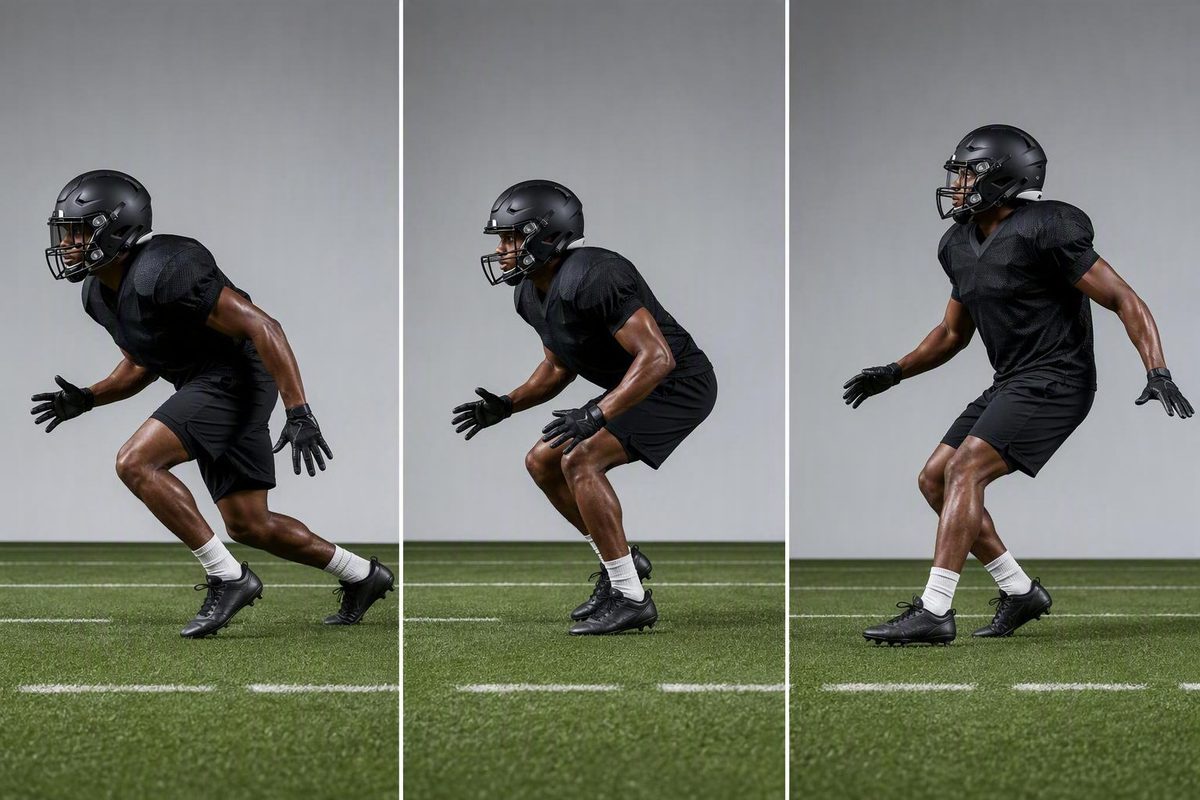
Press-bail, catch, and pedal are best separated by the defender’s first movement after the snap. In Mike Kuchar’s safety-over-slot system, catch means receiving the release with buzzing feet and without a sustained backpedal. Pedal can cautiously describe gaining depth through a square backpedal from off coverage. These labels describe visible technique, not the complete coverage assignment, and their meanings can vary by staff.
Related: How to Read a Defense Before the Snap.
The short answer: watch the first movement, not just the alignment
Chart the defender’s first two or three steps. Alignment provides context, but it cannot identify the technique by itself.
| Technique | Starting presentation and first movement | Cushion, contact, and evidence limits |
|---|---|---|
| Press-bail | Press or near-press presentation, followed by an early opening and movement into depth | May occur without a jam. This is common coaching usage, not a football-wide standard; exact turn and hip mechanics are not established here. |
| Catch | In the cited safety-over-slot system, a limited cushion and buzzing feet receive the release without a sustained backpedal | The available evidence does not establish universal hip mechanics or use by outside cornerbacks. Contact rules are system-specific. |
| Pedal | Off alignment followed by square backpedal footwork that gains depth | Best treated as a provisional film description, not a universally standardized standalone technique. |
Here, catch describes a safety aligned over a slot receiver.
The behavioral distinction is:
- Catch limits retreat in this safety-over-slot system.
- Pedal gains depth while the defender remains square.
Coaches may use bail, catch, pedal, shuffle, or soft press differently. If a clip does not fit your vocabulary, record what is visible before naming it: where the defender starts, whether the first steps hold or increase the cushion, and when the hips open.
Press-bail versus true press
Both starts can present close to the receiver, but the useful film distinction is how long the defender remains square.
In press-bail, the corner shows press or near press and opens early.
True press can instead emphasize patience. Mike Kuchar’s system places the defender approximately 1.5 yards from the receiver, adjusted for the player’s ability, with inside leverage and eyes near the bottom of the receiver’s jersey numbers. He teaches the defender to wait for a declared release and then use an off-hand jam; he also states a personal preference against a two-hand jam. Those details are Kuchar’s coaching choices, not universal requirements for press technique, as his explanation of defensive-back eyes and hands in press coverage makes clear.
On film, ask whether the defender waits square and responds to the release or opens before that declaration. This is more useful than asking only whether the defender lined up near the line of scrimmage.
Agree the first step, turn and hip position with your staff. Press-bail describes an early opening from a press look; the turn mechanics vary by system.
Catch versus pedal: holding the cushion or creating depth
The strongest available catch example is not a general outside-corner rule. It is Kuchar’s technique for a safety covering a slot receiver.
In that system, the safety aligns about five yards off the slot with inside leverage. At the snap, the defender buzzes the feet rather than retreating in a sustained backpedal, receiving the release while limiting the cushion surrendered. If the receiver gets on top vertically, Kuchar instructs the defender to track the receiver’s near hip rather than immediately look for the ball. The depth, leverage, footwork, application, and recovery cue all belong to the specific catch technique system Kuchar describes.
That scope should remain attached to the term. This example does not establish catch as a universal cornerback technique, nor does it establish one required hip orientation for every coach who uses the label.
Use pedal to describe a square backpedal from off coverage that increases the defender’s depth. The defender expands the cushion while staying square. Confirm what your staff means by the term.
Do not assume universal eye placement, leverage, contact rules, route advantages, or positional use for either term. Those details depend on the coverage structure and the staff’s teaching.
A phase-by-phase way to label the technique
Record visible behavior before assigning a label or guessing the coverage. A reusable film worksheet should contain six fields:
- Pre-snap depth: At the line, near press, or clearly off?
- Leverage: Inside, head-up, or outside?
- First two or three steps: Holding ground, retreating square, or opening and moving into depth?
- Hip orientation: Square, partially open, or fully turned?
- Eye target: Receiver, quarterback, or another key that can be seen on film?
- Attempted hand contact: No strike, one-hand strike, or two-hand contact?
In Kuchar’s catch example, the defender initially limits retreat and receives the release. A defender using what your staff calls pedal appears to gain depth while remaining square.
Keep the pedal label provisional. If a staff calls the same square retreat off-man, pedal, or something else, preserve its terminology while charting the visible movement consistently.
Later route positioning may look similar even when the starts differ. In Kuchar’s press-and-catch system, both defenders work toward leverage and control after the receiver declares the release. Similar positioning later in the rep does not erase the different initial footwork.
Do not infer man, match, zone, or safety help solely from the corner’s first movement.
Technique and coverage responsibility are separate layers
Separate three concepts during film study:
- Pre-snap presentation: Where and how the defender aligns.
- Post-snap movement technique: What the feet, cushion, and hips do after the snap.
- Coverage assignment: Which receiver, route, or area becomes the defender’s responsibility.
A specific Cover 7 installation shows why this distinction matters. In its BOX call, the corner uses off-man technique on No. 1. In MOD, the corner aligns in press and uses bail-man technique while retaining the broader BOX assignment rules. The same installation uses a slow bail in Red 7 Switch to help the corner define No. 1’s release before applying the call’s rules, according to USA Football’s breakdown of Quarters and Cover 7 checks.
BOX, MOD, CONE, SWITCH, and Under are terms from that installation, not standardized football vocabulary. Their value here is illustrative: a defense can change the corner’s presentation or movement technique without replacing the broader assignment structure.
A press alignment therefore does not prove man coverage, and a bail turn does not prove zone coverage. Label the visible start first. Then study the safeties, underneath defenders, route distribution, exchanges, and reactions across the secondary before identifying the coverage.
What coaches should define before using these labels
A position group needs operational definitions, not merely a list of borrowed terms. For each technique, define:
- Starting depth
- Intended leverage
- First movement
- Eye target
- Contact rule
- Assignment attached to the technique
Keep the staff’s definitions together: catch can mean buzzing the feet with limited retreat over a slot; bail opens early from a press look; pedal can describe an off-coverage backpedal. The footwork and responsibilities depend on the call.
Cushion, leverage, eyes, hand use, and recovery rules also depend on the coverage structure and the athletes executing it. When studying clinics, articles, or another team’s film, translate each term into observable action before importing it into your own vocabulary.
Technique work carries injury risk and should be supervised by a qualified coach or athletic trainer who can account for the athlete and situation; instructional material cannot replace qualified in-person oversight.
For film study, identify where the defender starts, what the first two or three steps do to the cushion, and when the hips open. Use catch only within a clearly defined system for receiving the release without sustained retreat. Use pedal cautiously for square off-coverage backpedal footwork. Then evaluate the coverage separately under the staff’s own terminology and assignment rules.