
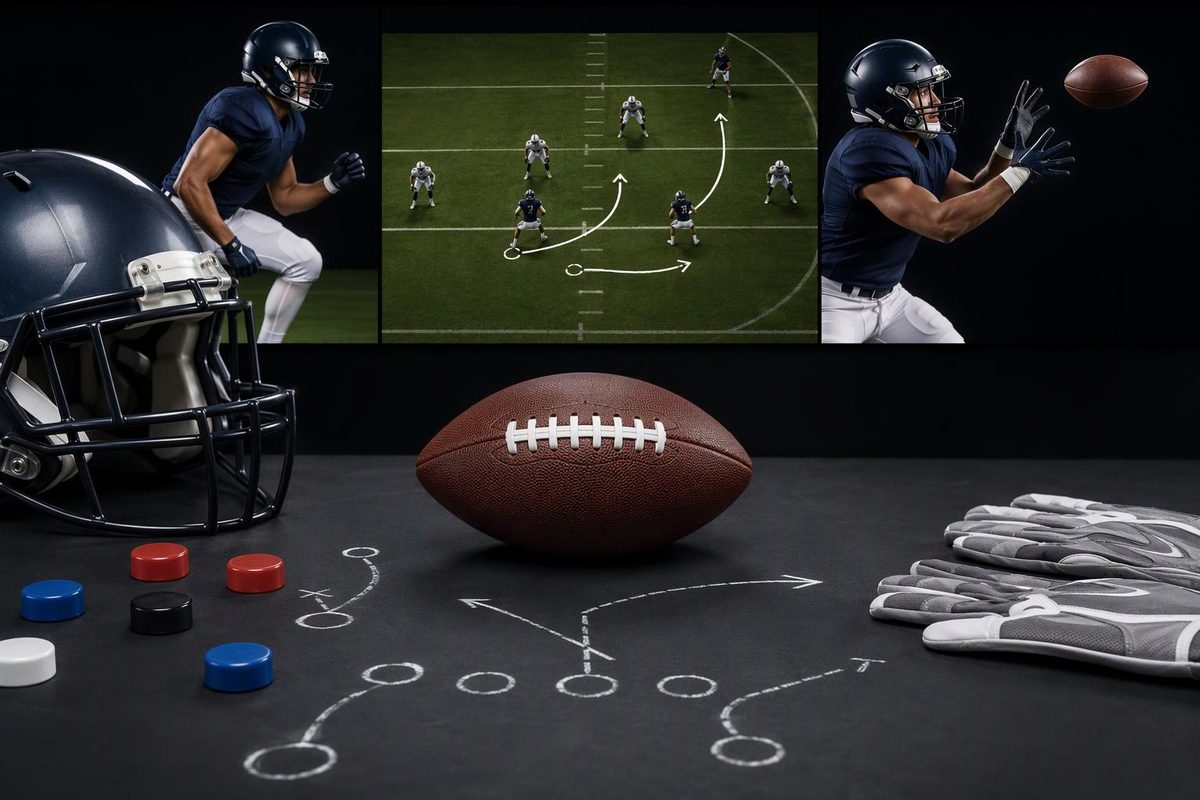
A drag route is a shallow crossing route: the receiver works across the formation near the line of scrimmage. Unlike a slant, it works mostly across the field rather than diagonally upfield; unlike a dig, it stays underneath the intermediate coverage. Throw Deep Publishing’s breakdown distinguishes its shallow drag from the deeper in-breaking route.
For a high school or small-college install, start with three receiver checkpoints: reach the assigned depth, cross without drifting, and show the quarterback whether you are running or settling. The route is not the whole play. Its place in the quarterback’s progression depends on the concept; see the Drive concept install for the shallow–dig combination.
Set one depth—not a range players can choose
There is no single depth shared by every offense. Throw Deep Publishing’s shallow-cross breakdown gives its slot drag a 3–4-yard landmark. Sean Lucas’s Providence Catholic High School installation instead puts the shallow on the pre-snap heels of the defensive linemen, with the receiver looking for the ball immediately. These are different installations, not interchangeable instructions. (Throw Deep Publishing; Sean Lucas’s coaching article)
For the station below, use a 3-yard crossing landmark. If your offense uses a tighter shallow, move the landmark and rehearse that version. Do not let a receiver turn a called drag into a 6-yard cross because that space looks easier to reach.
Define the starting split, release path and crossing depth together. Changing from a slot to a wide split changes how far the receiver must travel before reaching the quarterback’s throwing window.
Coach the receiver in four pieces
1. Win access to the crossing path
Against an unopposed release, take the shortest controlled path to the assigned landmark. Against press, rehearse a specific release that gains inside access without grabbing or pushing the defender. Avoid several lateral moves that leave the receiver behind the play’s timing.
Correction: If the receiver remains near his starting split when the quarterback expects him inside, isolate the release before repeating the full route.
2. Hold the shallow line
Once crossing, run across the field rather than gradually climbing toward the linebackers. Keep speed through the throwing window; do not jog simply because the pass is short.
Glazier’s summary of Wade Lytal’s Trinity (Texas) college installation offers a useful example of precise timing: the receiver hugs the line of scrimmage until crossing the football and crosses at the top of the quarterback’s three-step drop. Use that as an example of coordinating route and drop—not a universal timing rule for every drag. (Glazier Clinics)
3. Make the coverage adjustment explicit
Against man: Continue across the field when the defender trails. Throw Deep’s installation keeps the drag moving against man coverage. (Route coaching points)
Against zone: Teach the rule your offense actually uses. Some installations allow the drag to settle in a void; that does not mean every shallow should stop whenever the receiver sees open grass. If you permit settling, identify the window and rehearse it with the quarterback. Glazier’s summary of Lytal’s installation, for example, includes shutting down the route based on the overhang defender’s position—the underneath defender outside the box. (Glazier Clinics)
4. Finish the catch before turning upfield
Find the quarterback with your eyes while maintaining the route. Track the ball into your hands, secure it, then transition upfield. Grade whether the receiver changed his path before securing the pass, not just whether he caught it.
Give the quarterback a matching cue
In this station, coach the quarterback to see both the receiver and the underneath defender in the throwing lane. A trailing defender does not make the pass safe if another defender is waiting ahead.
For a moving drag, place the ball where the receiver can continue without stopping or reversing. For a called settle, deliver to the established window rather than leading him out of it. Set the quarterback’s drop and release expectation before the first rep; do not invent a separate progression for an isolated route drill.
Run a 12-rep drag station
Setup: Use one quarterback and one receiver, with cones marking the line of scrimmage and a 3-yard crossing line. Begin the receiver in your normal slot split. Mark the expected catch window with a flat disc. Add one defender or coach for the final eight reps. Keep the station noncontact, with clear run-out space.
- Reps 1–4: Path and catch. Two starts from each side. Throw in the marked window. Check depth, uninterrupted crossing speed and ball security.
- Reps 5–8: Man trail. The defender shadows from behind without contact. The receiver stays moving; the quarterback practices placement ahead of him.
- Reps 9–12: Zone window. The defender either occupies the throwing lane or leaves the agreed window open. Apply your keep-running or settle rule. If the lane is closed, the quarterback holds the throw and the rep ends.
On film, freeze the route at the quarterback’s expected release: Is the receiver at the right depth? Is he visibly running or settling? Is the throwing lane clear? Correct that checkpoint before adding another route or formation.