
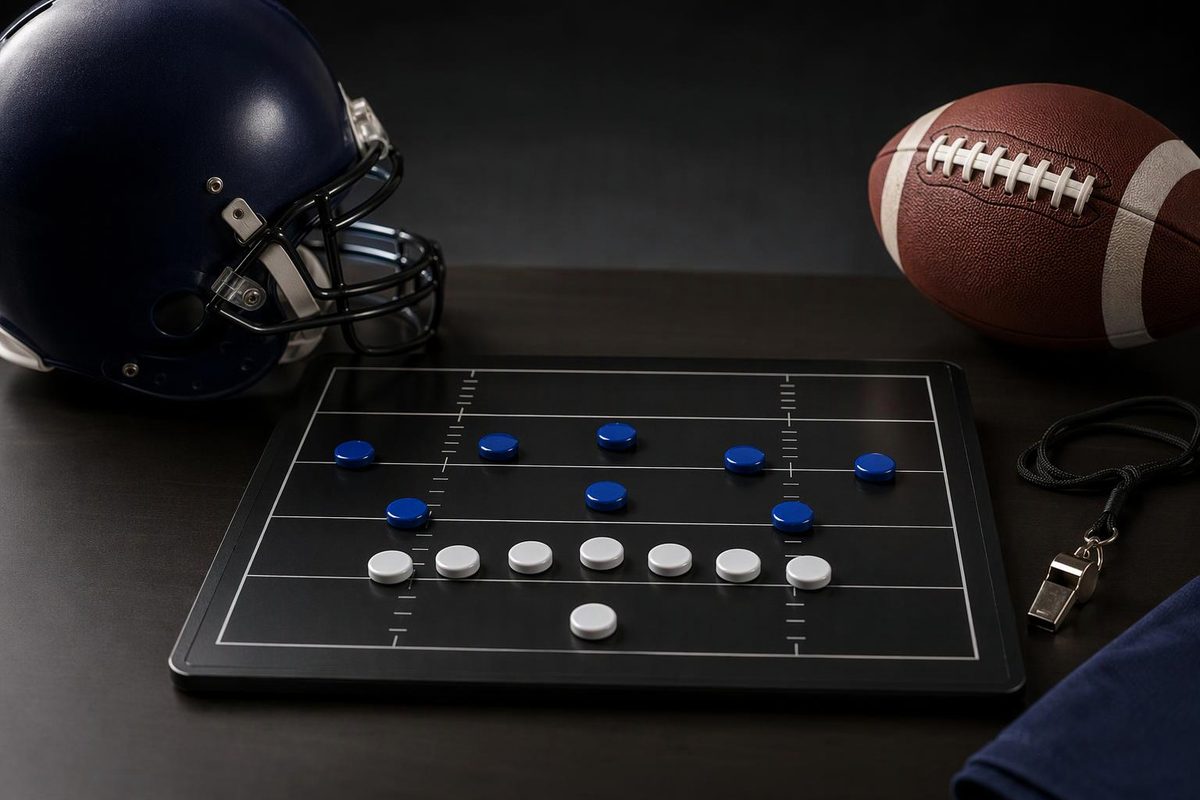
Dime defense is a personnel package with six defensive backs on the field. It adds a coverage player compared with nickel, which has five. The purpose is to improve passing-game matchups—not to prescribe one front, coverage or pressure. Dime can use four defensive linemen, one linebacker and six defensive backs (4-1-6), or three linemen, two linebackers and six defensive backs (3-2-6). VIQTORY’s coaching breakdown explains both structures and their passing-down use.
Count personnel before naming coverage
The numbers below list defensive linemen, linebackers and defensive backs, in that order.
| Package example | Linemen | Linebackers | Defensive backs |
|---|---|---|---|
| Nickel: 4-2-5 | 4 | 2 | 5 |
| Dime: 4-1-6 | 4 | 1 | 6 |
| Dime: 3-2-6 | 3 | 2 | 6 |
Moving from a 4-2-5 defense to 4-1-6 dime replaces a linebacker with a defensive back. It does not automatically change the coverage: dime can support man or zone calls. Nor does six defensive backs mean “Cover 6.” Personnel tells you who is playing; coverage tells you what they do. Source: VIQTORY
The sixth defensive back need not be another corner. A staff can add a safety and move an existing safety into a slot matchup. An archived Cowboys team analysis documented that approach in the NFL: Dallas added J.J. Wilcox at safety so Byron Jones could play in the slot. That is an example of personnel flexibility, not a required dime alignment.
When dime helps—and what it costs
Dime is worth considering when the offense puts multiple receiving threats on the field and the situation favors a pass. Four-wide sets and long-yardage downs are straightforward examples. The extra defensive back can reduce the need for a linebacker to cover a slot receiver in space.
The tradeoff is run defense: replacing a linebacker or lineman can leave fewer front players available to handle blocks and fit the run. VIQTORY identifies this vulnerability. Six defensive backs do not necessarily mean a five-man box, however; a safety can align near the line or enter the fit.
For a high school or small-college staff, make the decision by matchup rather than package name:
- Can the sixth defensive back handle the assigned receiver better than the player leaving?
- Who owns each run gap, the outside force assignment and quarterback contain?
- Can the group communicate against motion and bunch formations?
If those answers are unclear, keep the more dependable personnel on the field.
A 4-1-6 assignment example
Against four receivers in a balanced 2-by-2 formation, with one running back, consider this illustrative one-deep man call with an underneath robber. The robber is a help defender reading inside routes; these jobs are not universal dime rules. This is a pass-assignment map, not a complete run-fit install.
| Position group | Assignment in this example | Observable checkpoint |
|---|---|---|
| Four defensive linemen | Rush with assigned lanes; react to run blocks | Each edge rusher maintains his called contain responsibility |
| One linebacker | Cover the running back if he releases; execute the called run fit | Identify the back’s release without losing the draw key |
| Two outside corners | Cover the outside receivers | Maintain the leverage specified by the call |
| Two slot defensive backs | Cover the inside receivers | Communicate motion and traffic adjustments before the snap |
| Deep safety | Provide middle-of-field help | Stay deeper than the deepest threat |
| Robber safety | Help underneath and execute assigned run support | Do not chase an underneath route beyond the help responsibility |
That accounts for all 11 defenders: four rushers and seven coverage players. Before practicing it, specify the linebacker’s job when the back blocks, the robber’s exact run-fit responsibility and the remaining defenders’ run jobs. “Help inside” is not a complete assignment.
Check it on film, then walk it through
On film, identify the six defensive backs by player identity—not just alignment. A safety near the box can look like a linebacker. Then record the front, coverage after the snap, actual rushers and the defender responsible for the back. Grade those separately from the personnel label.
For a short no-contact check, align the example against four receivers and a back. Walk through six snaps: a basic four-receiver pass, back release, back staying in protection, slot motion, draw action and a screen. Stop each rep once assignments are visible; do not finish tackles.
The checkpoint is simple: every defender can state the pass job and run responsibility after the formation changes. If two players claim the same job—or nobody claims it—correct the assignment before adding another dime call.