
Build the period around an assignment, not a collection of moves: get off on ball movement, fit the blocker, protect the assigned gap, then finish. These five defensive lineman football drills form a suggested 20-minute individual period for high school or small-college players in a one-gap defense.
This is not a two-gap read-and-control progression. Confirm each player’s alignment, gap and edge responsibility first; use the defensive line techniques guide for that installation. This period adds rush-path and pursuit finishes to the foundational work.
Set the period before the first rep
After your team warm-up, organize eight players into two groups of four. Give each group a lane 5 yards wide and 10 yards long, with a 3-yard buffer between lanes. Keep waiting players behind the start line and clear of the finish area. Keep every rush and pursuit path inside its lane; widen the working area if that is not possible.
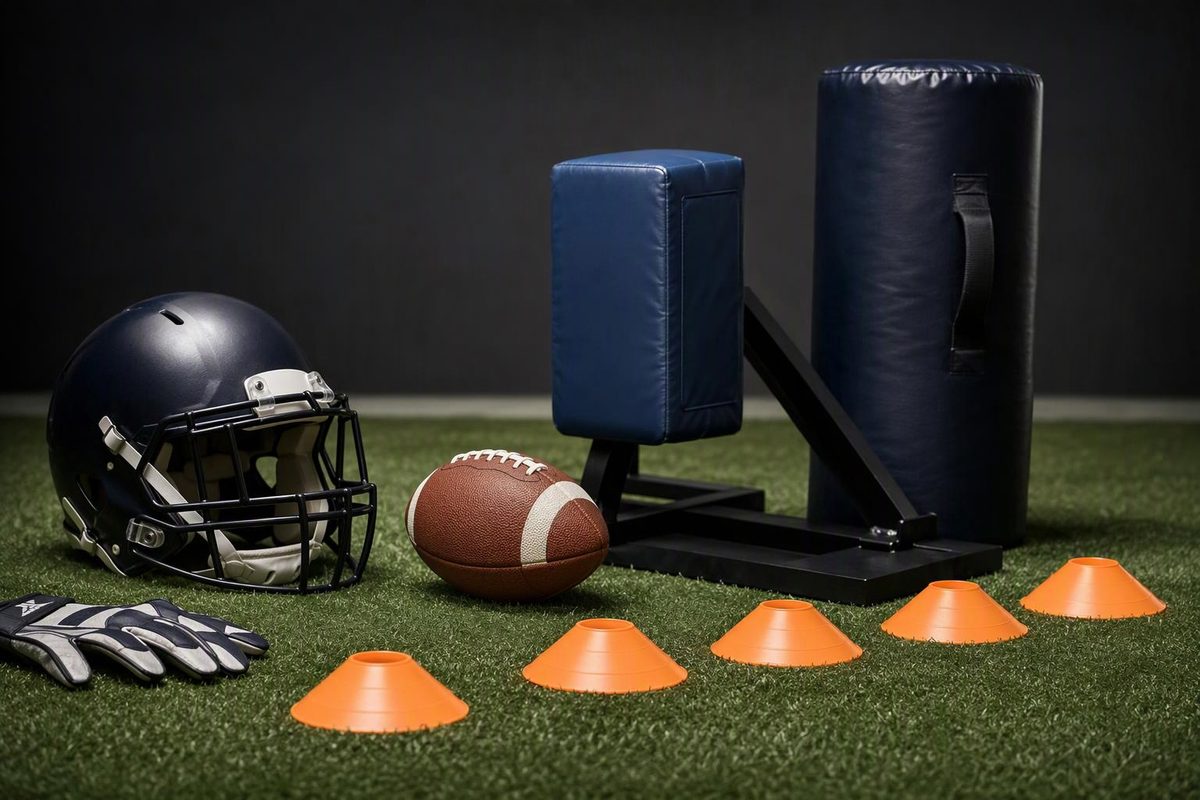
Equipment: football, cones and two blocking shields. Use properly equipped, size-matched partners and qualified supervision for player-contact work. Run both lanes together only when staff can supervise both; otherwise alternate them and reduce rep targets. Follow your governing body’s practice-contact limits.
| Time | Drill | Target per defender | Contact ceiling |
|---|---|---|---|
| 0–3 minutes | Ball-key get-off | 6 starts | None |
| 3–7 minutes | Two-step hand fit | 6 fits | Shield contact |
| 7–12 minutes | Base, reach or down reaction | 6 reads | Controlled, predetermined defender win |
| 12–16 minutes | Rush path to a landmark | 4 rushes | Shield contact |
| 16–20 minutes | Gap control to pursuit | 4 finishes | Controlled fit; no tackle |
These are planning targets, not conditioning quotas. Reduce reps if instruction or resets take longer. Do not speed up contact to catch the clock. USA Football’s Levels of Contact progression distinguishes bag work and controlled, predetermined-winner work from competitive contact. Keep the partner drills here at an assigned walk-through speed throughout, above the waist, on the feet and noncompetitive.
1. Ball-key get-off
Setup: Mark the line of scrimmage and a finish line 3 yards ahead. Two defenders work at once, one in each lane. A coach moves the football where both can see it. Alternate right- and left-side alignments.
Action: Use the stance installed for that alignment. On ball movement—not the coach’s voice—take the first two steps toward the assigned gap, then accelerate through the finish line. Include one cadence without ball movement between starts.
Dose: Three starts from each side.
Cue: “Ball moves; step into your gap.” Mike Kuchar’s one-gap teaching progression combines an offensive-lineman visual key with peripheral vision of the football and includes straight and redirected get-offs.
Checkpoint: No false start, backward gather step or immediate rise to an upright posture.
Correction: If the defender rocks backward before moving, reset the stance and rehearse only the first step. Correct the start before adding speed.
2. Two-step hand fit
Setup: A partner holds a shield vertically against the torso. Align the defender in the installed shade, close enough to reach the shield after two short steps. Mark the assigned gap beside the holder.
Action: On ball movement, step toward the gap and deliver the installed hand fit to the shield’s torso target. Extend without locking the knees, keep the feet underneath the hips and freeze. The holder offers light resistance but does not charge.
Dose: Three fits from each side; rotate defender, holder and observers.
Cue: “Thumbs up, elbows in.” Those cues appear in Kuchar’s hand-placement progression. Use your scheme’s specific aiming points rather than imposing one fit on every alignment.
Checkpoint: The hands—not the helmet—contact the shield, and the defender remains balanced enough to take another step.
Correction: If the defender lunges and trails the feet, shorten the approach and slow the rep. Do not ask the holder to absorb a harder strike.
3. Base, reach or down reaction
Setup: For this drill, pair an outside-shade defender with a blocker. A coach stands behind the defender and secretly signals the block: base straight ahead, reach across the defender toward the assigned gap, or down away from the defender toward an inside neighbor.
Action: First rehearse each block by name at walk-through speed. Then mix them without telling the defender, maintaining that speed. Allow only two or three blocker steps, give the defender a predetermined win and whistle the rep dead.
For this one-gap period:
- Base: Fit the blocker and maintain leverage in the assigned gap.
- Reach: Get the second foot down and move with the blocker without surrendering the gap-side position.
- Down: Follow the installed squeeze rule along the line, get hands on the departing blocker and look for a possible puller rather than charging blindly upfield.
Dose: Two reads of each block in a mixed order.
Cue: “Read the block; don’t guess the drill.” The hidden-signal setup and block responses adapt Kuchar’s base/down/reach drill.
Checkpoint: The defender’s first two steps match the block and preserve the assignment. This drill stops before a trap or kick-out encounter; teach your staff’s box-or-spill response separately.
Correction: If the defender guesses, reduce speed and ask them to identify the block after each rep.
4. Rush path to a landmark
Setup: Place a shield holder on the line and a quarterback cone 5 yards behind it. Mark the defender’s assigned rush path beside the shield. For an outside-contain rep, mark a finish point outside the cone on the defender’s side—not across the quarterback’s position.
Action: On ball movement, attack the assigned edge of the shield rather than its center. Use a controlled strike-and-rip past the shield’s edge, keeping the rip clear of the holder’s head and body. Keep the feet moving and finish balanced at the marked point—no dive or tackle. Adjust the cone depth to the opponent’s actual pocket in later periods.
Dose: Two rushes from each side.
Cue: “Clear the edge; keep the feet moving; finish in your lane.” Hand-foot coordination and the danger of losing contain on an inside move are emphasized in L.C. Clark’s pass-rush teaching. The shield setup here rehearses the path, not a live blocker’s hand reactions.
Checkpoint: The defender does not run several yards beyond the quarterback landmark or abandon assigned contain to take an inside shortcut.
Correction: If the rush loops wide, shorten the approach and rehearse the turn without a shield. Add resistance only after the path is repeatable.
Keep strikes and clears away from the head. For high schools using 2026 NFHS Rule 9-4-7, no player may use the hands to slap an opponent’s head; the prohibition already applied to defenders slapping a blocker’s head.
5. Gap control to pursuit
Setup: Use a defender, blocker and ball carrier, with the fourth player observing. The carrier starts 4 yards behind the blocker. Mark two run paths, one to each side, contained within the lane.
Action: At walk-through speed, the blocker gives a controlled base fit with the defender predetermined to win. After the defender establishes gap leverage, the coach directs the carrier along one path. The defender maintains the gap until the carrier commits, releases with the installed technique and tracks toward the carrier’s near hip. Keep the pursuit at walk-through speed, too. Whistle the rep dead before the defender closes within 2 yards of the carrier; both stop balanced. No contact with the carrier.
Dose: Two finishes toward each side; rotate all four roles.
Cue: “Own the gap first; pursue second.” In Kuchar’s gap-control approach, releasing before the ball commits can sacrifice gap integrity.
Checkpoint: The defender sees the runner without turning away from the blocker, then follows the installed pursuit rule rather than abandoning the fit early.
Correction: If the defender releases early, freeze the rep before the carrier chooses a path and identify the gap that must remain protected.
Carry one correction into team period
Chart three items on the next six relevant team snaps: legal start, correct block response and assignment preserved at the finish. Record the specific miss—not just “lost rep.” A defender who guesses reach needs more mixed reads; one who wins the edge but loses contain needs a clearer rush landmark. Use that distinction to choose tomorrow’s drill.