
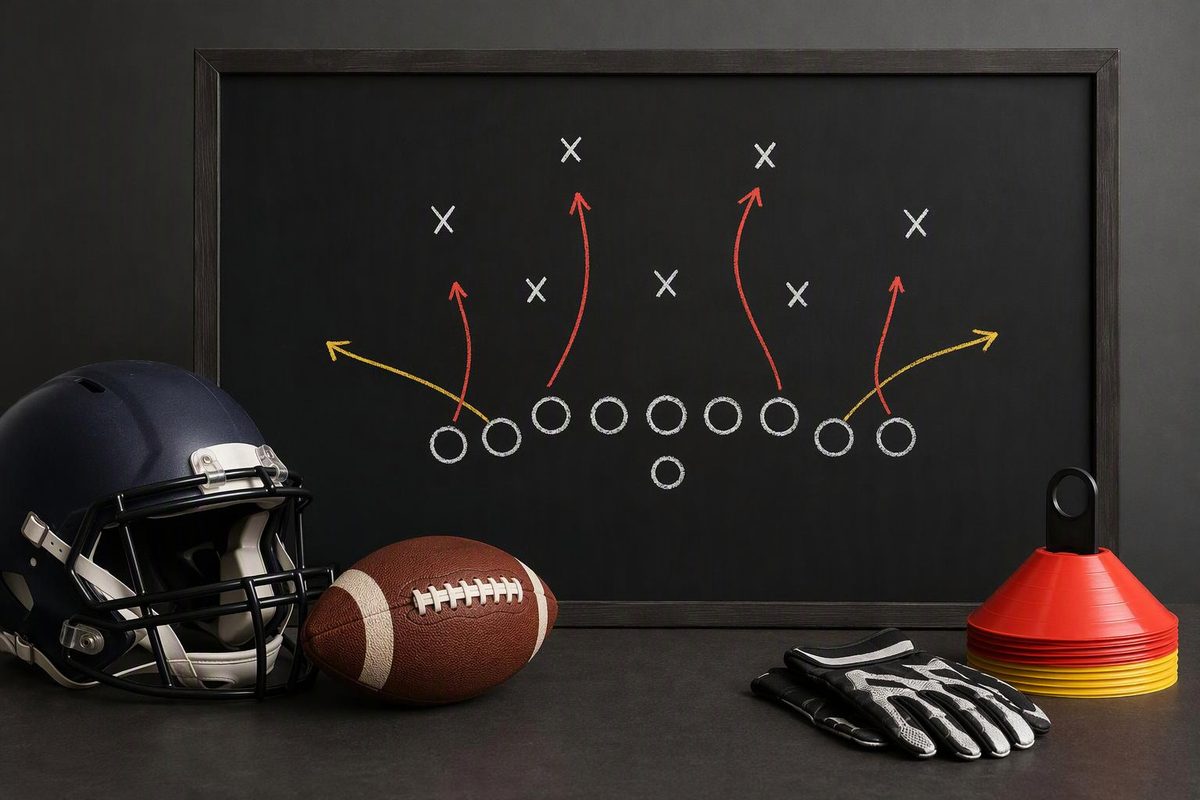
Cover 0 is man-to-man coverage with no deep safety help. The zero describes the absence of a deep help defender—not the number of safeties on the field or the number of rushers. A safety can still play Cover 0 by covering a receiver or joining the pressure. Cover 1, by contrast, keeps one deep help defender. Throw Deep Publishing’s coverage breakdown explains that distinction.
The coaching bargain is straightforward: commit more defenders to pressure, but ask the coverage players to survive without help over the top. Install both halves together. A free rusher does not fix an uncovered receiver.
Assignments: five cover players, six rushers
Against an offense with five eligible receivers, a basic Cover 0 pressure assigns five defenders to those receivers and sends the other six. Here is one example for a high-school or small-college install against 11 personnel—one running back, one tight end and three wide receivers—in a 2-by-2 formation:
| Defender | Assignment in this example |
|---|---|
| Two cornerbacks | Each covers the outside receiver on his side |
| Nickel | Covers the slot receiver |
| Safety | Covers the tight end |
| Linebacker | Covers the running back |
| Four defensive linemen, remaining linebacker and remaining safety | Execute the called six-man pressure |
This is an example, not a universal position chart. Write the actual matchup beside every eligible receiver, then assign each rusher a gap or rush lane and identify who contains the quarterback. Throw Deep Publishing illustrates the same five-matchup, six-rusher structure with different personnel assignments. See its Cover 0 rules.
The back-covering defender needs a separate rule:
- Back releases: cover him, including a swing or screen release.
- Back stays in protection: if your call includes a green dog, add to the rush after confirming that he is blocking.
- Back carries the ball: execute the called run responsibility; do not treat the play as a pass blitz regardless of the back’s action.
The green-dog option is a conditional rush, not permission to abandon the back at the snap. The cited coverage breakdown specifically includes pressure when the assigned back stays in protection.
Cover 0 is a coverage, not a front. You can pair it with different personnel structures; the 4-2-5 defense describes who is available, while the coverage call determines their pass responsibilities.
Technique: know your leverage, not imaginary help
Cover 0 does not require every defender to press at the line. Choose press or off-man alignment deliberately, with enough space to execute the matchup and formation adjustment.
For the first install, give each coverage player three answers before the snap: my receiver, my leverage, my motion rule. Leverage means positioning inside, outside or head-up relative to the receiver. Inside leverage can help deny a quick slant, but it is not a universal Cover 0 rule. DB coach Chad Wilson recommends head-up or tendency-based leverage because there is no deep help defender. His leverage guide ties that choice to scouting and the coverage call.
Useful corrections:
- DB looks into the backfield and loses the receiver: return his eyes to the assigned receiver; do not chase the quarterback’s pump fake.
- DB gives away the release the call intends to deny: reset his alignment and rehearse that release before adding a full route.
- Two defenders chase one receiver through a bunch: stop and reestablish the assigned matchups. Teach any planned coverage exchanges separately before using them in this period; do not improvise a switch mid-route.
Why call it—and how offenses answer
Cover 0 lets the defense bring pressure while accounting for every eligible receiver. Six rushers against five offensive linemen can create a numbers problem, but it does not guarantee an unblocked rusher: the offense can keep a back or tight end in protection. Coach Kou’s NFL and college pressure breakdown discusses those protection adjustments. Use Cover 0 as a pressure changeup when the matchups and protection plan justify the risk, rather than calling it simply because the situation feels aggressive.
The main vulnerabilities are connected:
- Quick throws: a slant, out or other immediate answer may beat the rush if the receiver wins early. Coach Kou’s breakdown shows offenses using those answers against zero-pressure looks.
- Vertical separation or a missed tackle: there is no deep safety to erase the mistake.
- Crossing routes, stacks and bunches: traffic can disrupt man assignments.
- Draws and quarterback escapes: receivers can pull coverage away while rushers work upfield.
Throw Deep Publishing’s breakdown details the big-play, crossing-route and run vulnerabilities. Pressure design must account for the quarterback, not merely produce penetration.
Six rushers are not a requirement. A Cover 0 “rat” variation can rush five and keep one underneath helper for crossing routes or quarterback escapes, while still having no deep safety help. Also distinguish Cover 0 from a Cover 0 look: a defense can threaten pressure, then rotate into a different coverage. Coach Kou’s examples show both rat variations and rotations into Cover 3. No-high-safety alignment alone is not proof; use the pre-snap reading sequence, then confirm assignments after the snap.
A 10-minute no-contact walkthrough
Use 11 offensive and 11 defensive players on a half-field. This is an assignment check, not a competitive tackling period. Use the six-man pressure example above, without adding a rat defender.
Minutes 0–2: match and point. Align in the 2-by-2 formation above. Each coverage defender points to his receiver; each rusher states his gap or lane. Identify contain. Freeze and correct any duplicate or missing assignment.
Minutes 2–5: motion and protection. Walk through motion in both directions, then a back release and a back staying in protection. Check that the matchup survives motion and that the back defender waits for the blocking read before green-dogging.
Minutes 5–10: six controlled reps. Run a slant/out combination, vertical routes, a back swing, a back staying in protection, a bunch crossing concept and a quarterback escape. Before the bunch rep, confirm each receiver’s matchup and any previously installed exchange rule. Walk or jog; rushers stop short of the quarterback, and coverage finishes without contact.
Record three items on every rep: all eligibles assigned, releases handled by the called rule, quarterback contained. If any fails, repeat that situation before adding disguise or another pressure.