
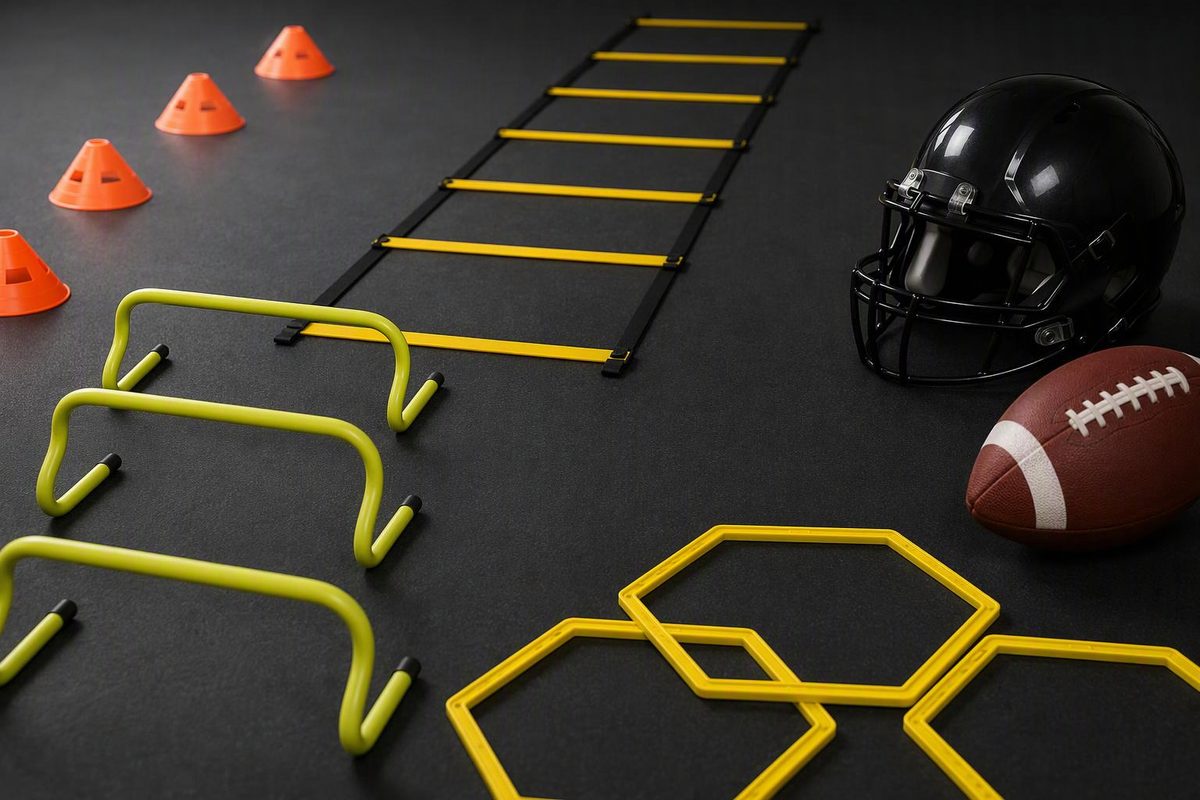
Good football agility drills give players two jobs: control their movement and respond to something they can see. A cone pattern lets you teach the first job. A moving opponent adds the second.
Use this no-contact progression for high school or small-college position groups. Start with braking and planned turns, then add a partner and an unpredictable break. The NSCA recommends progressing basic change-of-direction drills toward reactive work once athletes demonstrate sound body control, using cues relevant to their sport. Keep players at an earlier stage if they cannot yet move under control. NSCA drill progression guidance
Organize the period
Run four four-minute blocks after your normal warm-up. Each block includes a demonstration, repetitions and one correction. The spacing and rep counts below are coaching targets, not testing standards.
- Equipment: Flat cones or field lines; a football is optional for the final drill.
- Groups: Three to four players per running lane. Duplicate lanes for larger groups rather than shortening recovery. For the mirror drill, give each pair its own corridor.
- Workload: Aim for four repetitions per player in each block, with roughly 30–45 seconds between efforts. Both leading and following count as efforts in the mirror drill. Extend recovery or cut a rep if movement quality slips; do not rush to finish within the block.
- Space: Keep waiting players outside the movement area. Leave at least five yards of clear runoff beyond sprint finishes.
- Progression: Begin below full speed. Increase pace only while the player can brake and redirect under control.
Check footing before starting. Stop for pain, slipping or repeated loss of balance; an athletic trainer or qualified in-person coach should address those issues. This is movement practice, not a conditioning test.
1. Accelerate, brake and hold — 4 minutes
Setup: Mark a start line, a line five yards ahead and a stopping zone extending three yards beyond that. Use one runner at a time per lane.
Action: From a two-point stance, accelerate toward the five-yard line. Begin braking as you approach it, stop inside the zone and hold a balanced position for two seconds. Walk back outside the lane. Perform four reps.
Position job: Receivers rehearse arriving under control before a route break. Defenders rehearse slowing an approach without falling past their target.
Cue: “Start slowing before the stop; finish ready to move.”
Checkpoint: The player holds the finish without a recovery hop, hand on the ground or backward stumble.
Correction: If the player overruns the zone, lower the approach speed and start braking earlier. If the finish becomes a deep squat, ask for enough ankle, knee and hip bend to absorb the stop while remaining ready to move. NSCA deceleration guidance cautions that excessive flexion can make the next acceleration less effective. Deceleration technique
2. 5-10-5 shuttle — 4 minutes
Setup: Mark three lines, each five yards apart. Start on the middle line, with clear space beyond both outside lines. Use one runner at a time per lane.
Action: Run five yards to one outside line, touch it, reverse for ten yards to the opposite line, touch it, then sprint five yards through the middle. Perform two reps starting right and two starting left.
This is the route used in the NFL’s 20-yard shuttle. For this teaching version, use a two-point stance rather than the Combine’s three-point start. NFL shuttle description
Position job: All groups practice braking, reversing and accelerating. Treat it as a planned movement drill—not proof that a player can read an opponent.
Cue: “Brake before the line; push out of the turn.”
Checkpoint: The player reaches both lines and exits each turn without slipping or needing an extra balance step.
Correction: If a player dives for the touch or reaches far ahead with the plant foot, reduce speed and rehearse that turn alone. Do not time repetitions until the route and control are consistent. A faster clock does not excuse a missed line.
3. Partner mirror — 4 minutes
Setup: Make a corridor six yards wide. Partners face each other across a two-yard gap, with a separate lateral path for each player.
Action: The leader shuffles left or right for four seconds, changing direction once or twice. The follower stays opposite the leader without crossing into the gap. Rest between bouts and switch roles each time. Complete four bouts per pair so each player leads twice and follows twice.
Position job: Linebackers and defensive backs practice tracking a moving player while staying balanced. Linemen can use the same setup to rehearse short lateral adjustments, without hand contact.
Cue: “Watch the trunk; move with the player, not the fake.”
Checkpoint: The follower stays square and responds to actual displacement rather than every shoulder twitch.
Correction: If the follower guesses and moves first, slow the leader down. If the follower lunges or crosses their feet in this short shuffle drill, shorten the lateral distance and rebuild control. This restriction is for the drill; longer pursuit distances may require turning and running.
4. Backpedal-to-break reaction — 4 minutes
Setup: Mark a start, a backpedal limit three yards behind it, and two target cones three yards left and right of the start. The coach stands five yards in front of the player. Keep the two exit paths clear and use one runner at a time per lane.
Action: The player begins a controlled backpedal. Before they reach the limit, the coach points toward either target. The player reads the signal, brakes, redirects and runs through that target. Give four reps, varying the side without announcing a sequence.
Position job: Corners and safeties rehearse a pedal-to-break transition. For linebackers whose assignment calls for a lateral shuffle, substitute that movement rather than teaching an unrelated pedal.
Cue: “See the cue, then break—no early guess.”
Checkpoint: The first movement after the signal goes toward the correct target, followed by a balanced transition.
Correction: If the player turns before the signal, vary its timing. If the transition produces a stumble, reduce backpedal speed. Once controlled, replace the pointing cue with a quarterback’s visible throwing setup toward one of two short targets. Keep the choices limited; NSCA guidance favors task-relevant cues over generic reactions alone. Reactive drill adaptations
Grade the movement before adding more speed
Record three things: correct response, controlled turn and balanced exit. When a player misses one, repeat at a manageable speed with one correction—not several instructions at once.
Then connect the movement to the assignment. Use the break in defensive back drills, or replace the coach’s signal with a football read in your linebacker drill progression. The next challenge should be a better read, not simply more cones.