
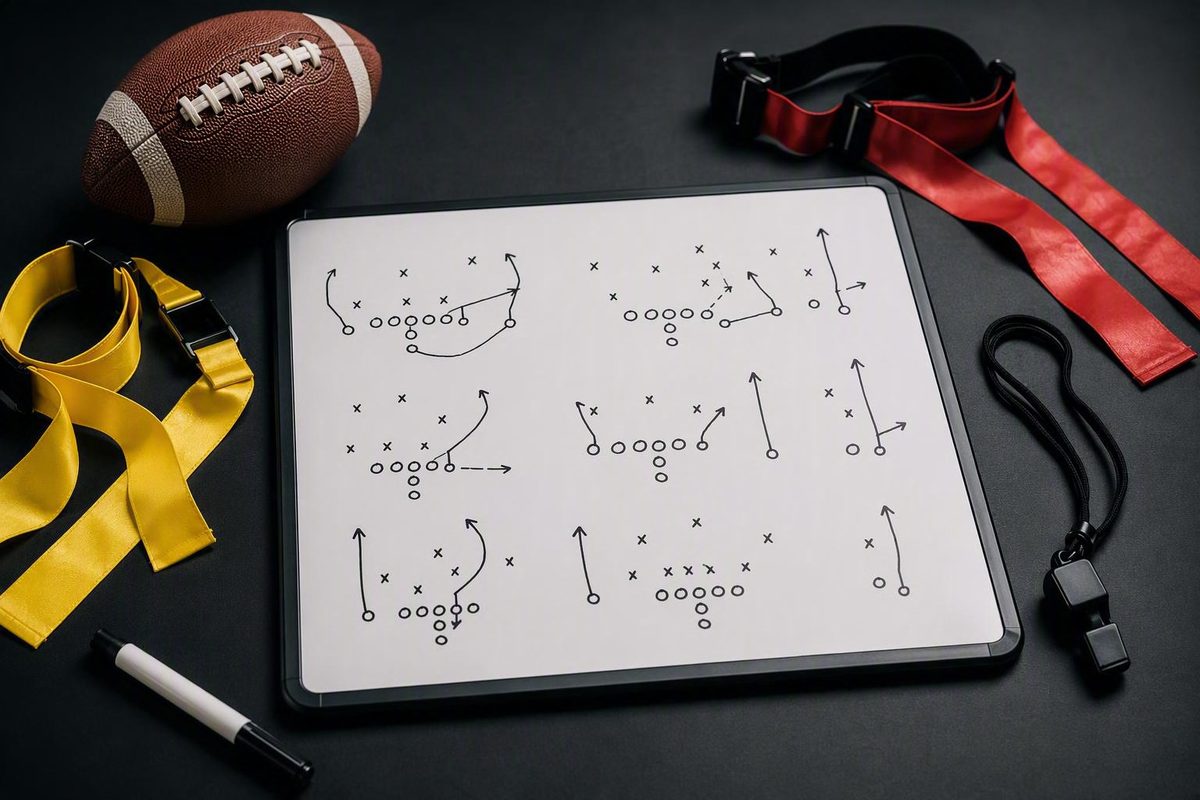
Start with eight complementary 5v5 flag football plays: All Curls, Quick Slants, Mesh, Smash, Three-Level Flood, Triple Verticals, Jet Sweep, and Curl-and-Go (also called Stop-and-Go). Teach them from Spread and Trips, keep the same player labels on every card, and mirror assignments instead of adding terminology.
This package gives the quarterback a basic completion call, a pressure answer, a man concept, two layered zone concepts, two deep counters, and a run where local rules permit it. The route depths, reads, diagrams, and installation order below are Down the Tunnel coaching recommendations assembled from established concepts—not universal specifications.
The eight-play call sheet
Treat each matchup tag as a starting point, not a guaranteed result. Defenders can disguise pressure, switch crossing routes, pass receivers between zones, or win individual matchups.
| Play | Primary purpose | Starting matchup | Field-zone use |
|---|---|---|---|
| All Curls | Basic completion | Soft or uncertain coverage | General use |
| Quick Slants | Fast pressure answer | Immediate rush or favorable inside leverage | Possible no-run-zone call |
| Mesh | Create horizontal separation | Tight man coverage | General use; avoid picks |
| Smash | High-low an outside defender | Underneath zone | Possible no-run-zone call |
| Three-Level Flood | Stretch one sideline at three depths | Zone coverage | Possible no-run-zone call |
| Triple Verticals | Challenge deep leverage with an outlet | Shallow or aggressive defenders | General use |
| Jet Sweep | Attack the edge by handoff | Vulnerable edge | Run-legal areas only |
| Curl-and-Go | Counter defenders jumping curls | Aggressive underneath coverage | Pass-only areas if the pass qualifies |
The package is small because the calls are related. All Curls establishes the receiver’s stop; Curl-and-Go begins with the same stem. Short completions can make vertical routes more credible, while Triple Verticals retains an underneath answer if defenders retreat. All Curls and Quick Slants use the same Spread shell. Smash and Flood use the same Trips shell.
The concept set synthesizes recurring ideas in youth flag resources: quick completions, timing throws, crossing routes, layered zone stretches, vertical routes, and a motion run. The order here is an editorial installation sequence, not a claim that these are the best eight plays or that eight is ideal for every team.
USA Football likewise recommends emphasizing fundamentals, mastering a limited group of plays, and naming the formation before the concept. That is coaching guidance—not comparative evidence that a particular playbook size produces better results—from its five-player flag football playbook.
Set the rules and player labels before drawing anything
Use fixed personnel labels on every card and wristband:
- QB: Receives the snap and distributes the ball.
- C: Snaps, then releases if eligible under the local rules.
- X: Aligns on the left.
- Y: The movable slot receiver or back.
- Z: Aligns on the right.
Those labels do not switch when a play is mirrored. X remains the left-side player and Z remains the right-side player; only their assignments and the concept’s direction change.
Use Left or Right only when it communicates one of three defined details:
- Trips direction: the side where Y joins the outside receiver.
- Concept direction: the side Flood or Smash attacks.
- Motion direction: the direction Y travels on Jet Sweep.
For symmetric concepts such as All Curls and Triple Verticals, omit Left or Right unless the word identifies the primary-read side. For example, Spread — All Curls — Z first is clearer than Spread Right — All Curls.
Before installation, answer these questions in writing:
- How long does the quarterback have to release the ball?
- How many defenders may rush, and where must they start?
- How many plays or downs does the offense receive?
- Where are the no-run or pass-only zones?
- May the quarterback cross the line of scrimmage?
- Is the center eligible immediately after the snap?
- How many players may be in motion?
- Which handoffs, backward pitches, and lateral exchanges are legal?
- Does an exchange end the pass count or release additional rushers?
- Must a forward pass be caught beyond the line of scrimmage?
- What constitutes a catch in bounds?
- What are the conversion distances?
Do not transfer rules from one operator to another. NFL FLAG’s published basic rules, for example, describe a seven-second release limit, four downs to cross midfield, no-run zones, up to two designated rushers, and a requirement that forward passes be caught beyond the line of scrimmage. The organization also warns that formats vary. Check the current NFL FLAG rules and linked rulebook if that is your operator.
Other formats differ materially. One published non-contact ruleset gives an offense three plays to cross midfield, applies a five-second passing count when the defense does not rush, uses different conversion distances, and changes the rush after certain exchanges. It also prohibits blocking and intentional contact. Those provisions apply to that operator’s 5v5 rules, not automatically to yours.
NO-BLOCKING CHECK
Treat every clear-out as a route, not a block. The receiver runs through open grass and continues the assigned path without seeking a defender.
Crossers must use separate lanes. A receiver releasing near the rusher must avoid entering or obstructing the legal rush path. In AAU’s published 5-on-5 format, blocking is prohibited, illegal picks are penalized, and more than one player moving is illegal motion. Apply those provisions only when that is the governing format, and review the current AAU 5-on-5 rules before installation.
Replace every generic rule note in this article with your league’s current wording before printing the call sheet.
Diagram key: ↑ vertical route, ↗/↖ angled route, →/← out or flat, ↔ shallow crossing route, ● settle point, and ~~> motion or ball path. Reads marked 1A/1B are a leverage choice, not two throws in sequence. Alert is a pre-snap option. Diagrams are not to scale.
Install the quick-game foundation
Play 1 — Spread All Curls
Align X and Z wide, Y in a slot, C on the ball, and QB behind C. Send X, Y, and Z to controlled curls at approximately five to seven yards. C snaps and settles underneath if eligible.
                 DEFENSIVE END / TARGET AREA

       (1A) ●              (2) ●              ● (1B)
            ↑ 5–7             ↑ 5–7             ↑ 5–7
            X                 Y                  Z

---------------------- LINE OF SCRIMMAGE ----------------------

                         (3) ●
                             ↑ short
                             C
                             │ snap
                             QB

                 OFFENSIVE BACKFIELD
QB progression: Choose the better outside matchup, X or Z, as read 1A/1B; read Y second and C third. Declare the preferred outside receiver in the huddle or identify that player from leverage before the snap.
Receivers stop under control, face the quarterback, and work back toward the throw. They should not drift into the next route or remain flat-footed while a defender drives forward. Published youth hooks commonly use approximately five to seven yards and teach receivers to stop, turn, and return toward the ball, but compress that landmark for younger players or shorter fields. Football Canada illustrates those details in its Hooks concept.
Coaching correction: If the curls feel crowded, widen the initial splits rather than sending every receiver deeper. Preserve horizontal space between the three stopping points.
Play 2 — Spread Quick Slants
Keep the same shell. X and Z run short slants. Y runs a quick out, and C settles at a legal short landmark.
                 DEFENSIVE END / TARGET AREA

              ↗ (1A)                       (1B) ↖
X / Z
/ short short \

---------------------- LINE OF SCRIMMAGE ----------------------

                         Y ───→ (2A) quick out
                         C ↑ ● (2B) settle
                           │
                           QB

                 OFFENSIVE BACKFIELD
QB progression: Choose the favorable slant as 1A/1B. If pressure closes that window, deliver immediately to Y or C as the 2A/2B outlet choice. Do not wait for a slant to cross the entire field.
Give both slant receivers one shared landmark: a common step count or shallow yardage depth. The exact landmark matters less than both receivers breaking on time. Slants, hitches, curls, and outs are commonly taught as timing routes that may help the quarterback release the ball before pressure arrives; none automatically defeats every rush.
PASS-ONLY VARIANT
Mark the line of scrimmage on the printed card. If local rules require a completed forward pass beyond that line, move Y’s break and C’s settle point clearly beyond it or remove that player from the progression. NFL FLAG’s published basic rules include that beyond-the-line catch requirement; other formats may use different wording.
Quick-game troubleshooting
- Curls occupy one window: Widen the initial alignment.
- Slants break at different times: Use one step count or cone landmark.
- QB is consistently late: Shorten the concept and throw on the break.
- Receivers drift after stopping: Finish each curl by stepping back to the quarterback.
- The rush affects the throwing lane: Move the preferred read away from that path or make the legal outlet the immediate answer.
Add one answer for man coverage and two for zone
Play 3 — Spread Mesh
Send X and Y across the field at deliberately different depths. X passes first on the shallower lane; Y follows on the deeper lane. Z runs vertically as a clear-out, while C settles away from the crossers.
                 DEFENSIVE END / TARGET AREA

                                             Z ↑ clear-out
                                               ↑

       X ─────→ (1) shallow lane
\
X passes first

                    / (2) deeper lane
             Y ────←

---------------------- LINE OF SCRIMMAGE ----------------------

                         C → ● (3) settle away
                         │
                         QB
QB progression: First crosser with leverage, second crosser, then C.
Mesh is commonly suggested against man coverage because horizontal movement makes defenders travel across the field. Its purpose is separation through timing and geometry—not collision. X and Y must not aim at defenders, alter course to obstruct them, or run shoulder-to-shoulder.
Coaching correction: Mark two crossing lanes with cones. X crosses first and shallower; Y crosses second and deeper. Widen the lanes immediately if the receivers converge.
Play 4 — Trips Right Smash
Put Y and Z on the right, X isolated left, and C on the ball. Z runs the outside hitch. Y runs the corner route from inside. C releases to the right flat where legal, while X runs a backside slant.
                 DEFENSIVE END / TARGET AREA

 X ↗ ALERT                           Y ─────↗ HIGH (1)
 backside slant
                                      Z ↑ ● LOW-A (2A)
---------------------- LINE OF SCRIMMAGE ----------------------

                                      C ───→ LOW-B (2B)
                                      │
                                      QB

                         CALL SIDE: RIGHT
QB progression: Check X’s slant as a pre-snap alert. If leverage favors it, throw on time rather than returning to it late. Otherwise, read the call-side outside defender high to low: Y’s corner first, then choose the available low route between Z’s hitch and C’s flat.
If the outside defender stays low, the corner route may have space. If that defender gains depth, the hitch or flat may become available. Another defender can still overlap the routes, squeeze the sideline, or take away the throwing lane.
Smash pairs a hitch with a corner route to create this high-low structure. The hitch and flat must not finish on top of each other.
Coaching correction: If the hitch and corner break into the same window, widen Z or move Y’s corner stem farther inside. If the hitch and flat overlap, widen the flat or relocate the hitch.
Pass-only adjustment: If the governing rule requires the reception beyond the line of scrimmage, place the hitch and flat clearly beyond that line or remove a nonqualifying outlet from the progression.
Play 5 — Trips Left Three-Level Flood
Create three routes to the left: X deep, Y intermediate, and C short. Z occupies the backside area by running a real route without blocking or seeking contact.
                 DEFENSIVE END / TARGET AREA

 (1) deep corner ↖──── X             Z ↑ backside occupy
                    /                   ↑ non-blocking

 (2) intermediate ←── Y
       relative landmark

---------------------- LINE OF SCRIMMAGE ----------------------

 (3) legal short flat ← C
                         │
                         QB

                         CALL SIDE: LEFT
QB progression: Read deep to intermediate to short only when the pass clock and rush picture allow. Against immediate pressure, begin with the shortest legal answer.
Flood places routes at three depths on one side to stress zone spacing. It does not guarantee an opening: defenders can pass routes off, overlap levels, or use the sideline to compress the lane.
Use relative landmarks—deep, intermediate, short—on the base card. If you prefer a numeric landmark, a five-to-seven-yard stem is a published teaching range for an out route, but it is not universal and should be adjusted for age, field size, and arm strength.
Coaching correction: Preserve vertical separation. If C, Y, and X reach the same depth together, the concept has become three receivers in one window. Put cones at the chosen short and intermediate landmarks during installation.
Pass-only adjustment: Move every intended receiving option beyond the required line, or remove any route that does not qualify from the quarterback’s progression.
Build the deep counter and legal run complement
Play 6 — Triple Verticals
Send X, Y, and Z vertically. C releases underneath as the outlet.
                 DEFENSIVE END / TARGET AREA

      X ↑ (1A)          Y ↑ (1B)          Z ↑ (1C)
        ↑                 ↑                 ↑
        ↑                 ↑                 ↑

---------------------- LINE OF SCRIMMAGE ----------------------

                         C ─→ ● (2) outlet
                         │
                         QB
QB progression: Before the snap, identify the least-supported vertical as the preferred choice among 1A/1B/1C. Confirm that leverage immediately after the snap. If defenders remain over the top, take C underneath rather than forcing a deep ball.
Deep routes may influence defenders and create space below them, but the outlet is not automatically open. A defender may ignore a vertical route, rob the center, or close after the throw.
Coaching correction: Vertical receivers must maintain their lanes. Do not let all three drift toward the middle and bring several defenders to one throw.
Play 7 — Jet Sweep
Begin in Spread. Motion Y across the formation and use a quick backfield handoff. X and Z run genuine vertical clear-outs. C snaps and releases away from the sweep if eligible.
                 DEFENSIVE END / TARGET AREA

       X ↑ ROUTE                          ROUTE ↑ Z
         ↑                                     ↑

---------------------- LINE OF SCRIMMAGE ----------------------

              Y ~~> motion ~~> QB
                            handoff ~~> Y → edge

                         C ← release
                         │
                         QB

        RUN PLAY — REMOVE IN A NO-RUN OR PASS-ONLY ZONE
JET SWEEP RULE BOX
Confirm all seven points in the current local rulebook:
- How many players may be in motion.
- Whether Y may move toward the line before the snap.
- Whether the backfield handoff is legal.
- Whether Y may turn upfield with the ball.
- Whether the exchange ends a pass count.
- Whether the exchange allows additional defenders to rush.
- Whether the ball is outside a no-run or pass-only zone.
These provisions vary. In NFL FLAG’s published basic rules, no-run zones require a pass, and a handoff, pitch, or backward throw makes all defenders eligible to rush. Its rules also prohibit blocking and screening. Apply the wording from your own operator rather than treating those provisions as universal.
X and Z run actual routes into open grass. They do not stalk, shield, screen, or place themselves between a defender and the ball carrier. Whether a particular action constitutes illegal blocking or obstruction depends on the governing rules and the official’s judgment.
Coaching correction: Time the snap so Y receives the exchange without stopping. If the mesh point becomes crowded, widen Y’s starting point instead of asking C or another receiver to obstruct pursuit.
Play 8 — Curl-and-Go
This is the Stop-and-Go counter from the All Curls family. Use the same Spread alignment and initial stem. Designate one outside receiver—Z below—to sell the curl before accelerating vertically. Keep the other routes short.
                 DEFENSIVE END / TARGET AREA

       X ↑ ● (2A) curl      Y ↑ ● (2B) curl

                                      Z ↑
                                      ↑ (1) go
                                      ● sell curl
                                      ↑ 5–7

---------------------- LINE OF SCRIMMAGE ----------------------

                         C ─→ ● (3) outlet
                         │
                         QB
QB progression: Z vertical, the better short curl, then C. The quarterback must confirm that Z has regained vertical leverage rather than throwing only because the shot was called.
Football Canada presents Stop-and-Go as a counter after an offense has established hooks. The targeted receiver sells the same stop before accelerating downfield, as shown in its 5-a-side playbook. That sequencing may challenge an aggressive defender, but it does not guarantee separation.
Coaching correction: If the fake lasts too long, the quarterback may run out of time. Use one hard deceleration and immediate acceleration. Keep the short routes active as real outlets.
Pass-only adjustment: Verify that the intended catch satisfies the local requirement. Move the short curls and C beyond the required line or remove any nonqualifying option from the progression.
Call the package by defensive problem
Call plays to address what the defense is doing, not to satisfy a predetermined rotation.
| Observed problem | First call | QB emphasis | Constraint |
|---|---|---|---|
| Immediate pressure | Quick Slants or All Curls | Find the fastest legal outlet | Throw on time |
| Tight man coverage | Mesh | Read crosser leverage | Separate lanes; no picks |
| Underneath zone | Smash or Flood | Use the layered read | Preserve spacing |
| Deep defenders sitting back | Triple Verticals | Take C if confirmed open | Do not force the vertical |
| Defense jumping curls | Curl-and-Go | Confirm regained leverage | Retain a short outlet |
| Vulnerable edge | Jet Sweep | Secure the exchange | Run-legal area only |
| Pass-only or no-run zone | Slants, Smash, or Flood | Verify qualifying catch depth | Remove illegal options |
Give the quarterback a four-part 5v5 pre-snap sequence:
- Identify the declared or likely rusher. Know where immediate pressure can enter.
- Count deep defenders. Decide whether the defense is protecting vertical space or crowding the short field.
- Inspect outside leverage. Note whether defenders are inside, outside, tight, or soft relative to X and Z.
- Locate the fastest legal outlet. Know where the ball goes if the first picture changes.
This is an adaptation for a five-defender flag game. Do not copy tackle-football box counts or conventional one-high and two-high structures without modification; 5v5 spacing, rush rules, and personnel create a different picture.
Pre-snap indicators are hypotheses. A defender can show man and fall into zone, exchange assignments on Mesh, pass a route to a teammate, or abandon a suggested pressure. Teach the quarterback to confirm the picture after the snap.
Mirror a play by preserving the fixed labels while changing their assignments:
- Trips Right Smash: Y joins Z on the right; Z runs the hitch and Y runs the corner.
- Trips Left Smash: Y joins X on the left; X runs the hitch and Y runs the corner.
- Trips Right Flood: Z runs deep, Y runs intermediate, and C releases right.
- Trips Left Flood: X runs deep, Y runs intermediate, and C releases left.
- Jet Sweep Right: Y motions and carries toward the right edge.
- Jet Sweep Left: Y motions and carries toward the left edge.
The spacing, read structure, and route relationships remain the same. Only the side and label-specific assignments change. Broader five-player resources also present formations that can be customized and mirrored, including Spread, Trips, Bunch, Twins, and stacked sets.
Use calls that communicate only necessary information:
- Spread — Quick Slants — Z first
- Spread — Mesh — X first
- Trips Right — Smash — high-low
- Trips Left — Flood — deep-to-short
- Spread — Triple Verticals — Y alert
- Jet Sweep Left — Y
- Spread — Curl-and-Go — Z shot
A three-practice installation plan
Practice 1: Build the quick game
Teach the player labels, Spread alignment, route vocabulary, All Curls, and Quick Slants.
- Align all five players without a defense.
- Mark the line of scrimmage and route landmarks.
- Walk every assignment.
- Run individual curls and slants on air.
- Add the center snap and legal release.
- Rehearse the quarterback’s numbered progression.
- Finish with controlled team reps against a stationary or guided defense.
Coach route depth, balanced stops, eyes to the quarterback, and throws timed to the receiver’s break. Begin the quarterback’s throwing motion before the receiver completes the change of direction; adjust the exact timing to the route, age, and arm strength.
Practice 2: Add the man and high-low answers
Install Mesh and Smash.
For Mesh, mark both crossing lanes with cones. Rehearse X alone, then Y alone, then combine them at walking speed. The first standard is not a completion. It is two receivers crossing without hesitation, contact, or converging paths.
For Smash, teach the hitch and corner separately. Then place one stationary outside defender between the routes and ask the quarterback to identify the high or low option. Add a live defender only after the quarterback can explain the read. Rehearse the backside slant as a pre-snap alert, not a late checkdown.
Stop and reset any rep in which the hitch and corner enter the same window, the Mesh receivers collide, or a route intentionally obstructs a defender.
Practice 3: Install the complements
Add Three-Level Flood, Triple Verticals, Jet Sweep, and Curl-and-Go.
Keep the language short:
- Flood: “Deep, intermediate, short.”
- Triple Verticals: “Best vertical, then outlet.”
- Jet Sweep: “Motion, secure exchange, attack legal edge.”
- Curl-and-Go: “Sell one stop, accelerate.”
Present Jet Sweep and Curl-and-Go as complements to established looks, not isolated trick plays. The sweep starts from the same Spread shell. Curl-and-Go begins like All Curls.
Before adding full defensive pressure, require several consecutive reps with correct alignment, correct route depth, legal rusher access, and no collisions in both directions. Choose the number to fit the age group and practice schedule; one successful rep is not mastery.
Finish with situational periods:
- Must cross midfield on the next play
- No-run or pass-only zone
- Short conversion
- Long conversion
- Final play with no time for another snap
- Immediate-pressure look
- Deep-defense look
Confirm the local rule for each situation before scripting it. A conversion play is not fully defined until the coach knows the attempt distance, running restrictions, and catch requirements.
Coach four details on every rep:
- Route depth: Did each receiver reach the assigned landmark?
- Release order: Did crossing or motion players enter in sequence?
- Quarterback timing: Was the ball released when the window formed?
- Rusher access: Did every offensive player avoid the legal rush path?
Stop and reset any rep involving a collision, deliberate obstruction, screening action, or entry into the rusher’s protected path. Correct the geometry before increasing speed.
Build the printable call sheet with formation or direction first, concept second, primary read last:
- Spread — All Curls — Z first
- Spread — Quick Slants — X first
- Spread — Mesh — X first
- Trips Right — Smash — high-low
- Trips Left — Flood — deep-to-short
- Spread — Triple Verticals — Z alert
- Jet Sweep Left — Y
- Spread — Curl-and-Go — Z shot
Adapt the names to the players’ age and mental workload. Colors, numbers, or one-word concepts all work if every player uses the same language.
Install All Curls and Quick Slants first. Add Mesh as the man answer and either Smash or Flood as the first zone answer. Introduce the vertical and running complements only after the base timing is clean.
Before game day, verify the current league rules, assign the five player labels, print the eight-play call sheet, and rehearse every concept in both directions.