
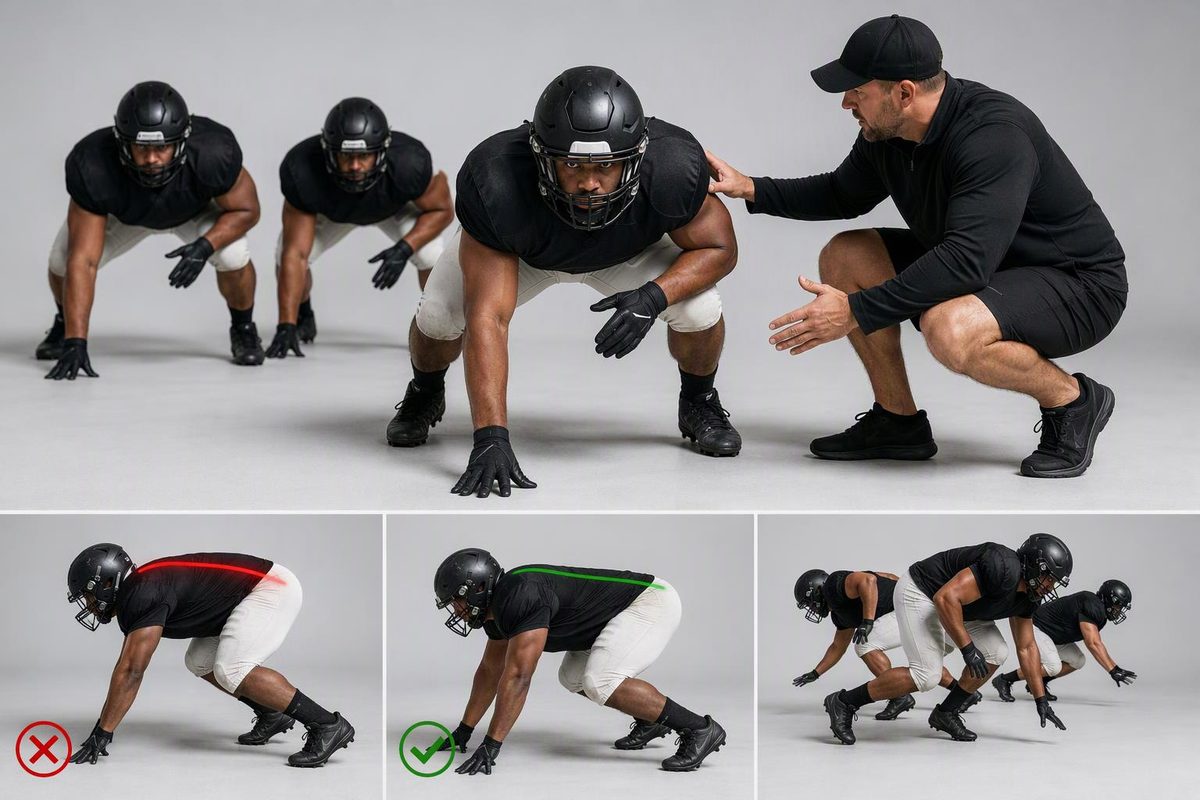
A four-point stance puts both feet and both hands on the ground. For a defensive lineman, it provides a base for taking on a block or starting a pass rush. The coaching task is to make sure the player can leave that base cleanly—not simply get low and stay there. Lou Marinelli’s defensive-line lesson describes both uses.
When to use it
Consider the four-point stance for a nose guard or defensive tackle whose assignment is to engage and control the blocker in front of him. In his youth-football teaching progression, coach Andy Bryson favors it for run defense from head-up alignments: 0, 2, 4 and 6 techniques. That is a coaching preference, not a requirement for every front. Bryson explains his approach here.
In the common technique-numbering system, those numbers describe alignment directly over the center, guard, tackle and tight end, respectively. Two hands down does not automatically mean two-gap responsibility. Teach the stance alongside the call: which blocker to engage, which gap to protect and whether the first movement is straight ahead or into a called gap. For more on alignment vocabulary, use the defensive line technique guide.
Do not choose it solely because a player looks lower. Check whether he can see his key, get his hands off the ground and execute his assignment without an extra gather step.
How to set the four-point stance
Use this as a starting setup, then adjust for the player’s build and movement:
- Set the feet about shoulder-width apart. Point the toes upfield. Use a small stagger, with the back foot’s big toe approximately opposite the middle of the front foot.
- Squat before reaching. Bend through the hips and knees rather than folding over straight legs.
- Place both hands on the ground. Walk them forward in small increments until the back is approximately level. Keep both shoulders level; do not reach one hand farther and twist the torso.
- Keep the eyes available. The player should be able to see his assigned key without dropping his face toward the turf or cranking his neck backward.
The foot spacing, small stagger and hand-walk setup follow Bryson’s four-point stance progression. Treat them as starting landmarks, not measurements to force onto every player.
Your sideline checkpoint: both hands are down, the knees remain bent and the hips have not risen into a straight-legged position.
Leave the stance with feet and hands working together
For a straight-ahead, blocker-control assignment, move on the assigned visual key, take a short first step and bring both hands directly toward the block fit. Do not lift the chest first, pull the hands backward to load up, or reach so far that the feet stop underneath the body.
Teach the palms toward the blocker’s chest/number area, then extension with the feet continuing to work. Keep the head out of the strike. Fritz Shurmur’s hand-skills teaching emphasizes forward hand movement without a windup, arm extension and maintaining low shoulder level.
Choose the key deliberately. In its teaching approach for an attacking four-man front, the AFCA’s defensive-line fundamentals article distinguishes a blocker key for run recognition from a ball key for pass rush or a predetermined movement. Do not tell the player to watch everything at once.
A short no-contact check
Use this eight-rep check before adding a blocker. Set players in lanes 3 yards apart, with 5 yards clear ahead. Use a coach-held ball as the movement cue for these predetermined starts. No blockers, shields or collisions are needed.
- Three stance holds: hold for three seconds, then stand and reset. Check feet, level shoulders and eyes.
- Three straight-ahead starts: take two short steps, bring both hands forward toward an imaginary fit, then stop under control.
- Two called-gap starts: name the assigned gap before each rep and check the first-step direction. Run one player at a time so angled starts do not cross another player’s path.
| What you see | What to correct |
|---|---|
| Hands reach far forward; legs straighten | Reset the squat and bring the hands closer before trying again. |
| Chest rises before the first step | Rehearse the two-step start slowly, keeping the shoulders from popping upright. |
| Hands swing backward before coming forward | Cue “ground to fit”—a direct path with no windup. |
| Player steps backward to gather | Adjust the stagger and hand reach, then repeat at reduced speed. |
Advance when the player can repeat the setup and move directly into the called path. If the position remains uncomfortable or movement stays awkward, reassess it with the position coach rather than forcing the stance.