
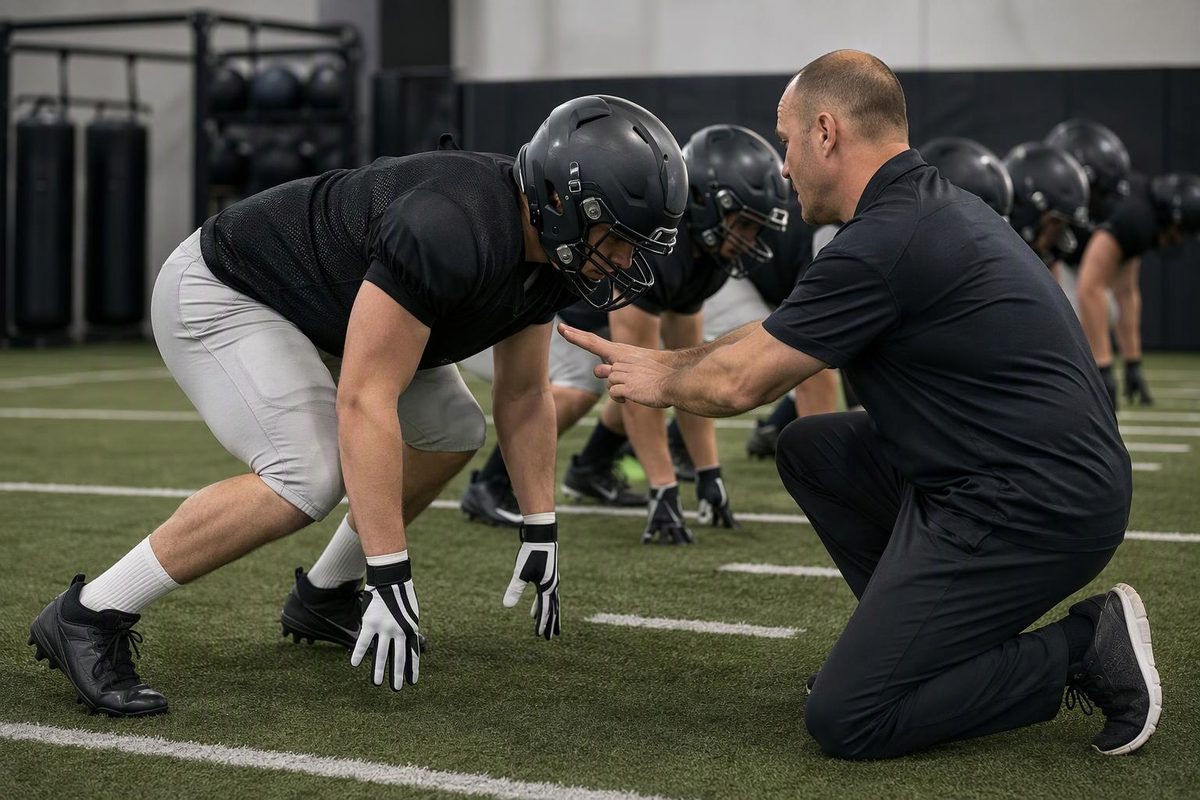
A 2 point stance is a football starting position with both feet on the ground and neither hand down. A three-point stance adds one hand to the ground. Offensive linemen can use the two-point stance to pass protect, but it is not limited to passing plays. ESPN’s stance explainer describes the distinction and its use in pass blocking.
For high school and small-college offensive line periods, teach it as a balanced starting position—not standing upright. The test is whether the player can execute the assigned first step without rocking, hopping or resetting his feet.
Build the offensive line stance
Use these cues for guards and tackles. Centers need a separate snap-and-step check; do not force their setup to match a tackle’s.
- Base: Start with feet slightly wider than shoulder width. Avoid a base so wide that the player must bring his feet together before moving.
- Stagger: Begin with a small outside-foot stagger. Adjust it to your blocking system and the player’s movement, rather than demanding one measurement for every lineman.
- Hips and knees: Bend the knees and sit the hips back. Keep enough chest tilt to avoid an upright start, but do not fold the torso onto the thighs.
- Weight: Keep pressure through the feet without pitching onto the toes or sitting back onto the heels.
- Eyes: Keep the assigned defensive key visible without craning the neck.
- Hands: For this progression, hold relaxed hands in front of the torso with elbows bent. Do not brace on the thighs and then have to unload the hands before moving.
VIQTORY’s offensive line stance guide emphasizes balanced weight, an athletic base and stance depth that varies with the athlete. Its useful principle: a player can be too high to gain leverage or too low to move efficiently.
Check from the front and side. Have the player hold the stance for two seconds, then execute a run step, lateral step or pass set on command. If he must first rise, dip or shift his weight, change one setup variable and repeat.
Match the first movement to the assignment
Run block: Name the defender and the first-step landmark before the rep. The player takes the scheme’s prescribed step while keeping a usable base. Watch for a backward rock before a forward or lateral assignment.
Pass protection: For this progression, use your installed vertical or angled kick-slide set. Name the protection and set direction. The player moves into the set without hopping, clicking his feet together or immediately opening his hips to the sideline. Stop after two movements so the coach can inspect balance. These checkpoints apply to this set drill, not every pass-protection technique.
Do not teach “two-point means pass; three-point means run.” Use a consistent stance presentation across your calls where your system permits it. If you also teach a hand-down start, compare it with the three-point stance setup and progression.
Correct what you can see
| Observable fault | Coaching correction |
|---|---|
| Player stands tall before the snap | Add knee bend and sit the hips back; retest the first step. |
| Player sinks very low, then rises before moving | Raise the starting hips slightly; look for movement without the extra lift. |
| Player rocks backward before a run step | Rebalance pressure through the feet; repeat one step and freeze. |
| First movement is an unintended hop | Reduce the travel demand and cue “step, don’t jump.” |
| Feet come together in the pass set | Shorten the set movement and freeze with a usable base. |
| Tackle’s hips face the sideline immediately in the kick-slide set | Check outside-foot flare, knee alignment and stagger; adjust one variable, then rehearse the prescribed set path. |
An eight-minute, no-contact progression
Setup: Use a clear strip of field. Space players four yards apart, with at least five yards of clear travel space. Work simultaneously where the coach can see everyone. No opponent, shield strike or collision is needed. Run this after the normal warm-up under coach supervision.
0:00–2:00 — Build and hold. Complete four stance holds of three seconds each. Reset between reps. Check base, hips, eyes and hands; give each player one correction at a time.
2:00–4:00 — Run step and freeze. Complete four reps: two toward each assigned side. Name the block and landmark before the cadence. Take one step, freeze and inspect the base. Add the second step only when the first is clean.
4:00–6:00 — Pass set and freeze. Complete four reps in the player’s normal set direction. Use the team’s cadence, execute two kick-slide movements and freeze. Check for an unintended hop, feet coming together or early hip opening.
6:00–8:00 — Mixed assignments. Complete four reps alternating run and pass calls that use the same installed starting stance. Give the assignment before the cadence—not as a surprise afterward. Require the same settled pre-snap presentation and grade the first two movements.
On film, start at the frame before the snap, then watch the first two steps. Record stance balance, unnecessary movement and arrival at the assigned landmark. Keep the setup that produces a repeatable start; change the variable linked to the visible fault.