
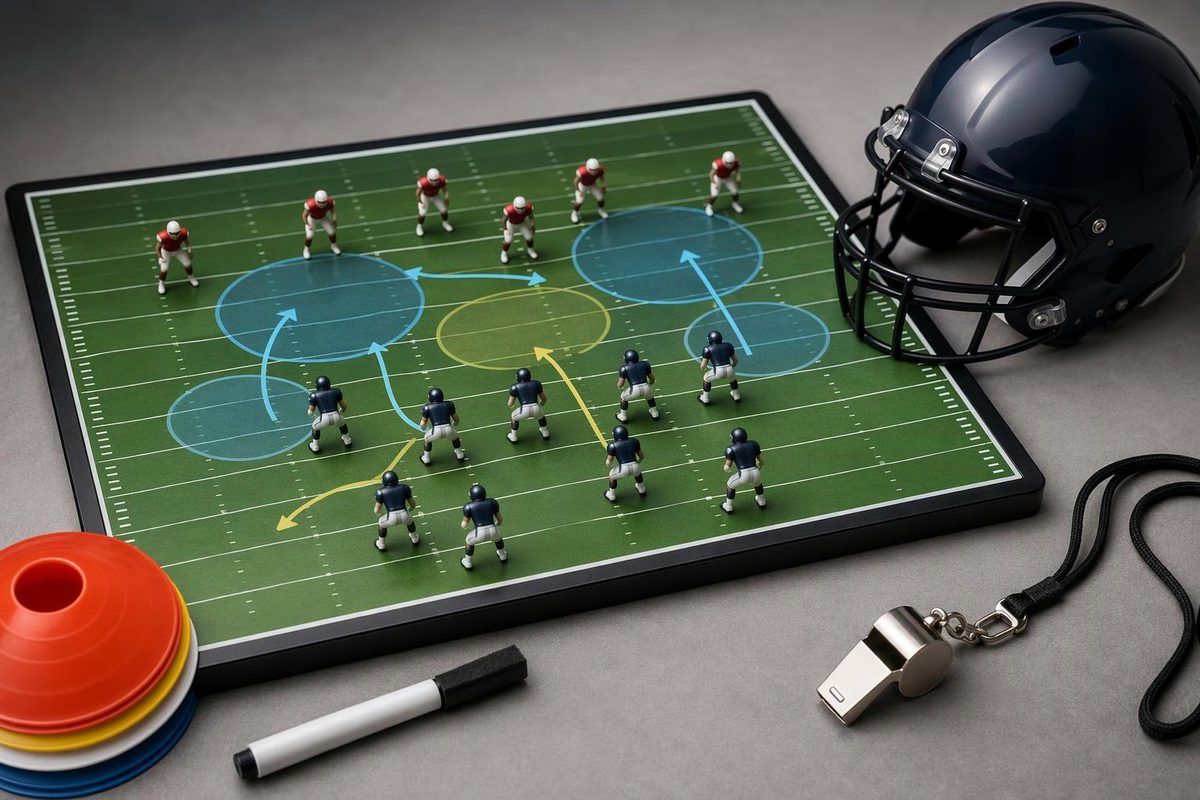
Zone coverage assigns defenders areas and route responsibilities rather than simply assigning each defender one receiver everywhere he goes. The coverage call tells players which threats to protect against, when to carry a route and when to transfer it to a teammate.
For high school and small-college players, the useful teaching point is: cover the threats in your zone—not the cone marking your drop. A landmark organizes spacing; it does not replace reading receivers.
Spot-drop zone versus match coverage
In a spot-drop zone, defenders work toward assigned landmarks, adjust to routes threatening their area and read the quarterback when the technique permits. They do not chase every receiver across the field.
In zone-based pattern-match coverage, route releases trigger specific rules. A defender may carry a receiver vertically using man-coverage technique, while passing an underneath route to another defender. Zone therefore does not always mean “stop here and watch the quarterback.” Matt Bowen’s NFL Cover 3 breakdown shows both landmark drops underneath and corners matching vertical releases.
Write the distinction into your install. “Carry the slot” is incomplete unless players know which releases trigger that responsibility and when, if ever, they can release him.
What the zones mean
Use these as a starting vocabulary, then put your staff’s landmarks and route rules beside them:
| Responsibility | Area or threat to explain | Observable checkpoint |
|---|---|---|
| Deep half, third or quarter | An assigned share of the deep field | The defender protects the threatening vertical instead of abandoning it for a short throw. |
| Hook | Inside underneath area | The linebacker gains enough depth to affect the called intermediate threats rather than standing near the line. |
| Curl | Outside-intermediate area | The defender occupies the throwing lane instead of drifting into empty space. |
| Flat | Short outside area toward the sideline | The defender expands to the outside threat according to the call. |
These responsibilities can be combined. In Bowen’s base Cover 3 example, curl-flat defenders sink through the curl throwing lane before widening with the flat, while middle-hook defenders cushion seams and digs. His stated depths are NFL examples, not mandatory landmarks for your team. See his alignment and drop explanation.
With four rushers and seven coverage defenders, the common starting structures are Cover 2 zone—two deep and five underneath—and Cover 3—three deep and four underneath. Throw Deep Publishing’s comparison describes those distributions. Cover 4 starts four deep and three underneath, but quarters can include extensive matching rules; Bowen’s Cover 4 explanation illustrates safeties and corners responding to receiver releases. Those numbers describe a structure, not every player’s complete assignment.
Give each defender four answers
Before adding disguise or another coverage, have each corner, safety and linebacker answer:
- What is my run/pass key? Name the staff-assigned key; do not teach a blind retreat at the snap.
- Where is my initial drop? State both width and depth for this formation and call.
- Which route changes my drop? Identify the vertical, inside or outside release that demands a response. Specify when the defender’s eyes stay on a receiver and when they return to the quarterback.
- What do I carry, and what do I transfer? Name the receiving teammate and communication word where the call requires an exchange.
A useful high school example comes from Erik Kruppe’s 2019 report as head coach at Farmington High School in Missouri. In that system, outside linebackers read their assigned No. 2 receiver—the second eligible receiver counted from the sideline inward on their side. They settle underneath a vertical, release an inside route and look for another threat, or expand with an outside release. They also run with the wheel. These are Farmington’s rules, not universal zone rules.
An eight-rep, no-contact walkthrough
Use this as a teaching check for one already-installed coverage, not a complete coverage install.
Setup: Put seven coverage defenders against a quarterback and five eligible receivers in a balanced 2-by-2 formation with a back. Use your installed formation splits and defensive alignments; mark the coverage’s initial landmarks with cones. No pass rush, blocking, rerouting or tackling. Keep all eight reps at walking speed.
Run two repetitions of each picture:
- Short outside release paired with a vertical: Check the called curl-flat or flat defender’s expansion. Correct a deep defender who leaves a vertical threat to chase the short route.
- Vertical releases: Freeze before the throw. Ask each defender which receiver now threatens his responsibility and who owns each seam.
- Crossing routes: Check the installed carry/transfer rules. If a defender chases beyond his responsibility, reset him and show the incoming route entering the space he left.
- Repeat a problem picture with a throw: Let the quarterback deliver only after assignments are sound. Defenders react to the pass at walking speed and stop short of the receiver; do not contest the catch or make contact.
On film, grade assignment, spacing, exchange and break separately. Do not count a rep as correct merely because the pass was incomplete. Ask: Was every threatening route accounted for, and did each defender react within the rules of this call?