
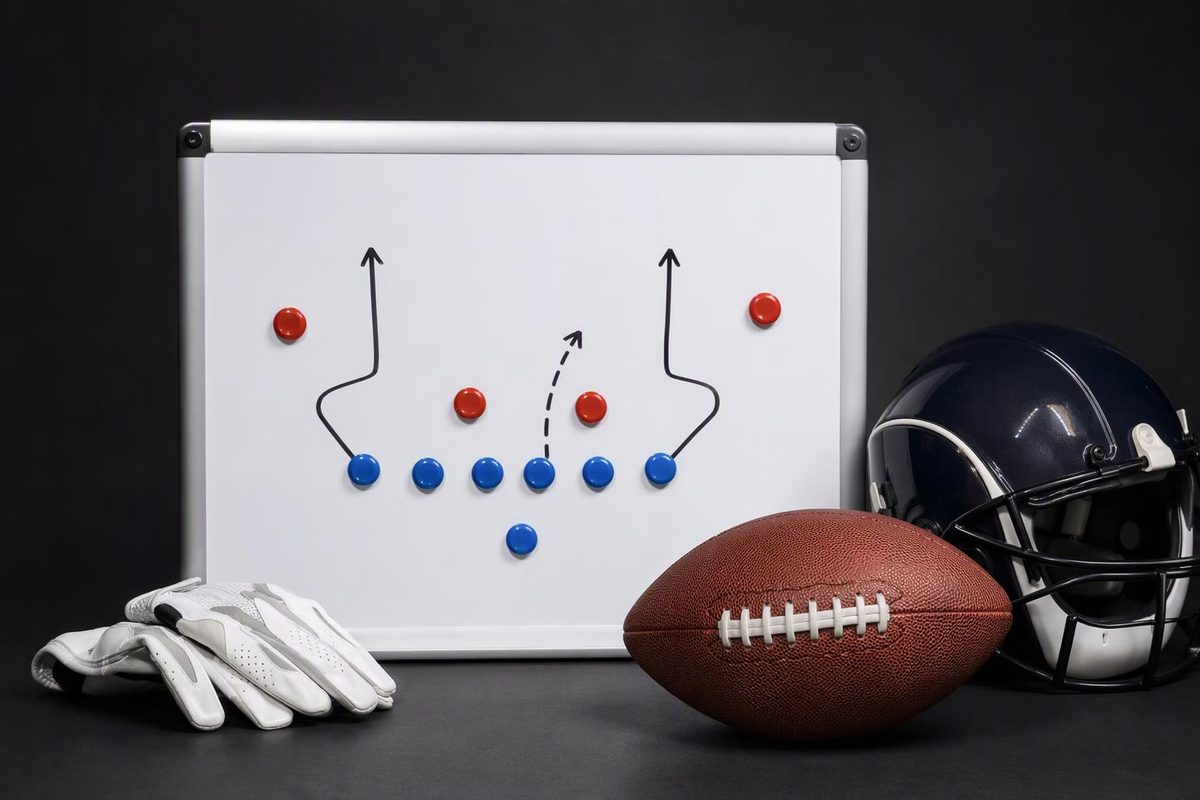
A whip route is a short pass pattern that sells an inside break, then reverses toward the sideline. The receiver’s assignment is not simply to change direction: it is to make the defender commit inside before accelerating outside.
It is commonly called a pivot route, although terminology differs between playbooks. The Scouting Academy’s pivot-route breakdown uses both names for the inside-then-out pattern and illustrates it with NFL receivers and running backs. Put the drawing and landmarks beside your route name so players know exactly what you mean.
Set the landmarks before teaching the move
For a high school or small-college install, start with this suggested slot-receiver version, not a universal route depth:
- Align the slot about 6 yards inside the outside receiver, with at least 8 yards between the slot and the sideline.
- Stem vertically for approximately 3 yards.
- Break diagonally inside for two purposeful steps, reaching roughly 4–5 yards of depth.
- Stop the inside movement and redirect outside, approximately parallel to the line of scrimmage.
- Accelerate toward the sideline and find the quarterback after the redirect.
Mark the vertical stem, inside breakpoint and outside exit with flat cones. Mirror the setup on the other side. Adjust the split and depth to your formation, field position and quarterback’s throwing range; keep the same landmarks throughout the teaching period.
Unlike a straight out route, the whip includes an inside sell. Unlike a slant-and-go, its second break goes outside rather than downfield.
Receiver technique: sell, brake, exit
Sell the inside route with your path. Attack the assigned stem, then take the inside break as though that is the route. Shoulders, hips and stride should support the fake. A head nod without meaningful inside movement gives the defender little reason to follow.
Lower before reversing. As the receiver finishes the inside sell, coach controlled deceleration, lowered hips and a plant close enough to the body to redirect without reaching or slipping. Teach the movement slowly before adding speed. Do not demand a dramatic spin or a long, lunging plant.
Accelerate out; do not admire the fake. The receiver should leave the break on the assigned outside path, then locate the ball. USA Football’s receiver separation guidance emphasizes control at sharper breaks followed by acceleration to gain separation. Apply that principle here without adding extra hesitation steps.
| Observable problem | Coaching correction |
|---|---|
| Defender stays outside throughout the fake | Check whether the receiver threatened inside. Restore the two-step inside path if missing, but recognize that a disciplined defender can still close the route. |
| Receiver stands tall and takes several steps to stop | Reduce drill speed and rehearse lowering before the redirect. |
| Receiver loops upfield after the turn | Re-mark the outside exit at the same depth and require a flatter path. |
| Receiver turns but remains beside the defender | Coach the first two exit steps, not a bigger fake. |
| Receiver looks for the ball before finishing the inside sell | Delay the eyes until the outside redirect begins. |
Use this as a route-specific station within your broader wide receiver drill progression.
Quarterback read and timing
The whip is a useful man-coverage answer, not an automatic completion. Its inside sell asks a trailing defender to change direction twice. USA Football’s breakdown of 2018 NFL plays documents Christian McCaffrey running a whip against a linebacker in a red-zone variation of Cover 2-Man, winning outside leverage for a 6-yard gain.
For the initial team install, pair the slot’s whip with an outside vertical route. The outside receiver runs his route; he is not assigned to block or collide with a defender.
Teach the quarterback to:
- Identify the likely slot defender and the nearby underneath help before the snap.
- Confirm after the snap whether that defender follows the inside break or passes it off.
- Throw as the receiver redirects and the outside window opens, placing the ball toward the exit path and away from the defender.
- Move to the called next read if the defender retains outside leverage or another defender closes the window.
Rehearse the quarterback’s feet with your actual protection and route depth. Do not time this like an immediate slant throw: the receiver still has to reverse direction. It is also not automatically a pressure answer merely because it is short.
Against zone, a defender may wait in the outside throwing lane rather than chase the fake. Keep the fixed route for this first install; do not let the receiver improvise a sit-down conversion unless the quarterback has learned the same adjustment.
A 12-minute, no-contact progression
Use a pod of one quarterback, two receivers and one defender, with a coach observing. This station isolates the whip rather than running the full paired concept. Alternate receivers; the resting receiver watches the breakpoint during the first two stages. For the coverage stage, place that receiver at a marked outlet spot 5 yards deep on the opposite side of the quarterback.
These are suggested workloads. Start the defender at controlled teaching speed and increase the pace only while receivers maintain balance. No jams, blocking or tackling.
- Minutes 0–3 — Learn the path: Each receiver runs six reps without a defender, three in each direction. Begin at walkthrough speed and progress only when the receiver can brake and exit under control.
- Minutes 3–6 — Add the throw: Each receiver gets four reps, two per side. Grade the outside exit and ball placement. Reset any rep in which the quarterback throws during the inside sell.
- Minutes 6–10 — Add the coverage picture: Each receiver gets three reps: two against a man defender and one against a defender holding outside zone space. Tell the quarterback the coverage initially. On the closed-window rep, require a reset and throw to the stationary outlet rather than a forced whip throw. The outlet represents the next read for this drill, not a complete team progression.
- Minutes 10–12 — Retest one correction: Each receiver gets two reps targeting his most frequent error. Keep the correction specific: “lower before the turn” or “two fast steps outside,” not “run it better.”
On film, grade three separate items: Did the inside sell move the defender? Did the receiver exit at the assigned depth? Did the quarterback throw into an open window on time? A catch alone does not answer those questions.