
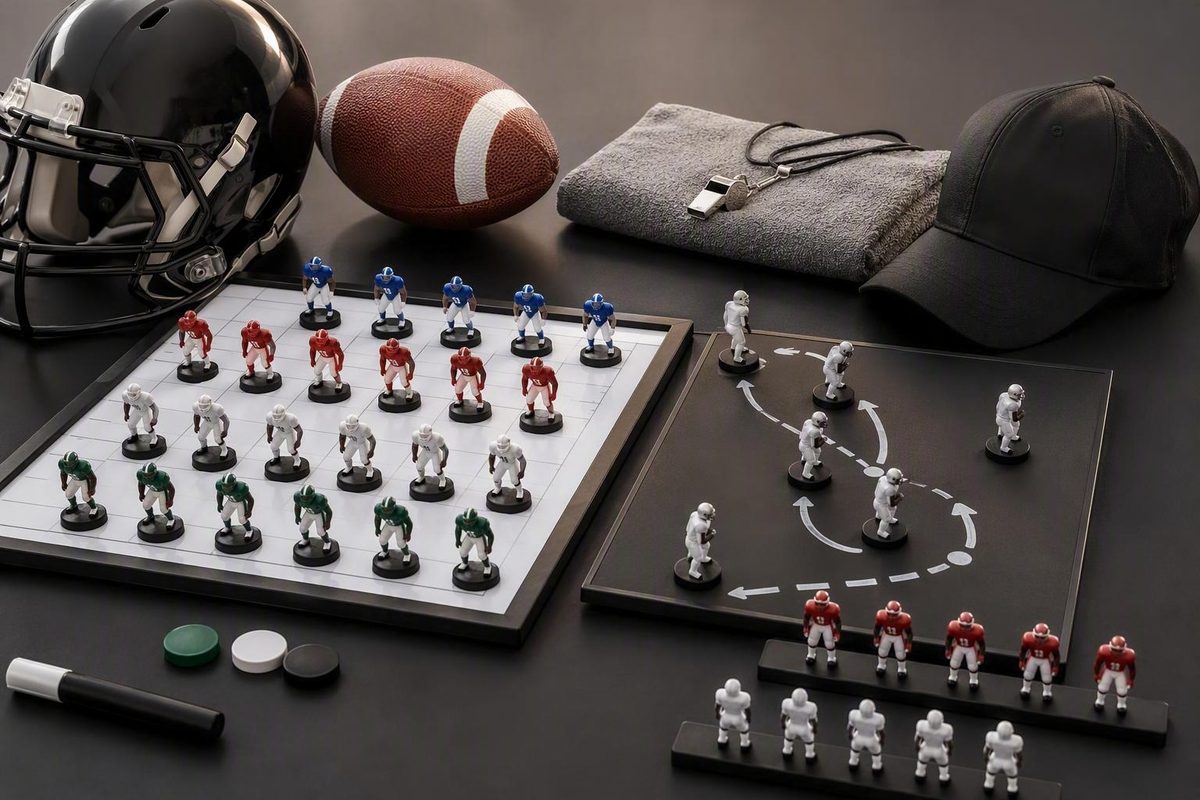
Organize the special-teams depth chart as one master chart that lists every installed unit and role with a starter, a first backup and an emergency replacement, then trace every absence across all units before practice instead of on the sideline. One player often starts on kickoff, protects on punt and holds on field goal; his absence is three vacancies, and the obvious backup may already start elsewhere on the same unit. Tie each row to scripted repetitions, one coach owner and a late-week reporting check in which the staff calls each unit and a designated counter verifies the group.
Edit the rows to match your units, then pick the unavailable player; the chain of replacements and any unresolved gaps update beside the table.
Substitution chain tracer
Starter and backup per unit role. Roles on the same unit are checked for cascades.
3 units affected · 5 moves · 0 unresolved
- Lane 4: Lee enters.
- Protector: Malik enters (also starts Punt return Return role — different unit, check workload), which vacates Gunner.
- Gunner: Chris enters, which vacates PP2.
- PP2: Avery enters.
- Holder: Sam enters.
Default rows are the worked example from this article, not a real roster. A blank backup is unknown and counts as unresolved. The tool checks names only; it does not know your scheme or workload limits.
Trace Every Absence Across Units Before Naming a Replacement
Before naming a replacement, search the entire chart for the unavailable player. One absence can affect several units, and the obvious backup may already hold another assignment on the same unit.
Suppose Jordan starts at kickoff lane 4, protects on punt and holds on field goal. Malik is the backup protector but also starts as a punt gunner. Moving Malik to protector fills one vacancy and creates another. Changing the holder may also pull an offensive player away from another game-day duty.
| Unavailable player | Affected units | Direct replacement | Resulting vacancy |
|---|---|---|---|
| Jordan | Kickoff, punt, FG/PAT | Lee at KO; Malik at protector; Sam at holder | Malik vacates gunner |
| Malik | Punt, punt return | Chris at gunner; Devon at return role | Chris vacates PP2 |
| Primary snapper | Punt, FG/PAT | Alternate snapper | Alternate leaves another unit |
| Unavailable player | Final adjustment |
|---|---|
| Jordan | Chris enters at gunner; Avery enters at PP2 |
| Malik | Avery enters at PP2 |
| Primary snapper | Activate the backup for the alternate’s former role |
Complete the flow in order:
- Mark every appearance of the unavailable player.
- Insert the direct replacement for each role.
- Search every affected unit for the replacements just activated.
- Resolve new vacancies or simultaneous assignments.
- Write the final personnel for each changed unit.
- Count and align the group rather than assuming the chain works.
Cross-trained or “universal” backups belong only where roles share teachable responsibilities. A player who understands several kickoff coverage lanes can cover those lanes in an emergency. That does not make him a snapper, holder, returner or punt protector.
Flag two-way starters and heavily used specialists for workload review. There is no universal fatigue threshold to apply; weigh offensive or defensive load, planned practice repetitions, coach-approved availability and the demands of each assignment.
The trace is finished only when the staff can name a complete, conflict-free alignment for every affected unit. “Malik moves to protector” is not an answer if nobody replaces Malik at gunner.
Build One Master Chart With Starter, Backup and Emergency Fields
Use one page per team, one row per unit and role. If the rows will not fit legibly on a single page, use grouped fields or a landscape second page rather than shrinking the chart until coaches cannot read it on the field.
| Unit | Role or lane | Starter | First backup |
|---|---|---|---|
| Kickoff | Kicker | ||
| Kickoff | Coverage lane or group | ||
| Kick return | Returner | ||
| Kick return | Front-line role or lane | ||
| Punt | Snapper | ||
| Punt | Punter | ||
| Punt | Protector or coverage role | ||
| Punt return | Returner | ||
| Punt return | Rush or hold-up role | ||
| Field goal/PAT | Snapper | ||
| Field goal/PAT | Holder | ||
| Field goal/PAT | Kicker | ||
| Field goal/PAT | Protection position | ||
| FG/PAT defense | Rush or return role |
Add four more fields to each row: emergency replacement, scout counterpart, availability, and coach owner with notes. Expand grouped entries such as “coverage lane or group” into the actual positions your scheme uses. Keep kickoff, kick return, punt, punt return, field goal/PAT and field-goal/PAT defense separate. Add hands and onside units only when they are installed.
Name the snapper, holder, kicker, punter and returners wherever they have assignments. If one snapper handles both punt and field goal, that player still gets an entry on each unit because the surrounding alignment and replacement consequences differ.
“Starter,” “first backup” and “emergency replacement” are working fields, not a mandated three-player structure. A small roster may have one cross-trained emergency option; a deeper team may carry several. The question each row answers is: if the assigned player cannot go, who reports next without a sideline decision from scratch?
Keep four documents distinct:
- Standing unit depth chart: normal personnel order for every role.
- Opponent-specific scout sheet: players and assignments used to imitate that week’s opponent.
- Daily practice script: periods, repetitions, tempo, groups and coaching assignments.
- Game-day personnel card: compact sideline reference for calling and checking units.
These documents must agree on current personnel, availability and substitution decisions, but they should not repeat each other. The master chart establishes assignments; the others apply them to a particular opponent, practice or game.
Scout team is a weekly practice function, not a permanent standing designation. A vendor-published guide to scout-team organization draws the same line. Keep only a brief scout cross-reference on the master chart; the weekly look and detailed assignments belong on the scout sheet.
Script Who Gets the Reps Each Day
The master chart identifies the personnel. The daily script determines who receives the repetitions. For each unit period, write the period, tempo, first-group reps, backup reps, scout look and responsible coach. Leave the repetition fields blank until the staff scripts that practice; sample numbers become an unsupported default if they sit in the template.
Before practice, name the unit, tempo, planned substitutions, opponent look, repetition count and responsible coach. Assign a clock manager or other timing owner so coaches do not spend the teaching period locating players or debating the next group.
Two scheduling models work:
- Rotating emphasis: one or two units get the primary block on a given day while urgent situations elsewhere are touched briefly.
- Daily special-teams work: special teams appear every day with the unit and intensity changing across the week.
Neither is automatically superior. Published templates include eight- and 10-minute special-teams blocks, while individual coaches have described longer daily periods. Those are examples, not evidence of one optimal duration. A commercial timed football practice template shows how special teams can sit beside individual, offensive and defensive work; its sample durations should be adapted to the team.
Every player needs a destination during the period: an assigned unit repetition, a scout look, specialist development, position technique, a backup walkthrough with a coach, or recovery and modified work directed by appropriate team personnel.
When performance, matchup duties, injuries or coach-approved availability change the plan, update the repetitions, then carry the revised personnel decision into the practice script and game-day card.
Run the Four-to-Five-Minute Late-Week Reporting Check
Use this short, non-contact check before a late-week practice:
- Line up the full team facing the staff.
- Call, “Kickoff team.”
- Require the assigned unit to report and align.
- Have one designated counter verify the group.
- Compare the personnel with the game-day card.
- Record every missing, late, duplicate or incorrect assignment.
- Reset and repeat for kick return, punt, punt return, field goal/PAT and field-goal/PAT defense.
- Test selected backups before dismissing the group.
Early in the season, or after major changes, call names when players need help learning the structure. Remove that help as recognition improves. The end state is a player who hears the unit call, knows whether he belongs and reports to the correct role without a coach supplying the answer.
To test the substitution chain, announce, “Starting R3 is unavailable.” The designated backup should report without being named. If that move creates another vacancy, the next replacement should respond too. The counter verifies personnel; the unit coach checks alignment.
A CoachFore post describes running this six-unit review in approximately four to five minutes, using a game-day card and declaring selected starters unavailable to test backups. Treat that late-week personnel check as an operating example from one program, not a proven minimum, a universal time limit or a guarantee that mistakes disappear.
Rehearse the Sideline Transition, Not Only the Alignment
An isolated unit period starts with the correct players nearby. A game does not. Players arrive from offense, defense, another unit or a coaching conversation. The staff has to recognize the situation, signal the next group, make the substitutions and verify the personnel.
Run this non-contact mock-game sequence:
- Offensive third down: call, “Punt team be ready.” After a simulated failed conversion, call, “Punt team, go.”
- Defensive stop: call punt return and require the unit to enter from the defensive sideline group.
- Touchdown: send the PAT unit and check the operation personnel.
- Post-score transition: clear the PAT group and call kickoff.
- Field-goal decision: present down, distance, clock and field position before calling the unit.
- Backup test: announce a simulated equipment issue or unavailable starter and require the replacement to enter immediately.
The readiness call tests anticipation without releasing the group early. The final command tests execution. Practitioner guidance likewise recommends early readiness calls, a designated counter and rehearsed punt alignments in this punt-team readiness article.
Give extra transition attention to punt, punt return and field goal because those units may follow a changing down rather than the more predictable stoppage after a score. That is practitioner guidance, not evidence that the other units need less preparation.
When the objective is personnel recognition and substitution mechanics, the late-week session can run on air without live opposition. A reported special-teams mock-game approach uses simulated situations and intentionally removes selected starters so backups must respond.
Give Six Staff Functions So Every Call Produces 11 Players
| Staff function | Primary responsibility |
|---|---|
| Situation caller | Watches the scenario and announces the required unit |
| Next-unit assembler | Gathers the most likely next group |
| Designated counter | Independently verifies the personnel |
| Unit coach | Checks alignment, lane, role and assignment |
| Correction recorder | Logs missing, late, duplicate or incorrect personnel |
| Master-chart owner | Synchronizes personnel decisions across working documents |
The situation caller keeps eyes on the simulated game state rather than turning away to gather players. The assembler works one step ahead. The counter performs an independent check instead of assuming the group is correct because the alignment looks familiar.
Once players report, the unit coach handles football corrections. Do not ask that coach to monitor the scenario, locate absent players, count the group, repair the alignment and record every change at the same time.
A small staff can combine jobs deliberately. With two coaches, preserve two functions: one makes the situational call, the other verifies the personnel.
Name one owner of the master chart. That person carries every personnel change into the posted internal chart, daily script, affected scout assignment and game-day card, tells the affected players and coaches directly, and walks the change through; a newly posted sheet alone is not communication. When the coordinator role changes hands, the chart and its owner assignment travel with it, the same way the New Defensive Coordinator Handover Checklist treats the defensive call sheet.
Audit Specialists, Overlaps and Emergency Roles Before Game Day
Before declaring the chart game-ready, confirm each line:
- [ ] Every installed unit has a complete personnel group.
- [ ] Every role or lane has a workable contingency.
- [ ] No player has two simultaneous assignments on one unit.
- [ ] Every multi-unit absence has been traced through its secondary vacancies.
- [ ] Current personnel and substitutions agree across all working documents.
- [ ] Snapper, holder, kicker, punter and returner assignments are explicit.
- [ ] Two-way players and specialists with concentrated roles have been reviewed.
- [ ] Each backup knows the unit call and the exact role or lane to enter.
- [ ] Only coach-approved availability labels appear on the operating chart.
- [ ] Sensitive medical or personal details stay with appropriate team personnel.
- [ ] Every recent correction has been walked through.
| Specialist role | Primary | Alternate | Other assignments affected |
|---|---|---|---|
| Punt snapper | |||
| FG/PAT snapper | |||
| Holder | |||
| Kicker | |||
| Punter | |||
| Kick returner | |||
| Punt returner |
There is no universal specialist sequence. An alternate holder might be a quarterback, receiver, backup specialist or another trained player; the step that matters is tracing what that move changes elsewhere.
“I’m second on kickoff” is not enough. The backup must know the unit call, exact lane, alignment, communication and the trigger for entering.
Treat each discovered problem as a revision cycle: record it, correct the assignment, communicate the change, walk it through. The master-chart owner then updates the affected working copies.
Fix Personnel Errors With Resets, Not Extra Contact
Classify the error first.
Administrative personnel errors: wrong unit reporting, an incomplete group, a late substitution, two players reporting for one role, nobody reporting for a vacancy, or an outdated personnel card. Correct these with an immediate reset. State the assignment, have the player repeat it, and rerun the reporting or alignment repetition without contact.
Technique errors: poor leverage, incorrect block mechanics, bad coverage spacing, an inconsistent snap or returner decision-making. Record those for the appropriate individual, group or unit period. Do not turn a personnel check into an extended technique session.
Do not add live collision repetitions because a chart, count or communication failed. A special-teams backup-tracking discussion names clearer assignments, an on-field counter and non-contact walkthroughs as the organizational responses; it is a community thread, not a safety standard.
Adapt period length, tempo, contact and staffing to roster size, age group, player workload, qualified in-person supervision and the rules governing the team. The chart organizes personnel; it does not replace applicable rules or medical decisions.
The weekly workflow:
- Update coach-approved availability.
- Revise the master unit chart.
- Trace every multi-unit substitution consequence.
- Script first-group, backup and scout repetitions.
- Run the scheduled unit work.
- Conduct the non-contact mock-game transition.
- Perform the late-week reporting check.
- Correct errors and synchronize the game-day card.
Before the next late-week practice, print the unit chart, fill every starter, backup and emergency role, and trace one simulated absence involving a multi-unit player. Then call all six core units, check each group and test selected replacements. The output is not a prettier depth chart; it is one synchronized personnel system that tells every player and coach who reports, who replaces whom and who verifies the unit.