
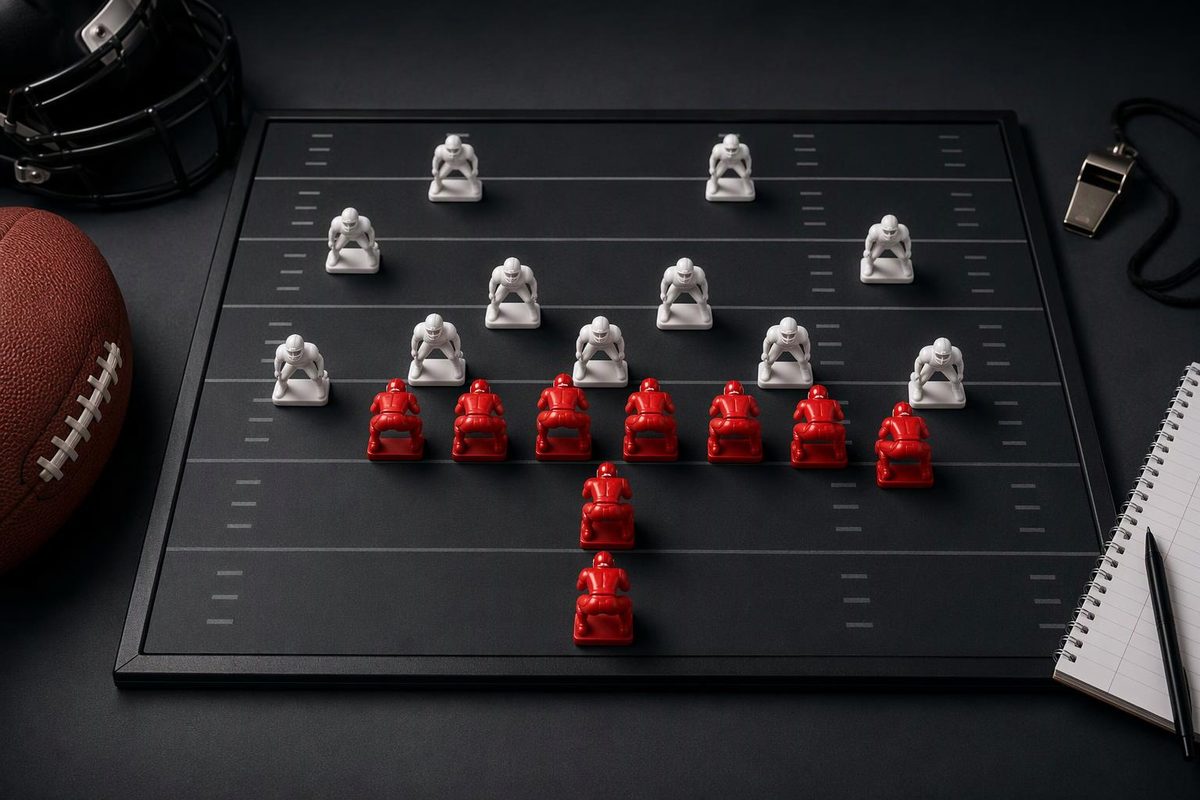
Power formation is a descriptive label for a run-oriented alignment with extra blockers close to the formation—not one universally standardized set. Power I is a more specific alignment worth recognizing: a quarterback under center, a fullback and tailback stacked behind him, and a third back offset beside the fullback. Coach Parker describes a double-tight version with that backfield in his youth-football formation guide.
For practice and film study, separate three questions: Who is on the field? Where do they line up? What play do they run?
Power formation is not the Power play
The formation tells players where to line up. Power names a blocking concept. A conventional Power play uses playside down blocks and double teams, a backside guard pulling toward the run and a kick-out block on the edge defender. It can be run from numerous personnel groups and formations, including shotgun looks—not just Power I. See the Power concept breakdown.
Likewise, Power I does not guarantee a Power call. Youth Football Online’s I-formation guide describes Power I with two fullbacks, or a fullback and H-back, and lists Power, Blast, Counter and play-action options.
Film checkpoint: Label the formation before the snap. Confirm the run concept from the blocking after the snap.
Align a double-tight Power I
Use this as a starting example, not a universal playbook definition. Here, “Right” means the extra back aligns to the quarterback’s right; both tight ends remain attached. We label that extra blocking back H.
                    Defense

       TE   LT   LG   C   RG   RT   TE     On the line
                     QB                  Under center
                     FB  H               Off the line
                     TB                  Deepest back
The diagram shows relationships, not scale. For an initial walkthrough, set these coaching landmarks. Measure backfield depths from the line of scrimmage.
| Position | Starting alignment | Observable checkpoint |
|---|---|---|
| Tight ends | Attached outside each tackle, on the line | Both are the outside ends of the scrimmage line |
| Quarterback | Under center | Center-QB exchange is unchanged by the extra back |
| Fullback | Directly behind the QB, about 3 yards deep | Stacked on the center’s midline |
| H-back/extra blocking back | About 3 yards deep, behind the right guard | Clearly off the line and beside—not behind—the FB |
| Tailback | Directly behind the FB, about 6 yards deep | Deepest back, maintaining the I stack |
Those depths are installation starting points. Adjust them to your exchange and blocking paths; do not treat them as defining features of Power I. Parker also describes moving his blocking backs closer to the line to change angles and timing in his youth-football variation.
NFHS 11-player legality check: With all 11 players present, this example has seven on the line and four backs, counting the quarterback. Rule 7-2-5 permits no more than four backs and normally requires at least five linemen numbered 50–79. Pass eligibility depends on position and number—not the “TE” label. If both tight ends will release on passes, keep them uncovered at the ends of the line and numbered 0–49 or 80–99. These requirements appear in the NFHS rules presentation.
Recognize it without guessing the play
On film, check the backfield first:
- Ordinary I: FB and TB stacked behind the QB; no third back.
- Offset I: FB shifted to one side, with the TB deeper; still only two backs besides the QB.
- Power I: An I stack plus an additional offset back.
Then record the surface separately: two attached tight ends, one tight end and a split receiver, or another arrangement. Two tight ends alone do not make an alignment Power I.
Chart a useful description such as “under-center Power I, double tight, extra back right.” That identifies the visible structure without assuming the ball will follow the extra back.
Teach the alignment in six minutes
Mark the center spot and backfield landmarks with flat field markers. Run eight no-contact alignment reps: four alternating right and left with markers, then four without them.
On each rep, the QB calls the formation; the offense aligns and freezes. Check the seven-player line, the I stack and the extra back’s side. Correct the specific error—“H, behind the guard, not behind the fullback”—then have players reset and repeat the call. Finish with a snap and exchange at walkthrough speed only after the alignment is correct.