
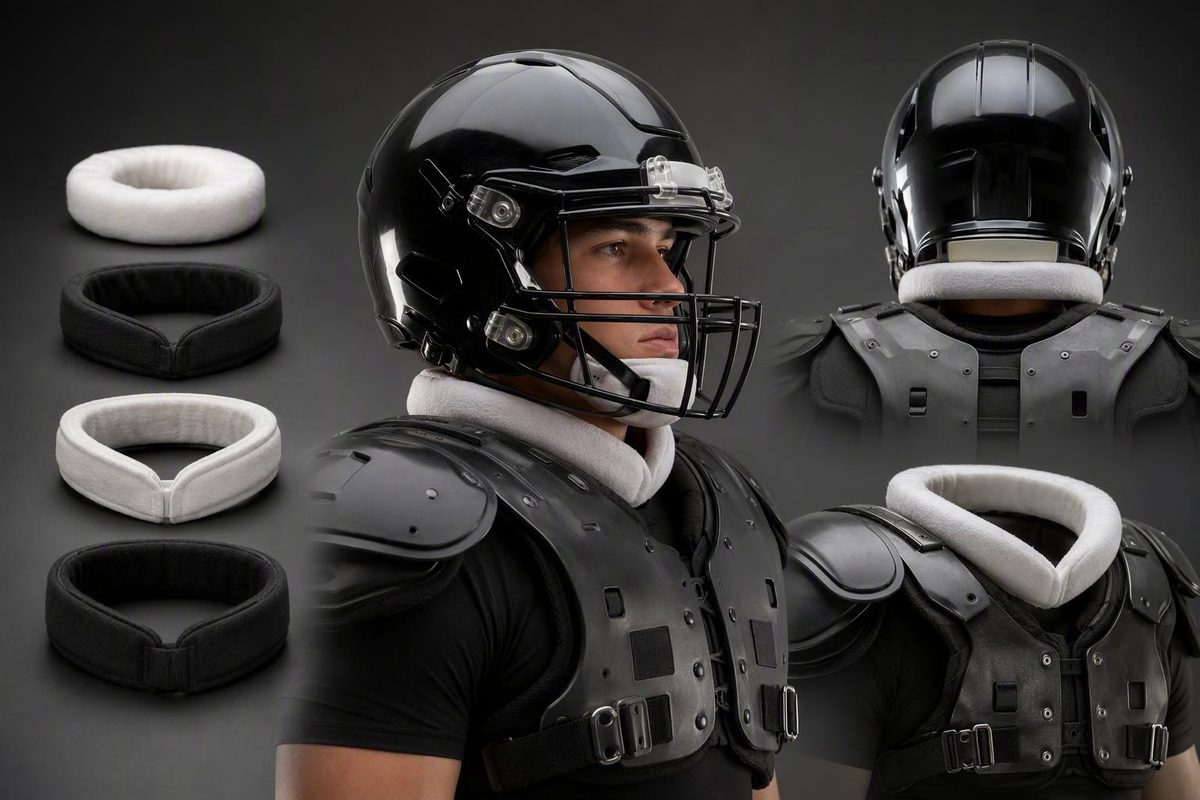
A football neck roll is padded equipment worn with or attached to the shoulder pads behind and around the neck. By creating a contact point beneath the lower edge of the helmet, it can restrict selected neck movements.
That mechanical effect should not be confused with proven injury prevention. Laboratory evidence supports a limited claim about restricting particular directions of cervical motion; it does not establish that football neck rolls prevent stingers, concussions, fractures, spinal-cord injuries, or neck injuries generally (football-collar range-of-motion study).
The practical buying decision should therefore begin with compatibility rather than popularity or marketing. Coaches, equipment managers, parents, and players need to identify the exact shoulder pads, determine how the proposed roll is supposed to mount, obtain the current manufacturer instructions, and evaluate the helmet, pads, and roll together.
This guide compares the major design categories, explains what the limited research measured, and provides a screening process for purchasing, fitting, and installation. It is not a substitute for the current manuals for the exact equipment, review by a qualified equipment professional, medical care, or applicable school, league, and governing-body rules.
What a Football Neck Roll Is—and What It Is Not
A traditional football neck roll is usually a round, horseshoe-shaped, or contoured piece of foam positioned behind and around the neck. Depending on the product, it may be secured to the shoulder pads with ties, screws, clips, snaps, brackets, or a model-specific mounting system.
The basic concept is physical contact. As the player bends the head backward or toward one side, the helmet’s lower edge may encounter the roll or collar sooner than it would encounter the shoulder pads alone. That contact may stop or reduce movement in that direction.
The word may is important. A neck roll does not lock the cervical spine in place or control every direction of motion. Its effect depends on factors including:
- The roll or collar design
- Its height and contour
- The mounting method and position
- The shoulder-pad shell and neck opening
- The helmet’s lower-edge geometry
- The player’s neck length, build, and posture
- The direction and nature of the loading
A neck roll is not a replacement for:
- A properly fitted football helmet
- Properly fitted shoulder pads
- Sound tackling and blocking technique
- Rule compliance
- Qualified coaching and supervision
- Evaluation and treatment by an athletic trainer or other medical professional
A conventional neck roll also should not be presented as a concussion-prevention or brain-protection device. It mechanically addresses selected movements of the neck beneath the helmet. That is different from controlling movement of the brain inside the skull.
Product pages may use broad terms such as “protection,” “support,” “stability,” or “helmet control.” Those descriptions do not establish a reduction in injuries during practices or games. Even a demonstrated reduction in one direction of motion is not proof of a clinical benefit.
The useful buying question is therefore not, “Which neck roll is most popular?”
It is:
Which design is approved for this player’s exact shoulder pads, can be installed by the specified method, and preserves the vision, posture, and movement the player needs?
That question produces a defensible shortlist. A bestseller ranking does not.
The Movements and Injuries Readers Commonly Confuse
Discussions of neck rolls often combine different movements and injuries as though they were interchangeable. They are not.
The main cervical movements are:
- Flexion: bending the head forward, with the chin moving toward the chest
- Extension: bending the head backward
- Lateral flexion: bending sideways, with the ear moving toward the shoulder
- Rotation: turning the head left or right
A device that limits extension does not necessarily limit lateral flexion, rotation, or forward flexion. It may also restrict movement differently when the player moves voluntarily than when an outside force imposes the movement.
That distinction matters when discussing stingers and burners. These terms generally describe injuries involving nerve structures running from the neck toward the shoulder and arm. Recognized mechanisms include excessive hyperextension, lateral flexion, and direct compression near the brachial plexus. Possible symptoms include burning pain, tingling, numbness, altered sensation, or weakness in an arm.
Although symptoms may be transient, they should not be casually self-diagnosed or treated by changing equipment. Similar symptoms can occur with injuries requiring urgent professional assessment.
A suspected brachial-plexus injury is not interchangeable with:
- A cervical fracture or dislocation
- A cervical spinal-cord injury
- A cervical disc injury
- A neck strain or sprain
- Transient weakness affecting multiple limbs
- Other neurological or musculoskeletal conditions
Sports-related cervical injuries can range from strains and nerve injuries to fractures, dislocations, and spinal-cord injuries. Warning signs after neck trauma can include radiating pain, weakness, sensory loss, paralysis, swelling, bruising, and breathing difficulty (AANS guidance on sports-related neck injury).
Direction-specific language is therefore essential. If a collar limits backward bending but not passive side bending, it addresses one movement while leaving another comparatively unchanged. If it restricts voluntary movement but does not resist externally imposed movement under testing, the restriction a player feels during a fit check should not be treated as proof of collision protection.
A neck roll should not be described as stabilizing the entire cervical spine. It also does not make head-first contact acceptable. Compression, lateral bending, rotation, direct nerve compression, and combined loading can still occur.
What the Research Actually Shows
The central peer-reviewed study in this area was published in the Journal of Athletic Training in 2003. It used a repeated-measures design involving 15 male NCAA Division I football players and measured active and passive cervical hyperextension and lateral flexion under five equipment conditions:
- Helmet alone
- Helmet with shoulder pads
- Helmet, shoulder pads, and a Cowboy Collar
- Helmet, shoulder pads, and an A-Force Neck Collar
- Helmet, shoulder pads, and a 5.08-centimeter foam neck roll
All three tested collars significantly reduced cervical hyperextension compared with the helmet-and-shoulder-pads condition. Under that specific protocol, the Cowboy Collar reduced hyperextension more than the tested foam roll. None of the collars significantly reduced passive lateral flexion compared with helmet and shoulder pads alone. The foam roll reduced active lateral flexion but not passive lateral flexion, which the authors interpreted as potentially impeding voluntary movement without adding protection when movement was imposed passively (2003 study of football collars and cervical motion).
That last result illustrates why more restrictive and more protective are not synonyms. A player may feel a device limiting motion during a voluntary check, but that does not establish how effectively it will resist motion imposed during a collision.
What the study supports
What the test showed:
Under the tested laboratory conditions, all three collars restricted cervical hyperextension compared with wearing a helmet and shoulder pads without a collar.
It also supports a product-specific comparison:
Under those conditions, the tested Cowboy Collar restricted hyperextension more than the tested foam neck roll.
The finding applies to the equipment and protocol used in that study. It should not be converted into a claim that every Cowboy-style collar outperforms every foam roll.
What the study does not support
The study did not measure:
- Stinger or burner rates in practices or games
- Cervical fracture rates
- Spinal-cord injury rates
- Concussion rates
- Time lost from football
- Current neck-roll models as a category
- Outcomes in youth, high school, or female athletes
It measured cervical range of motion in a controlled setting. Range of motion is a biomechanical outcome, not a clinical injury outcome.
The limitations are substantial. The sample consisted of 15 male Division I players, the equipment and fitting procedures were specific, the protocol did not reproduce all forms of game contact, and the study is more than two decades old.
The most supportable conclusion is that certain collar designs can restrict certain directions of neck motion. Available evidence does not establish that football neck rolls prevent stingers, fractures, spinal-cord injuries, concussions, or neck injuries as a broad category.
Football Neck Roll and Collar Types Compared
“Neck roll” is often used as a general term, but the category contains products with substantially different shapes, attachment systems, and compatibility requirements. Retailer classifications document what sellers offer; they do not validate effectiveness or safety.
Traditional round or horseshoe foam rolls
These are comparatively simple foam rolls positioned behind and around the neck. Many are attached to approved points on the shoulder pads with ties.
Because the attachment is flexible rather than rigid, the roll may move relative to the shoulder-pad shell. The amount and significance of that movement depend on the exact product and installation.
Traditional rolls are sold in different heights and profiles. Height should not be selected by itself. A taller roll may contact the helmet earlier, but it may also affect useful movement, vision, or posture.
Contoured rolls
Contoured rolls use shaped foam rather than a uniform round tube. Their profiles may leave more or less material in particular areas around the shoulder-pad opening.
Commercial guides sometimes suggest that round and contoured rolls perform similarly, but the available evidence does not establish equivalent performance. Contour should be treated as a product-specific fit characteristic, not proof of equal or superior protection.
Floating rolls
A floating roll is generally tied to designated points on the shoulder pads instead of being rigidly fixed to the shell.
“Floating” does not mean loose or unattached. The roll still requires the approved ties, anchors, routing, and position. Nor does a tie-on design become universally compatible simply because it does not use screws.
Fixed or non-floating collars
A fixed collar mounts directly to the shoulder-pad structure through hardware or an integrated attachment arrangement. Compatibility may depend on the shell, arch, hole pattern, cushioning, size, series, and hardware.
A fixed collar should never be assumed to fit another shoulder-pad line merely because both products share a brand or an adult or youth designation.
Cowboy-style collars
Cowboy-style collars are larger or more structured systems intended to interact with the helmet and shoulder-pad area. Their precise construction and mounting arrangements vary.
The 2003 study found greater hyperextension restriction with the specific Cowboy Collar it tested than with its tested foam roll. That does not prove that Cowboy-style products generally prevent more injuries or provide better overall protection.
Butterfly, lateral, and side restrictors
Retail assortments also include butterfly restrictors, lateral restrictors, mini side rolls, and related configurations. These names describe distinct product categories, not interchangeable terms for a traditional foam roll.
Their shape, intended location, attachment points, and compatible shoulder pads may differ. A specialty retailer’s assortment, for example, lists neck rolls, butterfly restrictors, lateral restrictors, and mini side rolls separately; that categorization documents product variety, not clinical performance (football neck-protection product categories).
| Design | Usual mounting approach | Mobility consideration | Main compatibility concern | Evidence limitation |
|---|---|---|---|---|
| Traditional round or horseshoe roll | Commonly tied to designated pad points | Height and profile can affect available movement | Tie points, pad opening, roll position, and helmet interaction | Limited comparative testing; no established reduction in game injuries |
| Contoured foam roll | Often tied to the pads | Effect depends on the product’s specific contour and fit | Contour must suit the player and pad geometry | No sound evidence that contoured and round rolls perform equally |
| Floating roll | Flexible tie attachment | Accessory movement and restriction are design-dependent | Approved anchors, ties, routing, and stability | “Floating” describes attachment, not effectiveness |
| Fixed or non-floating collar | Hardware or direct shell mount | Restriction is model- and fit-dependent | Exact series, size, shell, hole pattern, and hardware | Results cannot be generalized across fixed-collar models |
| Cowboy-style collar | Structured or model-specific system | Evaluate bulk, stance, vision, and required motion | Complete interface with the helmet, pads, and torso | One small study supports a product-specific hyperextension result, not injury prevention |
| Butterfly restrictor | Usually model-specific hardware or pad integration | Must be assessed with the complete equipment setup | Exact pad design and installation instructions | Sparse independent outcome evidence |
| Lateral restrictor or mini side roll | Side-mounted or model-specific | Effects on motion require model-specific verification | Symmetry, mounting points, and helmet clearance | Product name does not establish passive-load protection |
The practical tradeoff is restriction versus usable mobility. A larger design may contact the helmet in different positions than a lower-profile design, but more contact is not automatically safer. A player still needs sufficient vision, posture, and movement to perform the position without compensation.
Position can help define what movement and sight lines must be preserved. It does not support a clinically proven prescription for one collar type by position. Treat position as a supervised fitting consideration, not a medical rule.
Start With Shoulder-Pad Compatibility, Not a Bestseller List
The first selection checkpoint is the exact identity of the shoulder pads:
- Manufacturer
- Product line or series
- Model
- Size
- Production generation, if relevant
- Existing accessory interface or designated mounting points
Next, identify the complete name and model number of the proposed neck roll or collar. Determine whether it uses ties, clips, snaps, hardware, an integrated system, or another attachment method before comparing color, price, reviews, or sales rank.
Some traditional rolls use ties and may be approved for more than one pad design. Other collars are made for particular brands, pad series, sizes, or hole patterns. Retailer guidance documents both broadly attached tie-on products and brand- or series-specific collars, which is why the accessory must be matched to the actual pads rather than a general size category (football neck-roll compatibility guide).
“Youth” and “adult” labels do not establish compatibility. Nor does a photograph of the product mounted on shoulder pads. The pictured pads may be a different series, size, or generation.
Compatibility worksheet
Complete this worksheet before ordering or installing a roll:
| Item | Record before purchase |
|---|---|
| Shoulder-pad manufacturer | Full brand name |
| Shoulder-pad model or series | Exact wording from the product label and current manual |
| Shoulder-pad size | Complete size designation |
| Player size category | Youth, adult, or manufacturer-specific category |
| Proposed neck-roll model | Complete product name and model number |
| Mounting system | Tie, clip, snap, hardware, integrated, or other |
| Approved attachment method | Exact method authorized for the identified products |
| Included hardware | All ties, clips, screws, washers, brackets, or other parts |
| Current manufacturer manual | Current URL, document title, and revision date if shown |
| Compatibility confirmation | Manufacturer or qualified equipment professional, response date, and written answer |
| Modification required? | No, or exact written authorization for the model, location, and method |
| Applicable rules checked? | School, league, conference, and governing-body requirements |
If the product listing and shoulder-pad manual disagree, or neither confirms the combination, stop. Obtain written confirmation from the manufacturers or a qualified equipment professional.
Why popularity is not a selection criterion
Marketplace bestseller positions indicate sales activity. Ratings summarize submitted customer opinions. Price reflects a commercial offer. None of these measures establishes safety, biomechanical performance, quality, or suitability for a particular player.
Retail assortments include both youth and adult products at widely varying prices, but prices, stock, ratings, and rankings change. A fixed “best neck rolls” list is therefore a poor foundation for a safety-sensitive purchase.
Use the current manufacturer instructions for the exact collar and shoulder-pad models.
A product belongs on the shortlist only after it passes these gates:
- The exact shoulder-pad model and size are known.
- The exact collar and mounting system are known.
- The manufacturers approve the combination and attachment method.
- Current instructions and all specified components are available.
- Applicable participation and equipment rules have been checked.
- The complete setup can be evaluated with the player’s actual helmet and pads.
- A qualified person can perform or supervise installation and fitting.
Anything else is a browsing result, not yet a usable equipment option.
A Practical Fit Check With Helmet and Shoulder Pads
A neck roll cannot correct shoulder pads that are the wrong size or adjusted poorly. Fit the base equipment first.
With the shoulder pads secured as they would be for play, check that the shoulder caps continue to cover the shoulder joints during ordinary movement. The neck opening should be secure without pinching or leaving the collarbone improperly exposed. Retail shoulder-pad fitting guidance likewise emphasizes continuous shoulder-joint coverage and a secure neck opening without collarbone exposure (shoulder-pad fitting guidance).
Evaluate the roll only while the player wears the actual helmet and shoulder pads intended for use. Do not substitute another helmet model or spare pads and assume the result will transfer.
The completed fit depends on the interaction among:
- Neck length
- Shoulder and torso build
- Muscle mass
- Shoulder-pad arch and neck opening
- Helmet shell and lower-edge geometry
- Helmet fit
- Roll height and contour
- Mounting position
- Compression of the roll material
- Normal playing posture
The following is a screening checklist, not a substitute for the current product instructions or an installation standard.
Step-by-step non-contact screening check
1. Secure the shoulder pads. Fasten every strap, belt, hook, lace, and buckle as it would be secured during use. Confirm that the accessory has not displaced the pads.
2. Put on and secure the helmet. Use the player’s fitted helmet and fasten the chinstrap normally.
3. Check centering and symmetry. The roll should be positioned as the manufacturer specifies. Stop if it sits visibly off-center, one side is higher, or it shifts in a way the instructions do not permit.
4. Check the throat and surrounding tissues. Stop for throat pressure, a choking sensation, pinching, breathing difficulty, or interference with the chinstrap, pad fasteners, jersey, or other equipment.
5. Establish the normal playing stance. Have the player assume the stance used for the position. A setup that appears acceptable while standing upright may force an altered head or torso position in a two-point, three-point, or football-ready stance.
6. Evaluate required movement without contact. Under qualified supervision, assess gentle, controlled movement needed to align, communicate, and perform the position. Do not force the neck toward an end range, conduct a collision test, or continue through pain or neurological symptoms.
7. Check the field of view. Assess the forward, peripheral, and over-the-shoulder vision needed for the assignment. Watch for chin elevation, helmet tilt, or torso rotation used to compensate for restriction.
8. Recheck stability and fastening. After the movement check, confirm that the roll remains in its specified position and that the helmet and shoulder-pad fasteners continue to function normally.
Do not chase maximum restriction
The tallest or bulkiest roll is not automatically the safest. Excessive restriction may interfere with useful head movement, vision, or normal posture. A player who cannot assume the required stance or see the necessary area of the field does not have an acceptable setup.
There is no supported universal helmet-to-roll clearance or contact measurement for every product. Do not invent a team-wide finger-width, inch-based, or visual rule. Follow the specifications for the exact helmet, pads, and collar combination.
Stop the fit check if:
- Compatibility has not been confirmed
- The current manual is unavailable or unclear
- The roll is visibly asymmetric
- The roll shifts and cannot remain in its specified position
- It presses against the throat or interferes with breathing
- It pinches skin or soft tissue
- It obstructs necessary vision
- It changes the player’s normal stance
- It prevents movement required for the position
- It disrupts helmet or shoulder-pad fastening
- Hardware loosens or the pad shell appears stressed
- The player reports pain, tingling, numbness, weakness, or radiating symptoms
That history requires individualized guidance from an athletic trainer, physician, or other qualified medical professional.
Installation: Follow the Model, Mount, and Manufacturer
There is no universal neck-roll installation procedure. The following categories help identify what documentation and professional support are needed; they are not step-by-step installation instructions.
Before working on any category, confirm that both the collar manufacturer and the shoulder-pad manufacturer approve the combination. Use the current instructions for the exact models and sizes. If approval cannot be verified, do not install the product.
Tie-on systems
Tie-on rolls are generally secured to designated points on the shoulder pads. Use only the tie material, number of ties, anchor points, placement, routing, and securing method specified for the exact product.
Do not infer attachment points from a retailer photograph or generic illustration. Do not route ties through vents, cushions, shell edges, or existing hardware unless the current manufacturer instructions designate those locations.
After attachment, the complete setup still requires a supervised fit check. Stop if the ties pull the roll off-center, contact the player improperly, interfere with pad movement, or create an arrangement not addressed by the instructions.
Clip-on or snap-on systems
Clips and snaps depend on matching attachment points. Confirm that the receiving hardware is intended for the exact shoulder-pad series and size and that every required component is present.
Do not replace missing proprietary components with similar-looking general-purpose hardware unless the manufacturer expressly authorizes the substitution. Visual similarity does not establish compatibility.
Hardware-mounted systems
Hardware-mounted collars may use screws, bolts, washers, brackets, or specified holes in the shoulder-pad shell. Some retailer guides describe positioning a collar, marking attachment points, drilling if necessary, and installing supplied hardware. Those descriptions are commercial generalizations, not universal instructions.
Do not drill, cut, melt, punch, or otherwise alter shoulder pads unless the manufacturer expressly approves all of the following:
- The exact shoulder-pad model and size
- The exact neck-roll or collar model
- The mounting location
- The hole size and method
- The required hardware
- The person or service authorized to perform the work
Do not publish or rely on a generic drilling template, hole location, torque value, or clearance measurement. If the current instructions do not provide the required specifications for the exact combination, stop and contact the manufacturer.
Integrated or model-specific systems
Integrated systems are designed around a particular shoulder-pad structure or accessory interface. Apparent similarity across product lines does not make the components interchangeable.
Confirm the full model names, sizes, production generations, and required parts. Douglas, for example, lists a neck-roll installation guide in its manufacturer instruction-manual index. That confirms that product documentation exists; it does not justify applying Douglas instructions to another product family or inferring details that are not in the current guide (Douglas instruction manuals).
When professional installation is the right choice
Use an equipment manager or manufacturer-authorized professional when:
- New holes are required
- The shell or cushioning would need alteration
- The hardware is unfamiliar
- Existing holes do not align
- The manual is missing, outdated, or unclear
- The collar and pads come from different manufacturers
- A retailer listing conflicts with manufacturer documentation
- A previous installation may have damaged the shell
- The roll cannot be centered or stabilized
- Applicable equipment rules are uncertain
After installation, repeat the complete check with the actual helmet and pads. Review symmetry, throat clearance, breathing, stance, controlled movement, field of view, fastener operation, and attachment stability before any contact work.
Before later use, perform a basic visual stop check for obvious changes such as torn or compressed foam, a split cover, frayed ties, damaged clips, loose or missing hardware, shell cracking, cushion damage, or unexpected movement. This is not a complete inspection or replacement standard. Follow the exact manufacturers’ instructions for inspection, cleaning, service life, repair, and replacement, and refer questionable equipment for professional evaluation.
Use the Neck Roll as One Limited Layer of a Safety Plan
A football neck roll is optional equipment with direction-specific limitations. It is not permission to lead with the head, lower the crown into contact, or tolerate poor tackling and blocking mechanics.
A responsible equipment and coaching plan combines:
- Properly fitted helmet and shoulder pads
- Confirmed accessory compatibility
- Manufacturer-approved installation
- Compliance with applicable equipment and participation rules
- Coached tackling and blocking technique
- Appropriate conditioning
- Qualified practice and game supervision
- Prompt reporting and medical evaluation of symptoms
Head-first contact and poorly executed tackling or blocking are major cervical-spine concerns. No neck roll makes spearing safe. A collar that limits some extension cannot neutralize every combination of compression, rotation, bending, and impact.
Equipment adjustment is not medical treatment. Tightening a roll, changing its height, or adding a more restrictive collar does not identify the cause of symptoms or establish that a player is ready to return.
Emergency response after concerning neck symptoms
- Remove the athlete from participation.
- Do not let the athlete “test it out” with another repetition.
- Do not use a neck-roll adjustment as treatment.
- Seek prompt evaluation by an athletic trainer or other qualified medical professional.
- If a serious neck injury is suspected, do not move the athlete without competent medical care unless movement is necessary to address an immediate life threat.
- Do not return the player based only on symptom resolution or the addition of a collar.
Warning signs include neck pain or stiffness, pain radiating into a shoulder or arm, weakness, sensory loss, numbness, tingling, paralysis, swelling, bruising, or difficulty breathing. A suspected neck injury requires competent medical care, and return to play should occur only after appropriate medical clearance (AANS neck-injury symptoms and response guidance).
Previous injury changes the decision. Recurrent stingers, a prior cervical injury, uncertain neurological symptoms, and return-to-play questions belong with an athletic trainer, physician, or other qualified medical professional—not a product comparison page.
Use this five-step decision sequence:
- Fit the base equipment. Confirm that the helmet and shoulder pads fit correctly.
- Verify compatibility. Match the exact pad brand, series, model, and size to the proposed collar and mounting system.
- Install only by the approved method. Do not improvise hardware, attachment points, or modifications.
- Perform a supervised non-contact check. Evaluate symmetry, stability, vision, movement, breathing, fastening, and football stance.
- Stop for symptoms or uncertainty. Treat neck or neurological symptoms as a medical issue and unresolved equipment questions as a reason not to use the setup.
Frequently Asked Questions
Can a football neck roll prevent stingers or burners?
That has not been established. The main peer-reviewed laboratory study found that three tested collars reduced cervical hyperextension, but none significantly reduced passive lateral flexion. The study measured range of motion in 15 male Division I players, not stinger or burner rates during football.
A neck roll may restrict a movement associated with some injury mechanisms. That is not the same as proving prevention. A player who experiences burning pain, tingling, numbness, weakness, or recurrent episodes needs medical evaluation rather than an equipment-only response.
Does a football neck roll help prevent concussions?
A conventional football neck roll should not be presented as a concussion-prevention device. Its mechanical purpose is to interact with the helmet and shoulder-pad area to restrict selected cervical movements. The available neck-roll study did not measure concussion rates.
Do not infer brain protection from marketing terms such as “support,” “stability,” or “helmet control.” Those words may describe a physical interaction with the helmet without demonstrating any effect on concussion risk.
Will any neck roll fit any football shoulder pads?
No. Compatibility can depend on the manufacturer, product series, model, size, production generation, shell design, hole pattern, mounting system, and required hardware.
Some tie-on products may be approved for multiple pad designs, while fixed collars may fit only a narrow shoulder-pad family. “Youth” or “adult” labeling alone is not enough. Identify both products exactly and obtain written confirmation when their manuals or listings do not clearly agree.
Is a Q-Collar the same as a traditional football neck roll?
No. A traditional neck roll is a padded mechanical device associated with the shoulder pads and intended to limit selected neck movements through contact with the helmet. The Q-Collar is commercially described as a jugular-compression device using a different proposed mechanism (manufacturer-sponsored comparison of neck rolls and the Q-Collar).
A neck roll and Q-Collar are different products. The comparison is manufacturer-sponsored; it does not establish that combining them is appropriate. Any combination requires product-specific instructions, compatibility confirmation and a complete fit assessment.
Which symptoms after contact require immediate removal from play and medical evaluation?
Remove the player after neck pain or stiffness, radiating pain, weakness, sensory loss, numbness, tingling, paralysis, swelling, bruising, or difficulty breathing.
Do not manage concerning symptoms by tightening, loosening, or adding a neck roll. If a serious cervical injury is suspected, do not move the athlete without competent medical care unless movement is required to address an immediate life threat. Return to play requires appropriate medical clearance; symptom resolution alone is not enough.
The Bottom Line
The supportable case for a football neck roll is limited: certain designs can restrict certain neck movements, but available research does not prove that they reduce injuries during games.
Begin with properly fitted base equipment and exact manufacturer compatibility—not appearance, bulk, price, ratings, or popularity. Use only the approved mounting method, have uncertain or modification-dependent installations handled by a qualified equipment professional, check the complete setup with the player’s actual helmet and pads, and preserve the vision, posture, and movement required to play.
Most importantly, treat every concerning neck or neurological symptom as a medical issue rather than an equipment problem.