
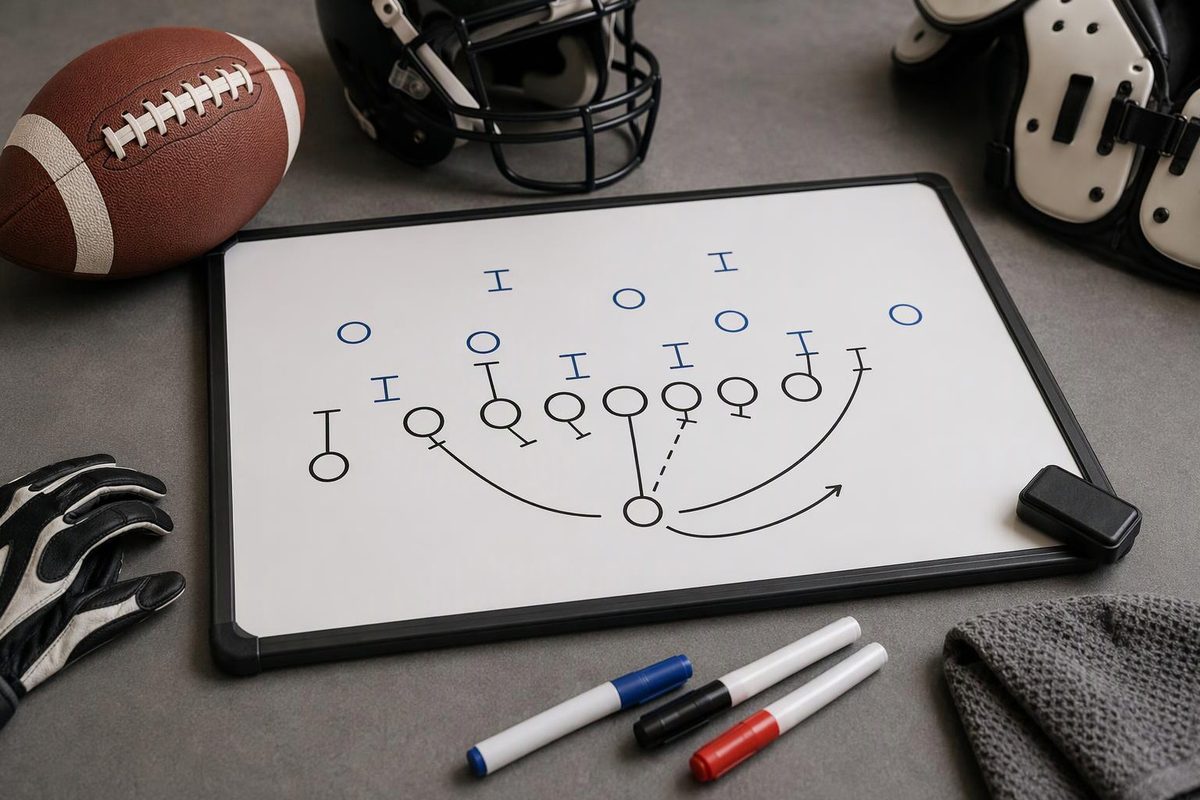
Inside zone is a downhill run concept built around coordinated line blocks and a running back reading the lanes those blocks create. The call gives the back a starting track—not a hole he must enter regardless of the defense. Unlike a typical gap-scheme run built around down blocks and a puller, inside zone uses zone steps, combinations and releases to linebackers. Youth Football Online’s overview describes that basic structure.
For a first high school or small-college install, teach one formation, one defensive front and one back landmark. Add variations after the line and back can explain the same picture.
Offensive-line rules: identify, fit, then climb
Start with three pre-snap questions for every lineman:
- Am I covered? A first-level defender is aligned over some part of me, including a shoulder shade.
- Who is my combination partner, if any? Name the adjacent blocker and down defender.
- Which linebacker are we working to? Identify him by alignment or jersey number—not just “a linebacker.”
Mike Kuchar’s covered/uncovered explanation for USA Football distinguishes outside, head-up and inside shades. Those alignments change the block; “everyone takes the same step” is not enough instruction.
Use these working rules:
- Covered blocker: Fit the down defender with balanced feet and keep the block from splitting. Do not assume help makes him someone else’s responsibility.
- Uncovered blocker: Protect against penetration and work through the declared combination toward the assigned linebacker. Read the down defender’s near hip for a slant into your gap. An uncovered player is not automatically free to sprint upstairs.
- Combination pair: Secure the down defender before releasing. His movement and the linebacker’s path determine who comes off and when; do not teach a fixed two-step release.
Kuchar’s zone-combination guidance emphasizes named combinations, specific linebacker targets and reading the down defender’s near hip. The checkpoint is simple: when one blocker leaves, can his partner maintain control?
For stance, hand fit and first-step work, use the separate blocking-foundation progression. Keep this period focused on assignment and transfer between levels.
A six-blocker example: inside zone right
Use five offensive linemen, an attached tight end on the right, an under-center quarterback and one running back. For this teaching look, align four defensive linemen as follows:
- Left end shaded outside the left tackle.
- Nose shaded to the center’s left shoulder.
- Right defensive tackle shaded outside the right guard—a 3-technique.
- Right end shaded outside the tight end.
Place two linebackers behind the interior front. These are the declared assignments for this example, not universal rules for every front:
| Blocker | Assignment |
|---|---|
| Left tackle | Solo cutoff on the left end; prevent pursuit across his face. |
| Left guard and center | Combination on the nose, working to the backside linebacker. |
| Right guard and right tackle | Combination on the 3-technique, working to the playside linebacker. |
| Tight end | Control the right end; keep him from collapsing the inside lane. |
The center–guard pairing is a deliberate backside combination. Rick Trickett’s Complete Offensive Line excerpt includes the center staying with a shaded nose for backside-guard help before releasing to the linebacker. It also stresses stopping penetration before climbing.
Walk this front first. Then move a linebacker or slant a tackle and ask the pair to explain the adjustment. If another defender walks into the box, identify how he will be accounted for before running the rep. This six-blocker picture does not account for every possible pressure.
Running-back track and read
For this install, give the back a landmark at the centerline of the right guard. That is one teaching choice, not a universal inside-zone landmark; BigSkillPosition’s coaching explanation separates the aiming point from the eventual entry gap and uses this landmark.
In the example front, key the playside 3-technique and the space opening around his block:
- He occupies the B gap: Take the open A gap between center and guard.
- He crosses into the A gap: Take the open B gap between guard and tackle.
- Both lanes close: Look for the backside A-gap bend; do not force a cutback into another defender.
These A/B-gap responses match the high-school teaching described in Glazier’s Kyle Ralph inside-zone breakdown.
Coach the back to press the landmark, see the block, then make one decisive cut. Do not reward a premature bounce just because it gains yards against a passive scout defense. On film, freeze before the cut: which defender closed the original lane, and which lane actually opened?
Inside zone is not automatically zone read. In this base handoff, the left tackle blocks the backside end. Leaving that end unblocked for a quarterback read would be a separate assignment change.
A 12-minute installation period
This is a suggested progression. Use walkthrough and controlled fits, no takedowns, and contact levels permitted by your program.
Minutes 0–4: Front recognition. Set the example front with bags or stationary defenders at your normal line splits. Walk four calls each direction. For zone left, move the tight end to the left and mirror the defensive front and assignments. Each blocker names his defender, partner and linebacker before stepping. Check that both partners identify the same target.
Minutes 4–8: Two-on-two combinations. Run guard–tackle and center–guard stations in parallel. Put one down defender on the line and one linebacker about four yards deep. Give each pair four reps each direction. Script a hold, a slant and linebacker movement. Correct any release that leaves the down defender uncontrolled.
Minutes 8–12: Line and back together. Run six controlled reps, three each direction, mirroring the formation and front for zone left. Script the read defender occupying B, crossing into A and closing the playside lanes with linebacker help. The back names his key and entry gap after each rep.
Grade three things before expanding the package: correct combinations, no immediate penetration, and a back’s cut justified by the block. Those checks tell you what to repeat at the next practice.