
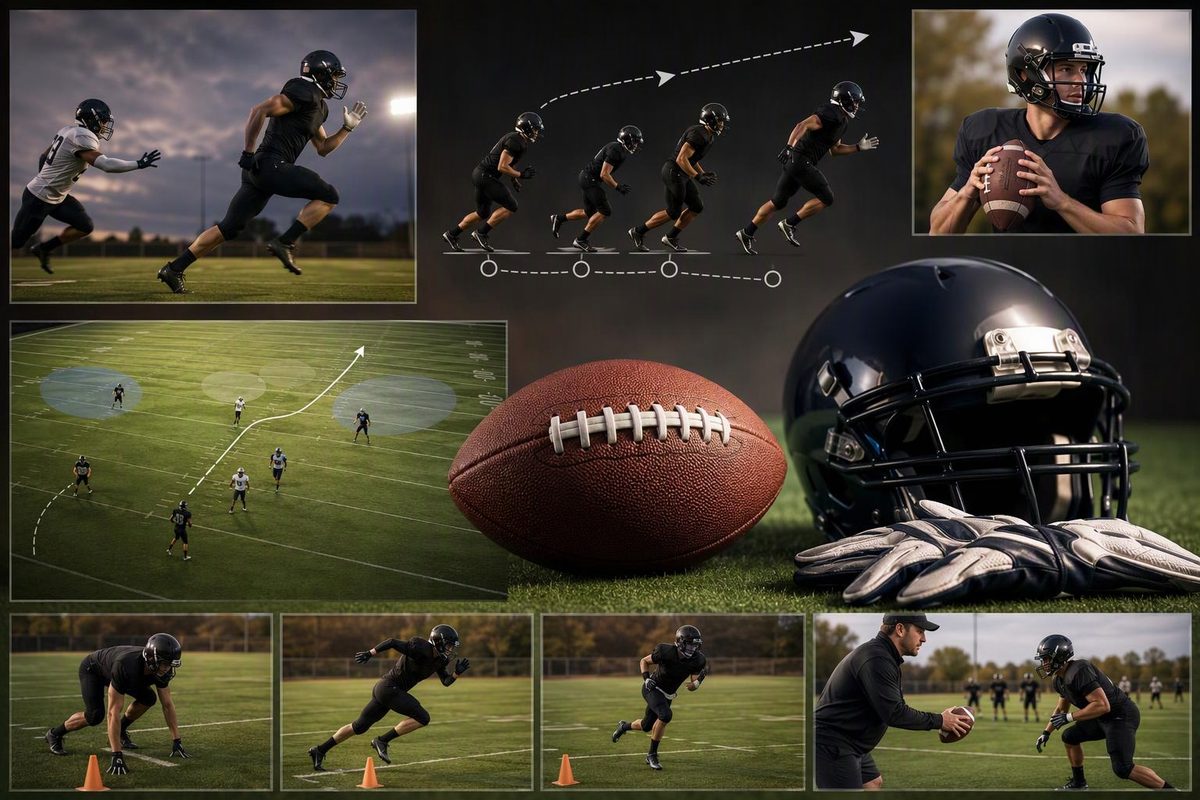
A go route is a vertical pass route: the receiver accelerates downfield without a planned cut toward the middle or sideline. Also called a fly, it is commonly numbered 9 on the route tree. It can target a deep completion or pull coverage away from another receiver’s route underneath. 360Player’s route-tree guide describes both uses.
For high school and small-college receivers, “run straight and fast” is only the starting point. The coachable pieces are the release, position relative to the cornerback and timing with the quarterback.
Receiver: win the release, then stack
Before the rep, name the receiver’s split, allowed release and downfield lane. Leave room between that lane and the sideline for the catch.
Against press coverage: use the assigned release to clear the corner’s jam, then accelerate. Correct a receiver who spends several steps dancing without gaining ground: rehearse one release and an immediate vertical exit before adding another option.
Against an off corner: close the cushion—the space between receiver and defender—with a purposeful stem, or initial route path. Attack the defender’s leverage rather than drifting wide and giving away the throwing lane. Keep the corner’s hips square as long as possible, then accelerate past when he turns to run. VIQTORY’s stem-and-stack guide explains how the stem challenges leverage and delays the defender’s hip turn.
Once clear, stack the corner: get downfield of him and work back into his running line, leaving him trailing rather than alongside you. That position creates a cleaner over-the-shoulder throwing window. Do not coach a push-off or force the receiver across a defender who still owns the lane. Big Blue View’s NFL film breakdown illustrates the release-to-stack sequence.
The checkpoint is visible: did the receiver put the corner behind him while preserving room to catch in bounds? A receiver can run hard and still lose the rep by drifting into the boundary.
Is a go route the same as a fade?
Some route trees group the names together, but the coaching assignment may differ. A staff may give its fade a mandatory outside release; Bobby Acosta explicitly teaches that version in Football Toolbox’s fade instruction. Do not assume every go route requires an outside release. State your rule in the install.
Quarterback: throw the window, not the finished route
Install the go with the actual play’s drop, protection and progression. There is no single drop count that fits every quick-game fade, dropback go and play-action shot. This install focuses on the over-the-top throw; a back-shoulder option needs its own shared quarterback–receiver rules.
On routes on air, choose a catch landmark the quarterback can reach without straining. Pair that landmark with the point in his footwork when he should release the ball. Coach the ball to arrive ahead of the receiver, not directly at his current location.
With coverage added, the quarterback must confirm that the receiver is gaining the throwing lane and that deep help cannot close it. Do not wait for the receiver to reach the catch landmark before starting the throw. Equally, do not keep hitching and hoping when the window never develops—move to the next answer in the called progression.
The useful timing principle is eyes and feet working together. A.J. Smith describes that approach, along with a checkdown deadline, in USA Football’s four-verticals coaching discussion. That is a concept-specific example, not a universal go-route progression.
Coverage checks before taking the shot
Read the corner’s depth and leverage, then locate the safety help. Confirm both after the snap.
| Defensive picture | Coaching decision |
|---|---|
| Press corner without nearby deep help | Consider the matchup, but require a clean release and a usable throwing lane. Press alone does not mean open. |
| Corner turning and staying on top | Do not force the over-the-top throw simply because the route is vertical. In spot-drop Cover 3, the outside corner owns a deep third and is coached to prevent the receiver getting behind him. Joe Daniel’s high-school coverage guide explains that responsibility. |
| Cover 2 corner underneath, safety over the top | The possible sideline window is behind the corner and before the safety arrives—not an automatic over-the-top throw. If the corner carries the receiver or the safety closes the window, move on. Win With the Pass’s Cover 2 breakdown describes that sideline opening and the corner’s carry technique. |
A six-rep teaching progression
Use this as a controlled teaching station, not a conditioning period. These starting landmarks are practice suggestions, not fixed go-route depths.
Setup: one quarterback, one go-route receiver, one defensive back and a coach. Add a second receiver or running back for the checkdown in reps 5–6. Put the quarterback at the play’s normal depth. Mark a receiver lane about four yards inside the sideline and an initial catch landmark 25 yards beyond the line of scrimmage; shorten the throw for developing players. Keep the catch and run-out area clear.
- Reps 1–2: on air. Match the receiver’s acceleration to the quarterback’s footwork and ball arrival.
- Reps 3–4: controlled trail. Have the defender yield the release and trail without contact. Coach stacking and maintaining the lane.
- Reps 5–6: top-position read. Have the defender begin with cushion and stay above the receiver, without contact. Run the play’s checkdown so the quarterback can practice declining the deep shot and completing the next throw.
Walk back and reset between reps. Grade release, lane and decision separately from the catch. If the receiver drifts, fix the lane; if the ball trails a clean route, check release timing and placement; if the corner stays on top, reward the correct checkdown. For additional release work, use the wide receiver drill progression.