
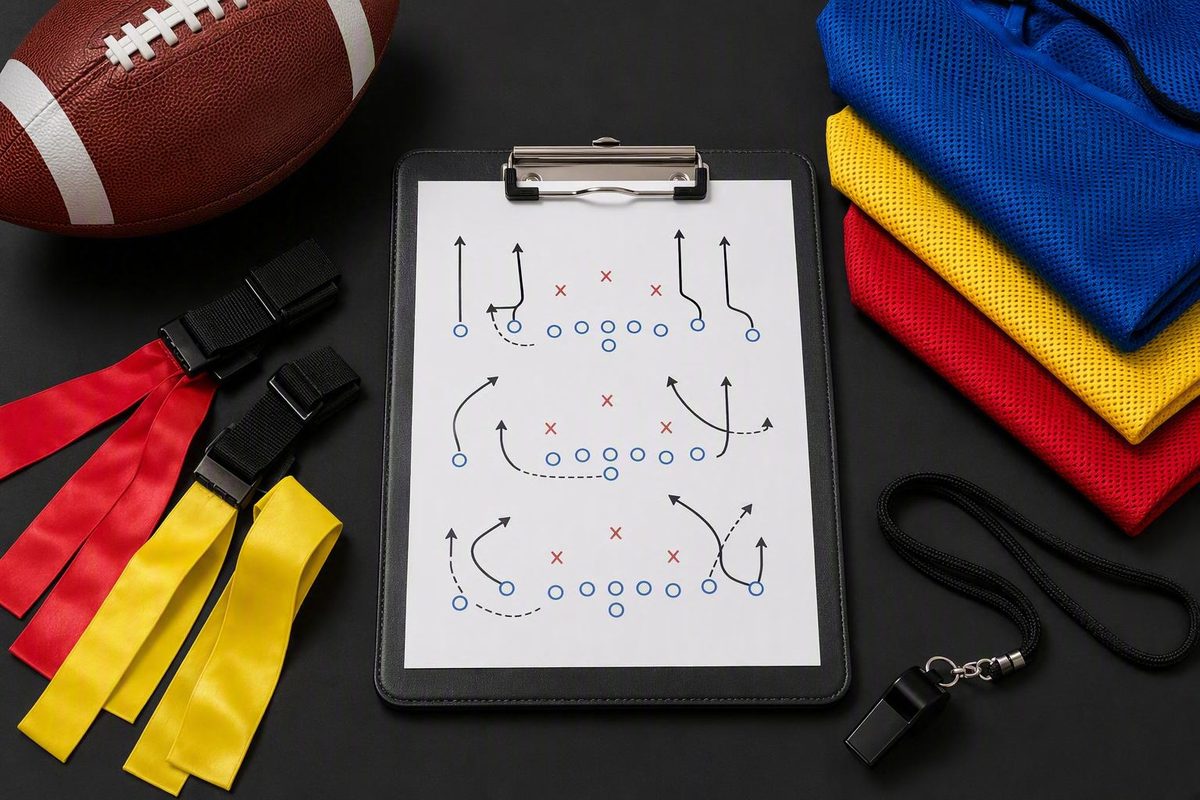
Eight connected calls are enough for a 6v6 flag football offense: four core passes (Deuce Flood, Deuce Smash, Trips Quick Cross, Trips Slant-Arrow), one Empty concept, and a three-play Jet series built on a single motion. Every one of the six players has a defined job on every call, the naming system stays the same across formations, and each play carries a legal alternative for leagues that restrict center releases, motion, handoffs, running, or blocking. Install the four passes first, the Jet series last, and confirm your league’s rules before you draw the first route.
The Eight-Play Package at a Glance
Flood and Smash both start in Deuce. Quick Cross and Slant-Arrow share Trips spacing. All three Jet calls begin with the same motion, so the defense sees one picture and the players learn one cue.
| Call | Formation | QB plan | Rules to verify |
|---|---|---|---|
| Deuce Flood Right | Deuce | Deep, intermediate, flat, then C | Center release |
| Deuce Smash Right | Deuce | Corner to hitch to C | Center release |
| Trips Quick Cross | Trips Right | First crosser, second crosser, outlet | Center release; contact |
| Trips Slant-Arrow | Trips Right | Slant to arrow, then C or backside | Center release; contact |
| Empty Verticals | Empty | Chosen matchup, then C settle | Center release; line rules |
| Jet Sweep Right | Deuce Jet | H carries or catches in the flat | Motion; exchange; running |
| Jet Reverse Left | Deuce Jet | Sweep action, second exchange | Motion; two exchanges; running |
| Jet Play-Action Flood | Deuce Jet | Deep to intermediate to outlet | Motion; fake; rush trigger |
Each concept applies one kind of stress. Flood stacks routes at several depths on one side. Smash puts an outside defender in a high-low bind. Crossers can find short windows against trailing leverage. Empty lets the quarterback watch how six defenders distribute. None of them beats man, zone, or pressure on its own.
USA Football’s 6v6 flag football playbook organizes its calls under Deuce, Deuce Jet, Trips, and Spread and includes Flood, Smash, vertical, screen, sweep, reverse, and misdirection concepts. The package here follows the same structure: related formations and repeated motion, so players learn fewer alignments and the formation itself gives away less.
Check Four League Rules Before Drawing a Route
There is no universal 6v6 rulebook. NFL FLAG publishes rules primarily for its 5v5 game and notes that formats differ; its rules include no blocking or screening, limits on quarterback running, designated rushers, no-run zones, and a seven-second release requirement. Use the current NFL FLAG rules only when they govern your competition.
Local rules vary widely. One youth organization’s 6v6 rules require three offensive players on the line, allow one player in motion, and require a direct snap to the player behind C; running permissions change by grade and the passing deadline runs from six seconds in the youngest division to three seconds in the older ones. Flight Action Sports’ men’s 6v6 rules require the ball to cross the line by run or pass within five seconds and permit certain backward setup passes, double passes, and limited engagement with a rusher behind the line, while banning downfield blocking. A call that is legal there may be illegal in a pass-only youth division.
Before practice one, get answers to: how many players must be on the line, who may take the snap and from where, whether C is eligible and may release at the snap, how many players may move before the snap, whether the snap recipient may run, whether any blocking, screening, or stationary pick is legal, where the designated rusher starts, whether a handoff, lateral, or fake triggers an immediate rush, whether handoffs, backward passes, and double passes are legal, whether there are no-run zones, and how long the passer has to release.
Set your league’s three rule answers; the table shows which calls run as drawn and which need the alternative.
Which of the eight calls are legal as drawn in your league?
Optional: does a fake or exchange trigger the rush?
Set the three rules to see which calls run as drawn.
| Call | Depends on | Run this version |
|---|---|---|
| Deuce Flood Right | Center release | As drawn if C may release; otherwise C stays home and Z is the quick outlet. |
| Deuce Smash Right | Center release | As drawn if C may release; otherwise C stays home and H is the late inside outlet. |
| Trips Quick Cross | Center release; no picks | As drawn if C may release; otherwise C stays home and X converts to a backside stop. |
| Trips Slant-Arrow | Center release; no picks | As drawn if C may release; otherwise C stays home and X shortens to the backside outlet. |
| Empty Verticals | Center release; line rules | As drawn if C may release; otherwise C stays home and H or Y becomes the checkdown. |
| Jet Sweep Right | Motion; handoff; running | As drawn with motion and a legal handoff. No motion: align H at the exchange landmark. Pass only: H runs the flat and QB throws a legal forward pass. |
| Jet Reverse Left | Motion; two exchanges; running | Run version only if both exchanges are legal. Otherwise X runs the reverse path as eye influence and QB throws a separately called quick route. |
| Jet Play-Action Flood | Center release; motion; fake; rush trigger | As drawn with C eligible, motion legal, and a legal fake. No C release: H is the sole fast outlet. No motion: static fake. Pass only: motion without an exchange. If a fake triggers the rush, throw the flat or C settle at once. |
Source: the alternatives in this article's rule boxes. Rules differ by league; verify each answer in your own rulebook before installing.
Put the same four labels beside every play in your book: Center Release (Yes / No / Restricted), Motion (Yes / No / One player), Ball Exchange (Handoff / Backward pass / Snap only / None), and Blocking (None / Screen only / Restricted). If a play depends on one label, draw the alternative beside it. A lead block becomes a clear-out in a no-blocking league; a sweep handoff becomes a quick flat pass in a pass-only division; C stays home when eligibility rules require it.
Motion, exchanges, and crossing routes put players on intersecting paths. Fix the crossing order, separate the exchange tracks, and start every install at walk-through speed. That reduces congestion; it does not eliminate collisions, so run these with qualified in-person supervision.
Six Labels, Four Formations, One Naming Rule
The labels are a teaching system, not league positions: QB is the snap recipient and passer, C is the center, X is the widest left receiver, H is the inside left receiver and motion player, Y is the inside right receiver, and Z is the widest right receiver.
Use horizontal landmarks rather than fixed yardage and adjust them to field width, age, arm strength, and the local line-of-scrimmage requirement.
| Formation | Left of C | Right of C |
|---|---|---|
| Deuce | X near numbers; H in slot | Y in slot; Z near numbers |
| Trips Right | X isolated near numbers | H inside, Y middle, Z widest |
| Empty | X wide; H in slot | Y in slot; Z wide |
| Deuce Jet | X wide; H at motion landmark | Y in slot; Z wide |
C is on the ball and QB is behind C in every formation. Deuce puts two receivers on each side, commonly one on and one off the line. Trips Right puts three to the right and X alone to the left. Empty here is two-by-two with C releasing only when eligible. Deuce Jet is Deuce with H set at the motion landmark.
Call the formation first and the concept second: Deuce Flood Right. Add Right or Left only when direction matters. To mirror a call, receivers swap left-right landmarks and QB reverses the progression; the words do not change.
Every player gets a deliberate job on every call: primary route, clear-out, backside route, fake, or checkdown. Do not turn a 5v5 design into a 6v6 call by parking the sixth player.
Four Core Pass Plays With Reads and Outlets
Depths below are relationships, not measurements. Shorten them for younger players, narrow fields, weaker arms, or short release clocks, but keep the order: deepest route above intermediate, intermediate above the outlet. If C cannot release, remove C from the progression and move the checkdown to an eligible inside receiver.
Deuce Flood Right
H runs a deep over into a deep out on the right side. Y runs an intermediate out underneath H. Z releases immediately to the flat. X clears vertically on the backside and does not cross into H’s path. C settles inside-right at minimal depth, inside Z’s lane, so the two short routes never share space.
| Player | Route | Read | Cue |
|---|---|---|---|
| QB | Set toward the right levels | H, Y, Z; C hot | Reset feet each level |
| C | Short inside-right settle | Pressure outlet | Stop inside Z’s path |
| X | Vertical backside clear | Alert only | Hold width; do not cross |
| H | Deep over to deep out | First | Gain width after clearing traffic |
| Y | Intermediate out | Second | Stay under H |
| Z | Immediate flat | Third | Expand outside at once |
Rules: center release eligible only (if restricted, C stays home and Z is the primary quick outlet); no motion; snap only; no blocking designed. Take the flat immediately if pressure wins before the deeper routes develop.
Deuce Smash Right
Y stacks and breaks to the corner above Z’s controlled hitch at the numbers. Read the outside defender high to low: corner if he drives down and the window is safe, hitch if he stays deep. C settles short inside the hitch. X runs a post or vertical clear on the backside and H runs a dig below X as a late option.
| Player | Route | Read | Cue |
|---|---|---|---|
| QB | Catch and set right | Y, Z, C | Key the outside defender |
| C | Short inside settle | Third or hot | Stay inside the slot |
| X | Post or vertical clear | Backside alert | Hold backside coverage |
| H | Dig or middle clear | Late option | Cross below X |
| Y | Corner above the hitch | First | Stack, then break away |
| Z | Controlled hitch | Second | Stop at the numbers |
Rules: center release eligible only (if restricted, H becomes the late inside outlet); no motion; snap only; no screening. Under a short throw clock, shorten the corner and hitch stems together so the high-low relationship survives.
Trips Quick Cross
H crosses first, right to left, on a shallow track. Y follows on a slightly deeper, clearly separated track. Z clears vertically to remove the outside defender and X clears or runs a tagged stop on the backside. C settles short into the right side the crossers vacate. QB decides as H clears the center: H if the first window opens, Y on the trail, then C or X.
| Player | Route | Read | Cue |
|---|---|---|---|
| QB | Set in place | H, Y, outlet | Decide as H clears C |
| C | Settle to vacated right | Third | Face QB immediately |
| X | Vertical clear or stop | Backside alert | Preserve width |
| H | First shallow cross | First | Go first, no hesitation |
| Y | Second cross, deeper | Second | Trail H with separation |
| Z | Vertical clear | Alert only | Remove outside defender |
Rules: center release eligible only (if restricted, X converts to the backside stop); no motion; snap only; crossers may not screen, pick, or obstruct. Walk through the crossing order before adding defenders. This is an option against trailing leverage, not an automatic man-coverage answer.
Trips Slant-Arrow
Y runs a short slant breaking inside toward QB’s window. Z expands outside on an arrow. H runs a controlled seam to hold deeper coverage. X runs a dig or clear adjusted to the clock. C settles short away from the trips side. This is the package’s designed quick answer to pressure.
| Player | Route | Read | Cue |
|---|---|---|---|
| QB | Catch and deliver | Y, Z, then C/X | Release before congestion |
| C | Settle away from trips | Emergency outlet | Find grass, do not drift |
| X | Dig or clear | Backside alert | Break earlier under short clock |
| H | Controlled seam | Coverage pull | Stay inside and vertical |
| Y | Inside slant | First | Win leverage, show hands |
| Z | Arrow or flat | Second | Gain width now |
Rules: center release eligible only (if restricted, X shortens to the backside outlet); no motion; snap only; H’s seam occupies space but may not become a pick.
One Jet Motion Builds Three Plays
All three calls use the same Deuce Jet alignment and cue: H motions left to right in front of QB. Time the snap so H reaches the exchange landmark at QB’s front hip without crowding C.
Jet Sweep Right
Where handoffs are legal, QB hands to H at the front hip and carries out a fake away from pursuit. In a pass-only division, H continues into the flat and QB throws a legal forward pass. X clears vertically, Y clears inside above H’s path, and Z clears outside to preserve the sideline lane. Nobody blocks.
| Player | Action | Landmark |
|---|---|---|
| QB | Snap, legal exchange, fake | H at front hip |
| C | Snap, stay home or short backside release | Secure snap first |
| X | Vertical clear | Release at snap |
| H | Motion, carry or flat | Front hip; width without cutting into C |
| Y | Inside clear | Above H’s path |
| Z | Outside clear | Immediate |
Rules: center release not required; one player in motion where legal (if prohibited, align H at the exchange landmark); direct handoff where legal, otherwise a quick flat pass; no blocking.
Jet Reverse Left
The two exchange points must stay distinct. H takes the sweep exchange from QB at Point A and continues right. X loops behind QB toward Point B, passes behind H, receives only after H controls the first exchange, and returns left. QB clears the second path instead of drifting into X’s loop. Y and Z clear above and away from Point B.
| Player | Action | Landmark |
|---|---|---|
| QB | Exchange with H, clear second path | H at front hip |
| C | Snap, stay clear of both tracks | No contact assignment |
| X | Loop behind QB to Point B | Arrive after H controls ball |
| H | Sweep exchange, continue right | Point A; exchange only at Point B |
| Y | Inside clear | Above exchange paths |
| Z | Outside clear | Width away from Point B |
Rules: two legal exchanges required for the run version; one player in motion where legal; no blocking. Pass-only alternative: H motions without the ball, X runs the reverse path as eye influence with no exchange, and QB throws a separately called quick route. Do not install a delayed handoff or lateral until its legality and its physical path are both confirmed.
Jet Play-Action Flood
QB shows the same Jet action, regains throwing posture, and reads three right-side levels: Z on the deep out, Y on the intermediate out beneath Z, then H in the flat after the fake or C settling inside H. X runs a deep cross to the opposite side after clearing underneath traffic.
| Player | Action | Landmark |
|---|---|---|
| QB | Show fake, reset right | Eyes downfield immediately |
| C | Short inside settle if eligible | Inside H’s flat |
| X | Deep cross | Clear traffic first |
| H | Jet fake, then flat | Normal motion tempo |
| Y | Intermediate out | Break below Z |
| Z | Deep out | Clear Y before breaking |
Some youth rules let a defender cross the line after a handoff, lateral, backward pass, or fake handoff. Where that provision applies, the flat and C settle must be available at once; confirm the trigger in your league’s rules. Other rules: center release eligible only (if restricted, C stays home and H is the sole fast outlet); one player in motion where legal, otherwise a static fake; fake or show only, and in pass-only play, motion without an exchange.
USA Football’s 6v6 inventory includes Jet sweeps, reverses, fake sweeps, and Flood concepts, which supports building a series this way. It does not establish that motion will fool any particular defense.
Empty Verticals Keeps C in the Progression
Empty should produce five different routes, not five identical straight lines. X and Z run outside verticals and hold the sideline. H and Y run seams with an optional bend, bending only into visible open space and never converging with the outside route. C runs a short settle or a controlled seam and stays visible to QB.
Before the snap, QB counts deep defenders, notes cushion and leverage, locates the legal rusher, and checks for late movement. QB picks the matchup, then finds C. Empty makes the defense’s distribution easier to see, but defenders can disguise or exchange assignments after the snap.
If C is ineligible, C stays home and H or Y becomes the checkdown. If the clock is very short, convert the outside verticals to hitches or quick outs and give the seams early break points. Rules: center release eligible only; no motion; snap only; staying home does not create permission to initiate contact.
Install in Three Practices and Group the Calls by Situation
Keep the daily structure stable and set rep counts by roster size, age, practice time, and how quickly alignment gets clean. Walk through each installation before running it at team speed.
| Practice | Install | Team period |
|---|---|---|
| 1: Deuce foundation | All four formations; stance, line status, hitch, corner, out, clear, settle | Flood levels and Smash high-low in both directions; each player states alignment, route, and four rule labels |
| 2: Trips and Empty | Trips spacing, Empty eligibility; slant, arrow, seams, shallow crosses | Quick Cross against man and zone looks; Slant-Arrow pressure period; Empty progression; separate crossing-order check |
| 3: Jet series | Motion start, snap point, exchange landmarks, clear-outs, flats | Sweep first; Reverse only after clean tracks; play-action only once QB keeps posture; script down, conversion, and pressure situations |
Do not advance from Sweep to Reverse until the first exchange and both travel paths are repeatable. Do not add play-action until QB can show the fake without losing balance or sight of the coverage.
Wristband abbreviations: D-FLD-R, D-SMS-R, T-QX, T-SA, E-VERT, J-SWP-R, J-REV-L, J-PA-FLD.
| Situation | Calls |
|---|---|
| Quick game | T-SA, T-QX |
| Zone spacing | D-FLD-R, D-SMS-R, E-VERT |
| Man-leverage answers | T-QX, D-SMS-R |
| Motion series | J-SWP-R, J-REV-L, J-PA-FLD |
| Pressure answers | T-SA, D-FLD-R with hot, J-PA-FLD outlet |
| Conversions | Best two legal quick calls, mirrored as needed |
Script a short opening sequence with one observation per call: Quick Cross shows whether defenders trail, switch, or pass off routes; Flood shows how they distribute by depth; Empty shows whether they account for C; Jet motion shows their adjustment and the rush timing. Recheck leverage immediately before each snap rather than trusting the first alignment. This is a diagnostic habit, not a guaranteed coverage read.
When execution breaks, the fix is usually spacing. Congested formation: widen the slots or shorten routes. Late routes: shorten stems and drop a progression step. Overlapping Flood outlets: keep C inside and send Z outside at once. Colliding crossers: re-establish H first, Y second, at separate depths. Crowded reverse path: widen Point B and delay X rather than rushing both exchanges. Pressure beating the read: go to the fastest legal outlet. Any assignment that needs illegal contact: replace it with a release, clear-out, or fake.
The order of work is fixed: confirm the local rules, pick the legal version of each call, draw all six assignments, install the four core passes before the Jet series, and repeat the same short terminology until every player can align and state the job without a long huddle.